
Want better results from WhatsApp ads? Focus on real conversations, not just clicks. Businesses in the UAE often waste budgets by tracking ad clicks as conversions instead of actual WhatsApp chats. This leads to inflated metrics and poor ad performance. Tracking real chats gives clearer insights, improves ad targeting, and increases ROI.
Here’s how you can maximise your WhatsApp ad ROI:
- Track real WhatsApp chats: Use tools like WAConversionTracking to log genuine interactions, not just ad clicks.
- Segment your audience: Group users by their intent and chat history to target them effectively.
- Write better ad copy: Tailor messages to audience needs and intent.
- Automate responses: Use message templates for faster, personalised communication.
- Leverage drip campaigns: Nurture leads with behaviour-based follow-ups.
- Use rich media: Add videos, images, or PDFs to make conversations more engaging.
- Monitor and adjust campaigns: Evaluate performance metrics regularly and optimise for better results.
Accurate conversion tracking and data-driven adjustments are key to turning WhatsApp ads into revenue drivers. Whether you’re targeting high-intent leads or nurturing prospects, these strategies ensure your ad spend delivers measurable outcomes.
1. Track Real WhatsApp Chats as Conversions with WAConversionTracking
Accurate Conversion Tracking
In the UAE, many businesses mistakenly count ad clicks as conversions instead of focusing on actual WhatsApp chats. But here's the catch: just because someone clicks your ad doesn’t mean they’ve started a meaningful conversation. Plenty of clicks lead to nothing, creating misleading ad metrics.
When conversions are misreported, Smart Bidding in Google Ads starts optimising for clicks rather than real engagement. If every click is marked as a conversion, the system focuses on driving more clicks - even if those clicks don’t translate into genuine interest. The result? Higher spending on low-quality traffic and missed opportunities to connect with high-intent customers.
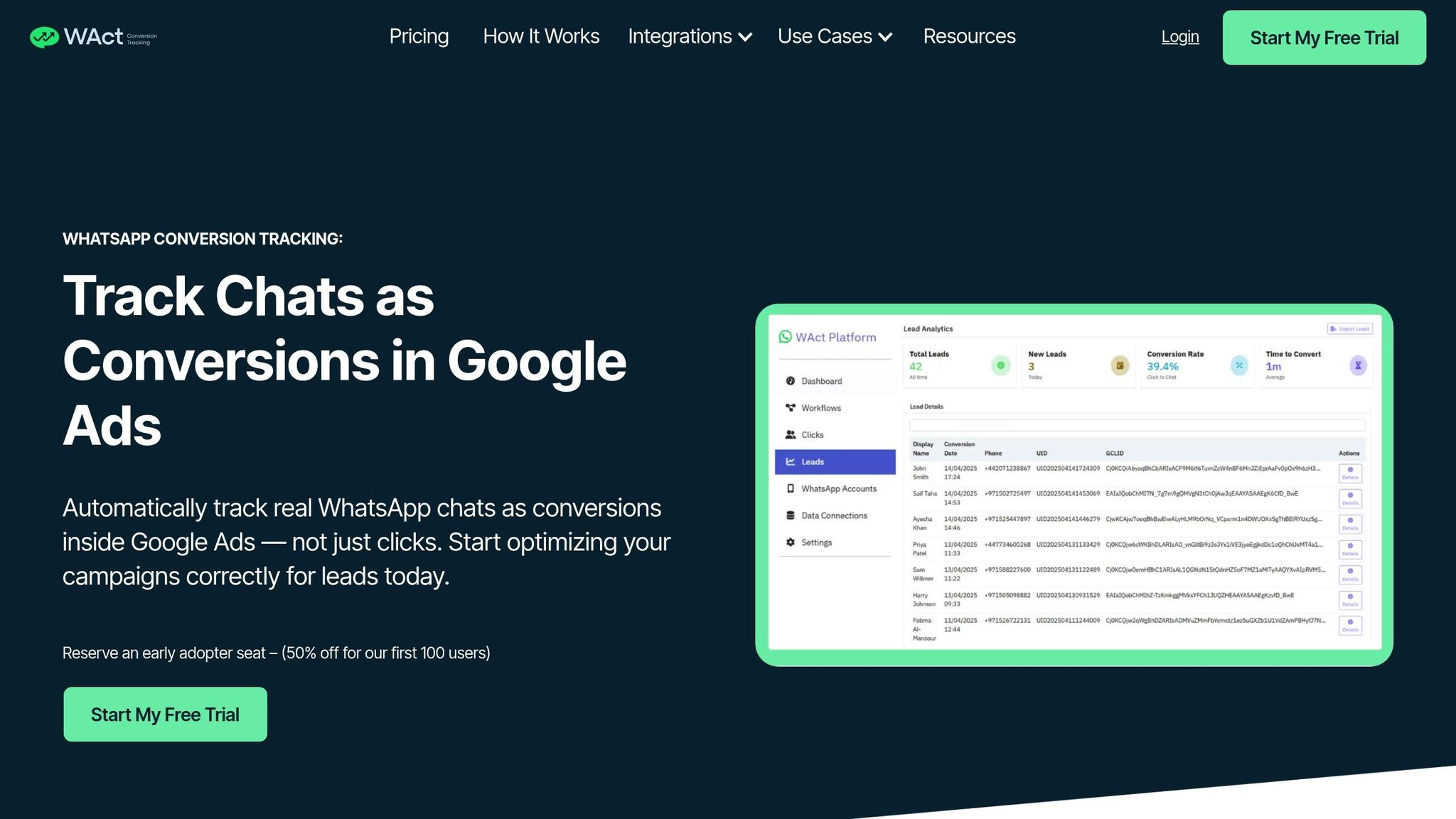
WAConversionTracking solves this problem by tracking the moment a WhatsApp message is sent, ensuring only real conversations are counted as conversions. It automatically captures key data like GCLID (Google Click Identifier), UTM parameters, and conversation metadata, sending it to Google Ads in real time. This gives Google Ads accurate insights into which campaigns, keywords, and audiences are driving real customer interactions.
And the best part? No developers are needed. Simply generate a tracking script, add it to your website, and let the system do the rest. The moment a customer messages your business, WAConversionTracking logs the event and sends it to Google Ads as a conversion.
The impact on ad performance can be game-changing. With accurate conversion data, Smart Bidding identifies patterns in user behaviour that lead to actual results. Instead of optimising for casual clickers, your campaigns target people who are ready to engage. This shift not only reduces wasted ad spend but also increases the quality of leads coming into your business.
This level of precision doesn’t just refine your conversion data - it also sets the stage for smarter campaign decisions.
Performance Monitoring and Optimisation
Once you have accurate conversion data, WAConversionTracking helps you fine-tune your campaigns based on real WhatsApp engagement. You’ll know exactly which keywords, ad creatives, and audience segments are driving meaningful conversations. With this clarity, you can make data-backed decisions about where to invest your advertising budget.
WAConversionTracking also integrates seamlessly with Google Sheets and CRM systems, making data analysis a breeze. You can track how WhatsApp chats lead to sales calls, appointments, or purchases, giving you a clear picture of your campaign’s ROI - measured in dirhams earned, not just clicks.
Its advanced URL tracking capabilities go beyond Google Ads. Whether customers find you through Facebook, Instagram, or other platforms, WAConversionTracking pinpoints the origin of every WhatsApp chat. This helps you identify which channels are worth investing in and which ones need rethinking.
Automation takes the hassle out of manual data handling. No more exporting spreadsheets, copying data between platforms, or worrying about broken tracking codes. Everything runs in the background, allowing your team to focus on meaningful customer conversations rather than managing tracking tools.
For UAE businesses looking to grow, even small improvements in conversion accuracy can lead to big savings and increased revenue. WAConversionTracking provides a solid foundation for sustainable growth through WhatsApp advertising.
2. Segment Your Audience by User Intent and Chat History
Audience Segmentation and Targeting
Once you've set up accurate conversion tracking, the next step is segmenting your audience based on their intent and chat history. WhatsApp conversations provide clear indicators of user intent, and segmenting these chats ensures your ad budget is spent wisely.
By using tools like WAConversionTracking, you can gather detailed insights into who’s reaching out and why. This data allows you to move away from generic campaigns and instead create ad sets tailored to different levels of interest. For instance:
- High-intent prospects: These are users who ask about pricing, availability, or booking details, showing they’re closer to making a purchase.
- Mid-intent browsers: These users enquire about product features or services but haven’t made specific purchase-related queries yet.
- Low-intent contacts: These are users who send general questions or fail to respond to follow-ups.
Such segmentation helps you fine-tune your bidding strategy. You can allocate higher bids to high-intent prospects while nurturing low-intent contacts with educational or awareness-focused content.
Chat history is another goldmine for sharper segmentation. Platforms like Respond.io integrate WhatsApp data to create unified customer profiles, offering a complete timeline of interactions. You can identify repeat engagements, track specific questions, and pinpoint where users drop off in their journey.
David Fiala, co-founder of Praga Medica, shared how tapping into this approach transformed their operations. By automating routine conversations, they freed up consultants to focus on "high-quality leads that were far more likely to convert into paying customers". This method not only boosts efficiency but also ensures your ad spend and team efforts are directed at the most promising opportunities.
With this level of insight, you can also set the stage for more precise and automated communication.
Automated Messaging and Personalisation
Once you’ve segmented your audience, the next step is crafting communication that resonates with each group’s intent. By combining automation with personalisation, you can boost conversions while keeping manual effort to a minimum.
Centralising your chat data gives you a unified view of customer interactions. This makes it easier to set up automated message sequences that feel tailored rather than generic. For example:
- High-intent prospects could receive an automated message with a detailed AED quote and a direct booking link.
- Mid-intent browsers might benefit from educational content about your products or services, followed by customer testimonials to build trust.
AI-powered tools can handle these initial conversations, ensuring your human team focuses on users who are ready to take action. For instance, iMotorbike managed to double their leads by using AI Agents on Respond.io. This approach not only improves efficiency but also allows you to handle a growing number of enquiries without increasing your team size.
Personalisation goes beyond just addressing someone by their name. With access to full chat history, you can reference past conversations, address specific concerns, and offer customised solutions. This builds trust and nudges prospects closer to making a decision.
After setting up your automated messages, it’s crucial to keep reviewing data to ensure your strategy remains effective.
Performance Monitoring and Optimisation
To maximise your ROI, continuous monitoring and refinement are essential. Platforms like Respond.io offer built-in analytics that show which ads, agents, and channels deliver the best results. This helps you identify which audience segments deserve more investment.
Keep an eye on metrics like conversion rate, average order value, and customer lifetime value for each segment. For example, you might find that mid-intent browsers who receive educational content convert at a higher rate than expected. This insight could justify allocating more ad spend to that segment.
Similarly, analysing which message templates and automation sequences generate the best responses can help you fine-tune your approach. If high-intent prospects respond better to direct WhatsApp calls than text messages, you can adjust your strategy accordingly. Syncing WhatsApp data with your CRM also enables you to track the entire customer journey - from the initial ad click to the final purchase - giving you a clear picture of ROI in AED.
Regular optimisation is key. Test different segmentation methods, message sequences, and bidding strategies to find what works best for your audience. A campaign that delivers great results in Dubai might need adjustments for Abu Dhabi, so staying flexible ensures you get the most out of your WhatsApp ad campaigns.
3. Write Better Click-to-WhatsApp Ad Copy and Offers
Audience Segmentation and Targeting
Writing effective ad copy starts with understanding your audience. Avoid one-size-fits-all messaging and tailor your ads to specific audience segments using data from conversion tracking and chat history.
For high-intent prospects - those who’ve already enquired about pricing or availability - your messaging should be straightforward and action-oriented. Use phrases like "Get your AED quote in 2 minutes" or "Book your appointment now – limited slots available". These users don’t need to be convinced about your service; they’re ready to take the next step, so make it easy for them.
For mid-intent users who are still considering their options, your approach should address their concerns while offering helpful information. Instead of a generic "Contact us on WhatsApp", try something like "Ask our specialists about payment plans – chat on WhatsApp". This approach acknowledges their hesitations while encouraging them to engage without pressure.
Your offer is as important as the ad copy itself. A generic "10% discount" may appeal to some, but it might not resonate with everyone. High-value businesses in Dubai and Abu Dhabi often see better results with exclusive offers like "Priority booking slots" or "Private WhatsApp video consultations". For example, property developers could promote "Private viewing via WhatsApp video call" instead of a simple price discount.
It's also worth experimenting with different value propositions. High-intent users may prioritise speed, so something like "Get approved in 24 hours" could work well. Meanwhile, mid-intent users may respond better to offers that reduce risk, such as "Free consultation – no obligation".
Once your tailored ad copy is in place, ensure your automated messaging continues the personalised experience seamlessly.
Automated Messaging and Personalisation
The moment a user clicks your ad, the conversation begins. Your automated messages should instantly address the promise made in the ad. For instance, if your ad offers a "Free property valuation in 5 minutes", your first message should reflect this: "Thanks for reaching out! Let’s get your valuation started. What area is your property in?" This continuity reassures users and builds trust.
Personalisation is key. Tailor your messaging based on what brought the user to WhatsApp. If someone clicked an ad about villa renovations in Dubai Marina, avoid generic responses like "How can we help you?" Instead, be specific: "I see you’re interested in villa renovations in Dubai Marina. Are you looking to renovate your own home or an investment property?"
It’s also essential to align your tone and language with your audience. In the UAE, consider whether your users prefer Arabic or English, and whether a formal or casual tone is more appropriate. For instance, a luxury service might opt for a polished, formal tone, while a youth-focused brand can be more relaxed and conversational.
Finally, your call-to-action within the WhatsApp chat must be crystal clear. Whether you’re asking users to send photos for a quote or share their email for a detailed proposal, make the request straightforward. Ambiguity can lead to drop-offs, so ensure every step is easy to follow.
To maximise ROI, focus on tracking genuine WhatsApp conversions and adjust your strategies based on performance data.
Performance Monitoring and Optimisation
Tracking performance goes beyond clicks. Pay attention to which ad variations lead to meaningful conversations. For example, an ad that generates 100 chats with a 5% conversion rate is far more effective than one that brings 200 chats but only converts 1%. Your cost per customer is what truly matters - not just cost per click.
Another critical metric is the time between the ad click and your first response. Delays of more than a few minutes can result in lost prospects. If your automated messages aren’t keeping up, consider having human agents available during peak hours.
Analyse the initial messages you receive from users. If people frequently ask for clarification about your offer, it’s a sign your ad copy needs improvement. Use this feedback to refine your messaging and remove any friction in the customer journey.
Also, regularly review your conversation logs to spot trends. You might notice that certain phrases in your ads attract high-quality leads, while others bring in users who aren’t serious. Use this insight to tweak your approach and focus your budget on traffic that’s more likely to convert.
4. Set Up Message Templates and Automation
Automated Messaging and Personalisation
Once you've nailed down targeted segmentation and personalised messaging, automated templates can take things up a notch by simplifying how you engage with customers while boosting returns.
Automation transforms WhatsApp chats into a revenue-driving tool by delivering instant replies, qualifying leads automatically, and keeping prospects engaged over time.
Start by identifying common questions or requests your ads might generate. For instance, if you're running property ads in Dubai, potential customers might ask about pricing, availability, payment plans, or scheduling viewings. Prepare templates for these scenarios, but make them sound conversational. Instead of a robotic "Thank you for your enquiry. Please provide your details", try something more engaging like, "Great to hear from you! Which area are you most interested in?"
With the WhatsApp Business API, you can even re-engage users after 24 hours using pre-approved templates. For businesses in the UAE, it's a good idea to have templates in both English and Arabic. A real estate agency, for example, could use a message like:
"Your property viewing for [Location] is confirmed for [Date] at [Time]. Reply YES to confirm or STOP to cancel."
Automation can also streamline lead qualification. Create a series of questions about budget, preferences, and timelines. Each response can trigger a tailored pathway. For instance, a lead with a budget of AED 150,000+ and immediate interest might be routed to a senior agent, while someone still exploring options could enter a nurturing sequence.
For late-night messages, set up an auto-reply to manage expectations: "Thanks for reaching out! Our team is available from 9:00 AM to 6:00 PM, Sunday to Thursday. We'll get back to you as soon as we're back online. If it's urgent, please call us at [number]."
To keep interactions lively, incorporate rich media. Instead of describing a villa in text, share a photo carousel. Promoting a new restaurant in Dubai Marina? Automate a message with a video tour and a link to the menu. WhatsApp supports images, videos, PDFs, and even location pins, making your messages more engaging and interactive.
If you're leveraging WAConversionTracking, you can capture UTM parameters and GCLID data to personalise the first message based on the campaign that directed the user to WhatsApp. For example, "Hi Ahmed, I see you're interested in our 2-bedroom apartments in Business Bay" feels far more personal and relevant.
Quick response times are key - aim to reply within 60 seconds to keep prospects engaged. These automated templates not only streamline communication but also lay the groundwork for tracking and improving performance.
Performance Monitoring and Optimisation
Once your templates are in place, it’s time to keep an eye on how they’re performing and make adjustments where needed.
Start by tracking response rates. If your initial greeting gets a 70% reply rate but drops to 20% after the second message, you might be asking for too much too soon or your tone could be too stiff. Test different approaches to find what resonates best with your audience.
Pinpoint where users drop off. If many stop responding after you request their email address, consider whether that step is necessary at that moment - especially in the UAE, where many prefer to stick to WhatsApp rather than switching to email.
Monitor how quickly a human agent steps in after automation qualifies a lead. Delays between the end of an automated sequence and a live response can cost you opportunities. Setting up alerts can help your team respond swiftly to high-intent leads.
Evaluate how well your automated sequences convert leads into customers. If 100 leads are qualified weekly but only a handful turn into sales, revisit your qualification criteria or follow-up strategy. Comparing these results with those from manually handled chats can reveal whether automation is driving better outcomes.
Tools like WAConversionTracking can help you identify which sequences are delivering results. If a particular template consistently drives sales, consider applying that approach across other campaigns. On the other hand, if a template generates lots of replies but no revenue, it’s time for a rethink.
Make it a habit to review your automation scripts monthly. Messaging that worked six months ago might feel outdated now due to seasonal trends, new product launches, or shifts in customer behaviour. Regular updates ensure your messaging stays aligned with your current goals and campaigns.
5. Use Drip Campaigns and Behavior-Based Sequences
Automated Messaging and Personalisation
Drip campaigns are an effective way to nurture leads over time, guiding potential customers through their journey with carefully timed and personalised messaging. By combining automation with thoughtful personalisation, businesses can create a seamless experience that feels tailored to each individual.
One key strategy is to map out distinct pathways based on user engagement. For instance, a prospect who enquires about pricing signals higher intent than someone casually browsing your website. High-intent leads might receive an immediate invitation for a call, while lower-intent leads could be placed in longer, more educational sequences.
To make these follow-ups more effective, align them with UAE-specific schedules. For example, consider the local workweek (Sunday to Thursday) when planning your outreach. A Saturday morning message might work better for weekend engagement.
Behavior-based triggers can take your campaigns to the next level. Let’s say a user clicks on an ad for a specific product but doesn’t respond to the initial message. A well-timed follow-up featuring a customer testimonial or a limited-time offer can reignite their interest. Similarly, if a prospect interacts with a brochure but remains unresponsive, you could send additional details or address common concerns to move them closer to a decision.
AI-powered tools can further streamline this process by qualifying leads, suggesting products, managing bookings, and even sharing payment details. This approach not only reduces friction but also speeds up the sales cycle. For example, SchuVar Tours managed to cut their sales cycle by 60% across eight branches by using automation to route serious buyers to human agents after initial qualification.
"Thanks to respond.io, we saw 3x more leads from ads, reduced response time and improved customer experience." - Esmeralda Sevilla, Deputy Manager of SchuVar Tours
Another powerful tactic is using targeted broadcasts within your drip campaigns. After segmenting your audience - perhaps by purchase history, budget, or product interest - you can send tailored updates to each group. For example, a luxury car dealership in Dubai might share exclusive previews of new models with high-budget leads, while sending service reminders to existing customers. Automax® achieved a 42.5x ROI from WhatsApp broadcasts by adopting such a targeted approach.
Drip campaigns aren’t just for retail or consumer goods. Educational institutions in the UAE have successfully used them to guide prospective students through the enrolment process. Innov821 DMCC, for instance, doubled their student enrolments by simplifying operations and improving response quality through automated sequences.
"Respond.io helped us scale our business and grow at a rapid rate. It reduced operational complexity so we could answer enquiries quickly whilst improving response quality. This was key to our 100% boost in student enrolments." - Ahmad Hijazi, Managing Director of Innov821 DMCC
For businesses offering subscription services or products that require replenishment, automated reminders can drive repeat business. A simple notification before a subscription expires has helped many companies achieve a 50% increase in repeat purchases.
To make your sequences more engaging, incorporate rich media. Instead of relying solely on text, add product images, video demos, digital catalogues, or even location pins. For example, a restaurant chain launching a new branch in Dubai Marina could start with a welcome video, follow up with a digital menu, offer an exclusive discount, and finish with a location pin for easy navigation.
Once your automated sequences are up and running, the next step is to measure their success and make improvements.
Performance Monitoring and Optimisation
Personalisation is just the beginning. To truly maximise the impact of your drip campaigns, you need to continuously monitor their performance and refine your approach. Built-in analytics can help you identify which sequences are converting leads into customers and which need adjustments.
Pay close attention to engagement patterns. If you notice a significant drop-off at a certain point in your sequence, it’s time to tweak your messaging or refine your call-to-action. Data might also reveal that quicker follow-ups lead to higher conversion rates, prompting you to reduce delays between automated qualification and personal outreach.
Comparing the performance of different sequences can provide valuable insights. For instance, if one pathway consistently outperforms others, analyse its elements and apply those principles to other campaigns. Additionally, tracking the source of your leads - whether from Google, Facebook, or Instagram - can help you focus on platforms that deliver the most qualified prospects. Tools like WAConversionTracking can reveal which ads are driving actual sales, not just chat initiations.
Regular reviews are essential to keep your sequences aligned with changing consumer behaviours, seasonal trends, and new product launches. For example, a campaign that performs well during Ramadan might require adjustments for the Dubai Shopping Festival. Metrics like cost per acquisition and customer lifetime value are crucial to ensure that your WhatsApp ad strategies are driving real revenue. Businesses that use targeted promotional messages have reported a 10x increase in leads, but remember, high lead volume only matters if those leads convert into paying customers.
sbb-itb-0a82e4d
6. Personalise Messages with Rich Media
Automated Messaging and Personalisation
In the competitive UAE market, adding rich media to your WhatsApp campaigns can help your business stand out. Using elements like images, videos, PDFs, location pins, voice messages, and interactive buttons can transform basic chats into engaging, high-conversion interactions.
Tailor the type of rich media to where your customer is in their journey. For instance, a product catalogue in PDF format works well for someone exploring options, while a short video demo is more effective for those making enquiries. Imagine a real estate agency in Dubai: they could share property images with initial enquirers, follow up with virtual tour videos for serious buyers, and provide floor plans and payment schedules when the customer is ready to move forward.
Keep your media concise and relevant. For example, avoid sending lengthy videos to early-stage prospects. Use chat history and segmentation data to select the right format. High-resolution images with AED pricing might be ideal for someone enquiring about luxury watches.
Location pins are particularly useful for businesses with physical locations. A restaurant opening a new branch could automate a sequence that includes a welcome message, menu images, a promotional video, and a location pin with directions - making it easy for customers to find the venue.
For B2B campaigns, document sharing is a must. Businesses offering software or professional services can share case studies, white papers, or technical specifications as PDFs directly within WhatsApp, keeping the conversation seamless and engaging.
Voice messages offer a personal touch that text alone can’t achieve. While automation handles routine responses, a personalised voice note from a sales representative can strengthen relationships. This approach is especially effective in the UAE, where building trust and connections is key.
Interactive features like quick reply buttons and call-to-action buttons simplify conversations. Instead of typing out responses, customers can tap options such as "Book a consultation", "View pricing", or "Speak to an agent." This reduces friction and speeds up decision-making.
Timing and cultural considerations are crucial for rich media campaigns. During Ramadan, for example, you might adjust visuals to reflect the occasion with appropriate imagery and messaging. Similarly, during the Dubai Shopping Festival, incorporating designs that create urgency can drive engagement.
Rich media also supports upselling and cross-selling. After a purchase, you could share follow-up content like product care videos, complementary product suggestions with images, or details about a loyalty programme.
Track the performance of these rich media elements to understand which formats resonate most with your audience.
Performance Monitoring and Optimisation
Once you’ve integrated rich media, it’s essential to monitor its performance to refine your strategy. Track metrics like PDF views, video watches, and location pin taps. For example, if customers who receive a video demo convert at higher rates than those who only see text or images, that insight can guide you to invest more in video content. Similarly, if responses are quicker after sending a video than a PDF, you may need to adjust your messaging sequences.
A/B testing different media formats can help you optimise your approach. Tools like WAConversionTracking are invaluable here, as they show which media elements directly contribute to sales. This allows you to focus your efforts and resources on what works best. Always ensure that any increase in conversion rates justifies the production costs of rich media.
Evaluate performance across platforms to fine-tune your strategy further. For instance, prospects from Instagram ads may respond better to visual content, while those from search campaigns might prefer detailed PDFs with pricing and specifications. Regularly auditing your media library ensures outdated content doesn’t circulate, helping you maintain credibility.
Finally, consider customer lifetime value when assessing your rich media strategy. Personalised video content might take more time to convert a prospect initially, but it could lead to higher retention and long-term value. Aligning rich media with buyer behaviours not only enhances ad performance but also boosts ROI - building on the earlier strategies for effective WhatsApp conversion tracking.
7. Monitor Performance Metrics and Adjust Campaigns
Accurate Conversion Tracking
To truly understand which ads are delivering results, accurate conversion tracking is a must. Without it, you’re left measuring clicks instead of meaningful customer interactions. This is where tools like WAConversionTracking come into play, especially for WhatsApp campaigns in the UAE.
WAConversionTracking captures actual WhatsApp chats as conversions - not just ad clicks. It automatically logs GCLID and UTM parameters and sends them directly to Google Ads. This ensures that Smart Bidding algorithms rely on real conversion data based on customer interactions, not just surface-level metrics.
With this level of precision, you can identify which ad creatives and audience segments are generating qualified leads. This allows you to shift your budget towards campaigns that are actually working. By tracking conversion rates at every stage - ad click, WhatsApp chat, and completed sale - you gain a clear picture of what drives results. This data becomes the foundation for continuous campaign improvement.
Performance Monitoring and Optimisation
Building on accurate conversion data, the next step is to monitor key performance metrics to refine your campaigns. Metrics like lead generation, customer acquisition costs, sales cycle duration, and repeat business rates are crucial for evaluating your return on investment (ROI).
For example, faster response times can have a massive impact. Automation tools have been shown to improve response times by up to 84%, directly boosting conversion rates. In the UAE’s fast-moving market, customers expect quick engagement. Single-conversation resolution rates also matter. Take Sicar, for instance - they managed to improve their single-conversation resolution rate by 35%, meaning more customers had their questions addressed in one interaction without the need for follow-ups.
AI Agents can further streamline the process by qualifying leads, freeing up your team to focus on high-value prospects. This efficiency speeds up the sales process and enhances your marketing ROI.
It’s also important to monitor customer lifetime value alongside acquisition costs. A 50% increase in repeat business can help offset higher initial marketing spend. Regular A/B testing of ad copy, targeting settings, and message templates can uncover valuable insights about what resonates with different audience segments.
Frequent reviews of your metrics are essential. WhatsApp campaigns evolve quickly, and timely adjustments can make a huge difference. In one case, a company boosted new customer acquisition by 40% in just one month by acting on performance insights.
Operational efficiency is another layer to consider. Metrics like chat response times, agent productivity, and customer satisfaction scores all contribute to how effectively your marketing spend translates into revenue.
To simplify the process, use tools like Google Sheets or CRM integrations to centralise your conversion data. Having a single source of truth makes it easier to identify trends and make data-driven decisions that optimise your campaigns.
How to Track WhatsApp Button Clicks in Google ads & GTM?
Conclusion
Boosting ROI on WhatsApp ad campaigns requires a focused, data-driven approach. The seven strategies we've discussed offer a practical guide for businesses in the UAE aiming to make the most of their advertising budgets and achieve measurable results.
A key starting point is accurate conversion tracking using WAConversionTracking. This tool captures genuine WhatsApp chats, enabling Google Ads to focus on real engagement. With this level of precision, you can identify which campaigns drive qualified leads and adjust your budget to prioritise what works.
Audience segmentation plays a crucial role in targeting the right people. By analysing user intent and chat history, you can deliver messages that resonate. Pair this with well-crafted ad copy and tailored offers to create a personalised customer journey. UAE audiences value businesses that understand their needs and communicate effectively.
Automation and message templates simplify operations without compromising quality. Automated responses and behaviour-based sequences ensure customers receive prompt engagement, even outside regular business hours. Adding rich media - such as images, videos, product catalogues, or interactive elements - enhances your communication, building trust and encouraging action.
The foundation of success lies in continuous monitoring and optimisation. Regularly reviewing performance metrics like lead generation, acquisition costs, response times, and repeat business rates helps you refine your campaigns. For instance, SchuVar Tours achieved three times more leads from ads while cutting response times and improving customer satisfaction. These results were driven by consistent data analysis and informed adjustments.
To bring these methods to life, begin with proper conversion tracking - it’s impossible to make informed decisions without reliable data. Next, review your ad copy to ensure it speaks directly to your audience’s needs. Automate responses for common queries, segment your audience based on behaviour, and deliver personalised content through drip campaigns. Finally, schedule regular performance reviews. Weekly check-ins can help you spot trends early and make timely adjustments that drive better outcomes.
In the UAE's competitive market, WhatsApp campaigns, when executed strategically, can deliver impressive returns. Whether your goal is generating leads, closing sales, or building lasting relationships, these seven strategies provide a solid foundation. By systematically applying them, measuring results, and refining your approach based on real insights, UAE businesses can turn WhatsApp advertising into a reliable revenue generator. The key is consistency, precision, and a commitment to making data-driven decisions.
FAQs
How does WAConversionTracking enhance the accuracy of WhatsApp ad campaigns?
WAConversionTracking brings a new level of precision to your WhatsApp ad campaigns by offering tailored conversion tracking specifically designed for the platform. With this tool, you can accurately link ad performance to real business results, giving you a clear picture of which campaigns deliver the most impact.
It also helps you fine-tune your targeting by leveraging detailed conversion data. This means you can adjust your ad strategy to achieve better returns on investment (ROI). In a competitive market like the UAE, this data-driven approach ensures your advertising budget is used efficiently to deliver maximum results.
How can segmenting my audience by user intent and chat history improve my WhatsApp ad campaigns?
Segmenting your audience based on user intent and chat history lets you craft messages that feel more personal and relevant, boosting both engagement and conversion rates. When you understand a user's past interactions and intentions, you can customise your ads and follow-ups to meet their specific needs, making your campaigns hit the mark.
For instance, if a user has previously expressed interest in your products or services, you can reach out with exclusive offers or updates tailored just for them. This not only improves their experience but also ensures your ad spend is used wisely, leading to a better return on investment. Tools like the WhatsApp Business API and CRM platforms can make this process even smoother by helping you automate and fine-tune your audience segmentation.
How can automation and message templates help boost customer engagement and improve ROI in WhatsApp ad campaigns?
Automation and message templates streamline customer interactions, enabling quicker and more tailored responses. AI-powered agents can manage ad inquiries, address FAQs, and direct serious buyers to your team, ensuring faster conversions and smoother customer experiences.
Thanks to multilingual support, these automated tools can connect with diverse audiences across the UAE, making customer engagement more seamless. By saving time and boosting efficiency, these features help you get the most out of your WhatsApp ad campaigns while driving higher-quality leads.