
In the UAE, both WhatsApp and email marketing play key roles in reaching customers. WhatsApp excels in delivering instant, personalised communication, with open rates as high as 98% and response times often within minutes. It's ideal for time-sensitive campaigns, like flash sales or quick updates, and aligns perfectly with the UAE's mobile-first audience. However, it requires Meta approval, follows a pay-per-conversation model, and has strict compliance rules.
Email, on the other hand, is better suited for long-form communication, such as newsletters or detailed product guides. It remains a cost-effective option with an average ROI of AED 132 for every AED 3.67 spent. While its open rates are lower (15%-42%), email is excellent for nurturing leads and maintaining professional, formal communication.
Quick Comparison:
| Feature | WhatsApp Marketing | Email Marketing |
|---|---|---|
| Open Rates | 90%-98% | 15%-42% |
| Response Time | Minutes | Hours/Days |
| Cost | Pay-per-conversation | Flat-rate subscriptions |
| Best Use Case | Instant, short messages | Detailed, formal updates |
| Compliance | PDPL, Meta approval | Opt-in, unsubscribe option |
For UAE businesses, combining both channels often yields the best results. Use email for detailed communication and WhatsApp for quick follow-ups or promotions.

WhatsApp vs Email Marketing Performance Metrics Comparison for UAE Businesses
The engagement revolution: WhatsApp Marketing vs. Email
What is WhatsApp Marketing?
WhatsApp marketing involves using the popular messaging app to directly connect with customers, sharing updates, offers, and information through one-on-one chats or broadcast messages. In the UAE, where almost 99% of people have internet access and WhatsApp dominates as the go-to messaging platform, it’s a vital tool for businesses aiming to reach both local and expatriate communities.
What makes WhatsApp so effective is its immediacy and personal touch. Messages sent through the app appear directly in the user’s main chat list - bypassing spam folders entirely. This results in impressive open rates of 90%–98%, compared to the 20%–25% typically seen with emails. Even more striking, about 80% of WhatsApp messages are read within five minutes, and users check the app roughly 24 times per day. These factors create a unique opportunity for businesses to achieve high engagement, as we’ll explore further.
For businesses in the UAE, WhatsApp aligns perfectly with local preferences. Both Emirati nationals and expatriates value trust, direct communication, and quick responses. The app’s bilingual messaging capabilities allow businesses to easily communicate in both Arabic and English, while its ability to share rich media - like photos and videos - makes it particularly useful for industries such as real estate, retail, and services.
WhatsApp Marketing Features
WhatsApp’s powerful features amplify its ability to engage customers and drive results. The platform boasts click-through rates of 45% to 60%, along with similar conversion rates, making it an excellent choice for turning interactions into tangible business outcomes.
Some of its standout features include:
- Multimedia messaging: Share images, videos, voice notes, and documents to create engaging content.
- Two-way communication: Customers can ask questions and receive immediate responses, fostering trust and connection.
- Interactive tools: Quick-reply buttons and list menus help guide users through decisions without leaving the chat.
"It's much harder to ignore a WhatsApp message than it is to ignore an email." - Omar Nabil, Rasayel
WhatsApp Business API for Businesses
For larger businesses, the WhatsApp Business API takes things to the next level by offering tools to scale operations and streamline communication. It integrates seamlessly with CRMs like HubSpot and Zoho, supports AI-powered chatbots for automated responses, and can handle thousands of conversations at once.
The API also enables businesses to run bulk campaigns for opted-in contacts, track conversions from "Click-to-WhatsApp" ads on platforms like Facebook and Instagram, and even process payments directly within the chat using payment services like Stripe or Razorpay.
One notable example is Maggi Germany’s "Chef In Your Kitchen" campaign in 2025. Using a virtual assistant named "Kim" on WhatsApp, the campaign provided recipes and cooking videos over eight weeks, exchanging more than 200,000 messages with users. The results? A 4.2-point increase in ad recall and a 3-point boost in brand awareness.
For UAE businesses, the API’s support for bilingual communication is invaluable, as is its compliance with the Personal Data Protection Law (PDPL), which ensures explicit opt-in from users. The pricing operates on a pay-per-conversation model, with costs varying depending on the region and type of message.
What is Email Marketing?
Email marketing involves sending targeted messages to subscribers who have opted in, aiming to drive sales and nurture leads. Unlike the quick, conversational style of WhatsApp, email serves as a more formal channel. It’s perfect for delivering detailed content like newsletters, product catalogues, or official updates. This structured and professional approach makes email marketing distinct from the immediacy of WhatsApp marketing discussed earlier.
One of email marketing’s greatest strengths is its reach - it connects with billions of people worldwide at a very low cost. In fact, 81% of small businesses rely on email as their main tool for acquiring customers, while 87% of B2B marketers rank it as a top distribution channel.
Email Marketing Features
Email marketing platforms are equipped with tools tailored for large-scale campaigns. While email open rates typically range between 20% and 36%, and click-through rates hover around 2% to 5%, these numbers may seem lower compared to WhatsApp. However, email stands out by allowing businesses to send detailed, long-form content that recipients can review at their convenience.
Modern email tools also offer automated workflows, such as drip campaigns, welcome emails, and behaviour-triggered messages like abandoned cart reminders. These features work around the clock to nurture leads. Additionally, platforms often integrate with CRM systems, enabling advanced personalisation.
Cost-efficiency is another major perk. Many email marketing services offer affordable flat-rate plans or even free options for smaller subscriber lists. Entry-level plans can start at just AED 33 per month for 1,000 subscribers. Beyond the subscription fee, the cost per additional email is minimal, making email marketing scalable for businesses of all sizes.
Email Marketing for UAE Businesses
In the UAE, email marketing is highly valued for its formal tone, making it ideal for official communications like order confirmations, service proposals, and other professional exchanges. This level of formality is especially important in B2B industries and professional services, where maintaining a record of interactions and projecting credibility are critical.
As ReuAds notes:
"Email remains a trusted platform, especially for formal or informative communication... it offers more flexibility in design, automation, and analytics."
UAE businesses also leverage email for long-term lead nurturing and sharing educational content that requires more depth than a quick chat message. For example, real estate agencies use email to send detailed property listings and market insights, while retailers distribute seasonal newsletters to keep their brand fresh in customers’ minds. To ensure compliance, businesses must secure explicit opt-in consent and include clear unsubscribe options, adhering to UAE PDPL and TDRA regulations.
A growing trend among UAE businesses is combining email with other channels, like WhatsApp. For instance, email might deliver comprehensive information upfront, followed by WhatsApp messages for instant responses and conversions. This multichannel strategy highlights the unique strengths of email marketing while complementing other tools like WhatsApp.
WhatsApp vs Email Marketing: Side-by-Side Comparison
When comparing WhatsApp and email marketing, the differences in performance metrics are striking. Consider this: WhatsApp boasts open rates of 90% to 99%, while email struggles with averages between 15% and 42%, depending on the industry. On top of that, around 80% of WhatsApp messages are read within just five minutes, whereas email engagement can take hours or even days.
The gap widens even further when looking at click-through rates (CTR). WhatsApp delivers CTRs ranging from 15% to 60%, compared to email's modest 2% to 5%. This difference directly impacts business results: WhatsApp conversion rates can hit an impressive 45% to 60%, while email typically lags behind at 2% to 5%. That said, email still holds its ground when it comes to return on investment (ROI), generating AED 132 to AED 154 for every AED 3.67 spent.
To make these comparisons clearer, here’s a quick breakdown of key performance metrics:
Performance Metrics Table
| Metric | WhatsApp Marketing | Email Marketing |
|---|---|---|
| Open Rate | 90%–99% | 15%–42% |
| Click-Through Rate (CTR) | 15%–60% | 2%–5% |
| Deliverability | High (No spam folder) | Moderate (Spam/Promotions filters) |
| Response Time | Instant (Minutes) | Slow (Hours/Days) |
| Response Rate | 30%–60% | 5%–10% |
| Cost Structure | Pay-per-conversation/message | Flat-rate/Bulk subscription |
| Setup Requirements | WhatsApp Business API / Meta verification / Template approval | Email Service Provider (ESP) / Domain authentication |
| Media Capabilities | Rich media, voice notes, buttons, interactive elements | HTML, images, limited video support |
| Personalisation | High (1:1 conversational) | Moderate (Segmentation/Dynamic tags) |
| Content Format | Short, conversational text and rich media | Long-form, detailed HTML designs |
For businesses in the UAE, WhatsApp’s mobile-first focus fits seamlessly with local habits. On average, users in the region check the app 23 to 25 times a day. These contrasts set the stage for deeper exploration of the advantages, challenges, and tracking capabilities in the sections that follow.
sbb-itb-0a82e4d
WhatsApp Marketing: Pros and Cons
WhatsApp Marketing Pros
WhatsApp provides an unmatched level of visibility. Messages bypass spam folders and land directly in users' chat lists, with 80% of them being read within just five minutes. In the UAE, where mobile usage is a way of life and people check WhatsApp 23 to 25 times a day, this creates a powerful channel for time-sensitive promotions like flash sales and limited-time offers.
The platform’s conversational nature also drives higher engagement. Take Zara, for instance. By using the WhatsApp Business API for exclusive previews, they achieved a jaw-dropping 96% open rate, far surpassing the 18% for similar email campaigns. Even better, this approach led to a 43% conversion rate and a 145% surge in repeat purchases. Domino’s Pizza also tapped into WhatsApp's potential, using it for order tracking and promotions. The result? A 94% open rate and a 56% boost in direct orders, saving them roughly AED 8.4 million annually by cutting down on third-party delivery app fees.
Another major perk is the ability to build trust through two-way conversations. Customers can ask questions, request information, or even make purchases directly within the chat. This approach is particularly effective in the UAE, where businesses can seamlessly communicate in both English and Arabic to cater to the diverse population. A great example of this is Unilever’s "MadameBot" campaign in Brazil, which received 290,000 messages from 12,000 unique users and drove a 14-fold increase in sales.
While WhatsApp marketing offers these clear advantages, it does come with its set of challenges.
WhatsApp Marketing Cons
One of the hurdles is the WhatsApp Business API itself, which requires Meta verification and template approval. This process can take up to 24 hours, making it less flexible than email. Additionally, businesses are required to use pre-approved templates for any message they initiate, which limits spontaneity. Another restriction is the 24-hour response window for customer-initiated conversations. Beyond this timeframe, only paid templates can be used.
The pricing model can also be a concern, especially at scale. Unlike email services that often offer flat-rate subscriptions, WhatsApp uses a per-conversation pricing structure. Costs vary depending on factors like region and whether the conversation is business-initiated or user-initiated, making it harder to predict budgets. To maintain high engagement rates, businesses need robust CRM systems or AI-powered chatbots to ensure timely responses. Any delays in responding could harm the brand’s reputation.
Compliance is another critical area. Under the UAE's Personal Data Protection Law (Federal Decree-Law No. 45/2021), businesses must obtain explicit consent before sending marketing messages. This is especially important for businesses operating under PDPL regulations. On top of that, WhatsApp’s strict anti-spam policies mean accounts can be banned if users report unwanted messages. The Telecommunications and Digital Government Regulatory Authority (TDRA) also has the power to block persistent offenders at the network level, adding another layer of risk for businesses.
Email Marketing: Pros and Cons
Email Marketing Pros
Email marketing continues to deliver impressive results for businesses in the UAE, thanks to its scalability and cost-efficiency. With a global email user base projected to hit 4.6 billion by 2024–2025, this channel allows businesses to reach vast audiences while achieving remarkable returns - averaging between AED 132 and AED 154 for every AED 3.67 spent. It’s also an ideal platform for detailed communication, offering the space to share product catalogues, newsletters, and formal business updates. This is particularly valuable for B2B companies managing invoices, official reports, or professional outreach. These benefits make email marketing a powerful tool, especially when combined with advanced targeting and automation features.
"Email is the most underrated marketing channel for businesses today. Given that 99% of global email users check their inboxes daily - often up to 20 times - it's clear that it remains a vital communication channel." – Digital Farm
One of email’s standout features is its ability to support automation and segmentation. For UAE businesses catering to a diverse population, segmenting audiences based on demographics or behaviour - like VIP customers or those who haven’t engaged recently - can significantly improve relevance and engagement. Email marketing also integrates seamlessly with other strategies, such as social media campaigns, paid ads, and SEO, creating a unified experience for subscribers. Unlike instant messaging, email provides a less intrusive way to maintain regular contact, making it an excellent tool for nurturing long-term customer relationships.
Email Marketing Cons
While email marketing offers plenty of advantages, it’s not without its challenges in the UAE. Unlike WhatsApp, which avoids spam filters entirely, emails from unverified domains often end up in spam folders or promotional tabs. Open rates in the Middle East remain low, ranging between 6% and 11%, while click-through rates rarely exceed 1% to 2%.
Professionals often receive over 100 emails daily, leading to inbox fatigue. In a mobile-first market like the UAE, where users check messaging apps like WhatsApp more than 20 times a day, traditional email inboxes have taken a backseat. This reliance on user-initiated engagement means email is less effective for time-sensitive offers or promotions.
Creating impactful email campaigns requires significant effort, from designing visually appealing layouts to meeting bilingual requirements in both Arabic and English. Businesses must also adhere to strict legal standards, including obtaining explicit opt-in consent and providing clear unsubscribe options. Non-compliance can result in hefty penalties or even network-level blocking.
Tracking WhatsApp Conversions from Paid Ads
How WAConversionTracking Works
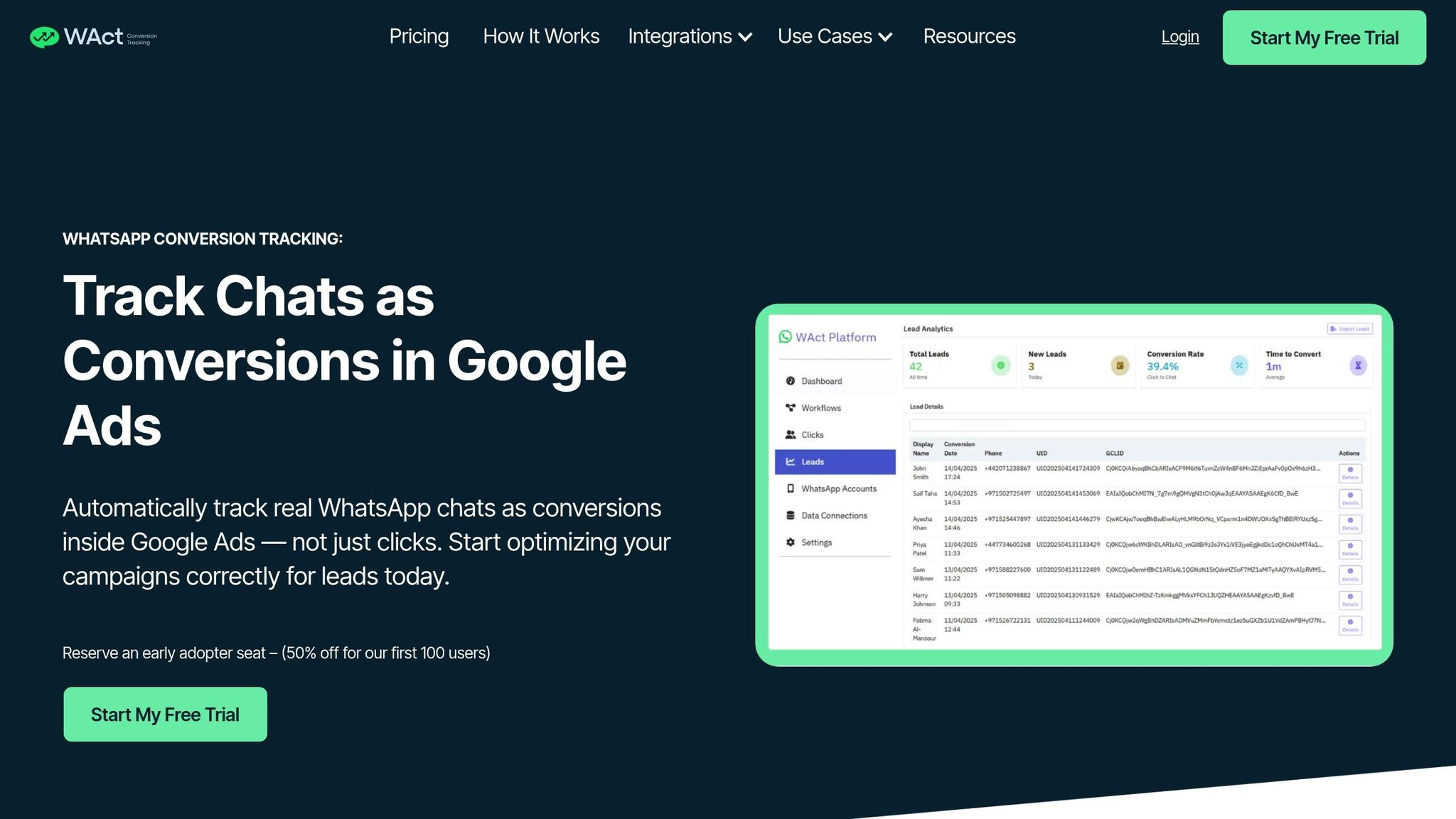
Most Google Ads campaigns only track button clicks, which can be misleading since they don't guarantee real engagement - just intent. WAConversionTracking changes the game by capturing actual WhatsApp chats and automatically feeding that data back into Google Ads.
Here’s how it works: it tracks the GCLID and UTM parameters from your ad click all the way to WhatsApp. When a customer sends a message, the system captures this moment and links it back to the specific ad that triggered the interaction. All this data is uploaded directly to Google Ads - no technical setup required.
This approach helps you go beyond just counting clicks. It identifies which ads are sparking genuine conversations, not just accidental taps. This is especially important when Click-to-WhatsApp ads in the UAE typically cost between AED 1 and AED 5 per lead. Knowing which leads actually engage can make a huge difference in how you plan and optimise your campaigns.
Benefits for UAE Businesses
WAConversionTracking brings clear advantages for businesses in the UAE, especially those in industries like real estate, healthcare, education, and automotive - sectors where WhatsApp often serves as the main channel for inbound leads. While traditional tracking stops at the click, this tool digs deeper, showing the real return on investment by logging qualified chats and tracking deal closures.
"Meta identifies which ads lead to real actions, such as purchases or sign-ups through WhatsApp, and adjusts targeting accordingly. Better targeting leads to improved performance and reduced waste on ad spends." – Wati Editorial Team
By sending real conversation data to Google Ads, Smart Bidding can focus on optimising campaigns for high-quality leads rather than just clicks. This ensures your ad spend goes toward the keywords, audiences, and creatives that truly drive customer engagement. And in a market where 77% of consumers expect a response within 24 hours, tracking conversations in real time allows your sales team to qualify leads and respond while interest is still fresh.
For businesses in Dubai, a practical starting budget for WhatsApp campaigns ranges from AED 3,000 to AED 10,000 per month. With accurate conversion tracking, you can quickly spot underperforming ads and reallocate your budget to campaigns that deliver real, measurable results.
Which Channel Should UAE Businesses Use?
Selecting the right channel depends on your conversion objectives. If you're aiming for immediate results - like flash sales, recovering abandoned carts, or sending appointment reminders - WhatsApp is a standout choice. With an impressive open rate of around 98% and 80% of messages read within just five minutes, it’s designed for instant interaction and quick responses.
On the other hand, email is perfect for long-term strategies. It's ideal for sending newsletters, product guides, formal documents, or educational content that helps build trust and nurture relationships over time.
"WhatsApp isn't here to replace email but to complement it. While email continues to be a strong channel for long-form communication and nurturing, WhatsApp brings immediacy, personalisation, and real-time engagement into the mix." – Abhinav Solipuram, Co-founder & CTO, Flowcart
By integrating both channels, you can harness their individual strengths. For instance, start with a detailed email newsletter to educate your audience, then follow up with a WhatsApp message offering a limited-time discount or a clear call-to-action. This combination allows you to build trust while encouraging prompt conversions.
Tools like WAConversionTracking can help you track which WhatsApp interactions lead to actual sales, ensuring your ad spend translates into measurable outcomes. For UAE businesses, focusing on ads that drive genuine engagement and conversions is key to optimising your budget and refining your strategy.
FAQs
How can businesses in the UAE combine WhatsApp and email marketing effectively?
Combining WhatsApp and email marketing gives businesses in the UAE a powerful way to connect with their audience. WhatsApp offers high open rates and real-time interaction, while email allows for detailed, segmented communication. Together, they cater to the UAE's mobile-savvy audience and their preference for personalised messages.
Here’s how businesses can make the most of this pairing: Use email to encourage WhatsApp opt-ins by adding clear calls-to-action in newsletters or welcome emails. Once a customer opts in, WhatsApp can step in with instant, tailored messages - think reminders or flash-sale alerts triggered by email activity. Meanwhile, email shines when it comes to sharing in-depth updates, product catalogues, or content tailored to specific demographics or language preferences like Arabic and English.
By integrating analytics from both platforms, businesses can measure success in AED, fine-tune their campaigns, and create a smooth, engaging experience that drives stronger customer connections and higher conversion rates.
What are the rules for using WhatsApp marketing in the UAE?
To effectively use WhatsApp marketing in the UAE, it’s essential to adhere to the platform’s consent and privacy rules. This means you can only contact individuals who have clearly agreed to receive messages from your business. On top of that, all communications must align with the terms outlined in the WhatsApp Business API and prioritise user privacy.
Sending unsolicited promotional messages or spam is strictly prohibited. Ignoring these guidelines could lead to account restrictions. Make sure your marketing strategies comply with both WhatsApp’s policies and the UAE’s local regulations to avoid any issues.
Which marketing campaigns work best with WhatsApp versus email?
WhatsApp works brilliantly for campaigns requiring instant and personal communication. Think flash-sale alerts, limited-time deals, order confirmations, appointment or delivery reminders, cart recovery prompts, or real-time customer support and surveys. With open rates soaring past 90% and responses often arriving within minutes, it’s a go-to tool for time-sensitive and interactive messages.
Email, however, shines in more detailed and segmented campaigns. It’s ideal for monthly newsletters, product launches, B2B lead nurturing, educational content, event invitations, or brand storytelling. Emails offer the flexibility of richer formatting and longer content. That said, open rates generally hover between 20–30%, making it less immediate than WhatsApp.
In the UAE, remember to display prices in AED (e.g., AED 150.00) and format dates as dd MMM yyyy (e.g., 06 January 2026). Use commas for thousands (e.g., 1,250), periods for decimals, metric units for measurements, and British spelling conventions like "organisation" and "prioritise".