
When running Google Ads in the UAE, choosing the right channel - WhatsApp, phone calls, or lead forms - can make a big difference in lead generation and conversion rates. Each option has its advantages depending on your business goals, audience preferences, and industry. Here's a quick breakdown:
- WhatsApp: Popular in the UAE with a 95% penetration rate. It allows instant, real-time engagement, making it ideal for quick sales and high response rates (20–60%). However, it requires accurate WhatsApp tracking tools and scalability.
- Phone Calls: Perfect for high-value transactions like real estate or legal services. Calls show immediate intent but need proper tracking and 24/7 availability to maximize effectiveness.
- Lead Forms: Best for structured data collection. They integrate directly with Google Ads but rely on fast follow-ups to avoid losing leads.
Quick Comparison
| Metric | Phone Calls | Lead Forms | |
|---|---|---|---|
| Conversion Rate | 20–60% | High (if answered) | 2–5% |
| Cost Per Lead (AED) | ~AED 15 | Higher (staffing) | ~AED 30 |
| Response Time | Instant/<5 mins | Instant (if live) | Hours to days |
| Tracking Complexity | Moderate (API) | High (call tools) | Low (native) |
| Best For | Quick sales | High-value deals | Structured data |
WhatsApp is great for fast engagement, phone calls build trust for complex sales, and lead forms are useful for data-driven campaigns. The right choice depends on your business needs and how quickly you can respond to leads.
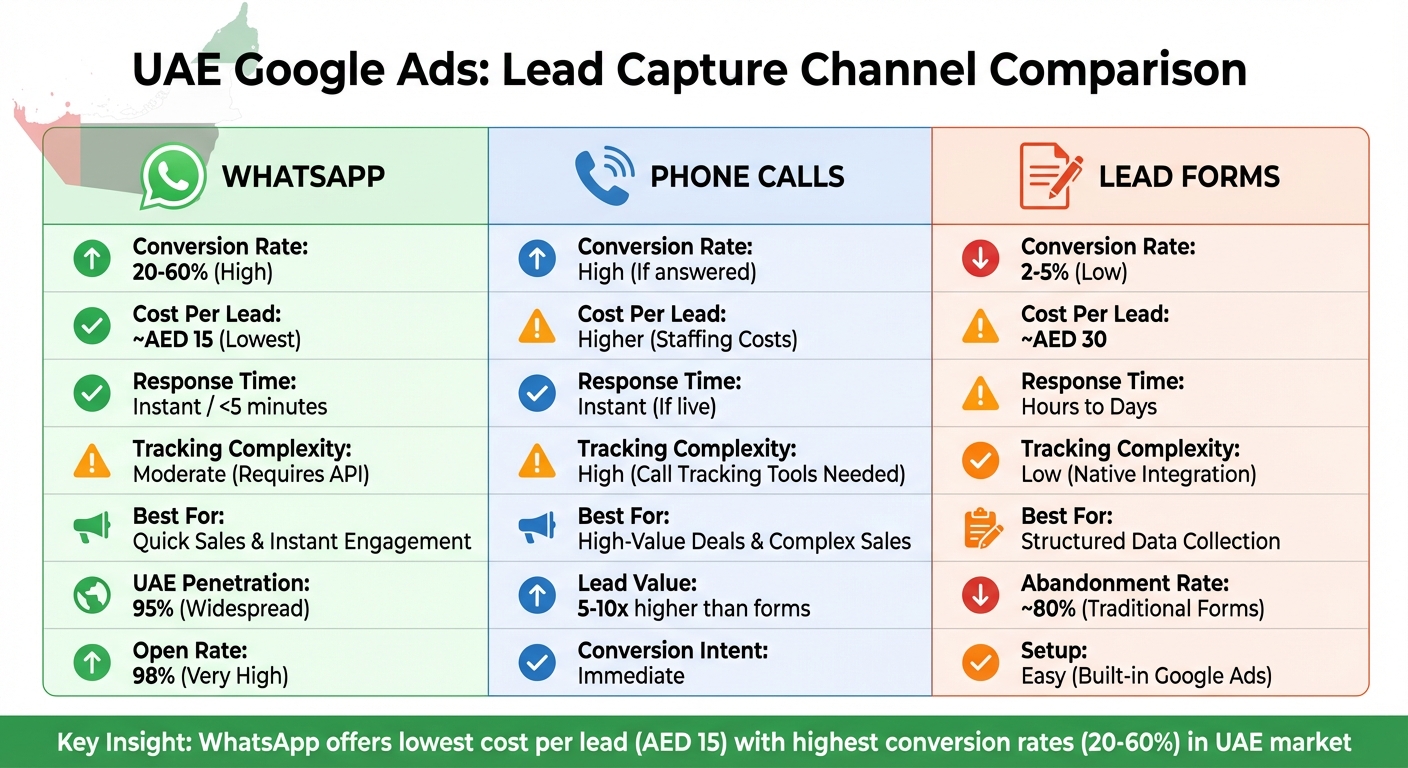
WhatsApp vs Phone Calls vs Lead Forms for UAE Google Ads: Conversion Rates, Costs & Performance Comparison
Google Ads Message Assets with WhatsApp
WhatsApp for Lead Capture and Conversion Tracking
Building on its popularity, let’s explore how WhatsApp performs in lead capture and conversion tracking.
In the UAE, WhatsApp dominates communication, with over 85% of internet users relying on it daily. This creates a huge advantage for Google Ads campaigns - users are already familiar with the platform and often prefer chatting over filling out long web forms. The result? Open rates exceeding 90% and response rates between 45% and 60%.
Instead of directing users to forms, ad clicks take them straight into a WhatsApp chat. This "compressed funnel" allows sales teams to qualify leads, address concerns, and build trust - all in real time.
As Younis Al Balushi explains, "WhatsApp leads convert twice as fast - and our sales pipeline has never moved smoother".
For industries like real estate, clinics, and home services in the UAE, speed is critical. Responding within 10 minutes can boost your chances of closing a deal by 60%.
That said, tracking WhatsApp conversations can be tricky. Google Ads doesn’t natively track these interactions; most setups only count a "click to open WhatsApp" as a conversion, not the actual message sent.
Manolo Alvarez, CGO at Reach Tools, points out, "The gap between clicks and actual messages can be 20–30% or higher. You need to know this number... It's the difference between thinking you're getting 100 leads and realising you're getting 70".
Tools like WAConversionTracking solve this issue by capturing the Google Click ID (GCLID) when someone clicks your ad and matching it to actual WhatsApp messages. This data is then uploaded to Google Ads as an offline conversion, ensuring Smart Bidding campaigns get accurate signals for optimisation.
Pros of Using WhatsApp
WhatsApp offers several advantages for lead capture in UAE campaigns:
- Instant engagement. Users can start chatting immediately, skipping the hassle of forms or callbacks. Most WhatsApp messages are opened within three minutes.
- Real-time qualification. Teams can share multimedia like property photos or location pins and even negotiate prices in a single conversation. This personal touch resonates in the UAE, where customers value direct interaction before making decisions.
As Manolo Alvarez says, "People prefer conversations to forms. When given a choice between filling out a lead form and sending a message, people choose the message. Every time".
- Cost efficiency and automated attribution. Leads initiated through a Meta ad allow a 72-hour window for follow-ups at no extra cost. For businesses with monthly ad budgets between AED 3,000 and AED 10,000, this free messaging window significantly improves ROI. Tools like WAConversionTracking link WhatsApp messages to their originating ad clicks, ensuring Google Ads identifies which keywords and audiences drive actual conversations, not just clicks.
Cons of Using WhatsApp
While WhatsApp offers many benefits, it also has its challenges:
- No native Google Ads integration. Unlike phone calls or lead forms, WhatsApp requires third-party tools and a WhatsApp lead tracking planner for proper conversion tracking. Without these, you risk measuring clicks instead of real leads.
- Scaling requires WhatsApp Business API. The free WhatsApp Business App is suitable for small-scale use but limits access to five devices and offers only basic automation. For advanced features like CRM integration or detailed tracking, upgrading to the API is necessary, which incurs per-conversation fees.
- Tracking discrepancies. Basic setups may report 100 "conversions" when only 70 messages are actually sent. This skews cost-per-lead data and complicates campaign optimisation.
- High response expectations. In the UAE, customers expect quick replies. Delays, especially during peak hours, can lead to lost opportunities. Conversations answered within five minutes convert three to four times better than those delayed by an hour.
Comparison Table: WhatsApp Features and Costs
| Feature | WhatsApp Business App | WhatsApp Business API + WAConversionTracking |
|---|---|---|
| Cost | Free | Per-conversation fee (API) + tracking tool |
| Tracking Accuracy | Counts clicks to open app | Matches GCLID to actual messages sent |
| Google Ads Integration | Manual/None | Automated via offline conversions |
| Team Access | Up to 5 devices | Unlimited via CRM/API |
| Automation | Basic quick replies | Full workflows, chatbots, lead attribution |
| UAE Avg. CPL (Real Estate) | Not tracked accurately | AED 50–AED 85 |
| Setup Complexity | Simple (download app) | Requires API approval and tracking scripts |
| Best For | Small tests or solo operators | Scaling campaigns, agencies, enterprises |
WhatsApp’s ability to simplify lead capture and enhance real-time engagement is undeniable, but businesses must weigh its benefits against the technical requirements for accurate tracking and scalability.
Phone Calls for Lead Capture and Conversion Tracking
In the UAE, phone calls remain one of the most effective ways to capture leads, especially for high-value services. Unlike forms or chat options, a direct call shows urgency - customers are looking for immediate answers. This makes phone calls especially important in industries like real estate, legal services, and home services, where trust and detailed conversations are crucial before making a decision.
Here’s the data to back it up: 65% of businesses rank phone calls as their top lead source, and 43% of search conversions happen over the phone. For mobile users in the UAE, 61% state that calling a business is the most critical step in their purchase process. Additionally, 70% of paid search conversions for local businesses come from phone calls rather than form submissions.
Margot Whitney from WordStream highlights this perfectly: "Calls are the most important lead type for many businesses, often worth 5-10 times as much as form-fill leads".
Google Ads offers robust call reporting features, such as insights into keywords, call duration, and caller area codes. This data can be used in automated bidding strategies like Target CPA, helping businesses optimise for valuable outcomes. In fact, service-based industries see call-only ads delivering up to 20% higher conversion rates than standard text ads, with an average conversion rate for prospect calls around 25%.
However, businesses in the UAE face unique challenges when it comes to tracking calls. Google forwarding numbers, which are essential for seamless call tracking, aren’t widely available in the region. As a result, companies often need to rely on third-party tools or manually import data into their CRM systems. This lack of native integration makes it harder to connect calls to specific keywords or campaigns.
Pros of Using Phone Calls
Phone calls provide several key advantages for businesses in the UAE, especially when targeting high-value customers:
- Immediate and personal interaction: For services like mortgage advice, property sales, or legal consultations, customers often have specific questions. A live conversation builds trust, addresses concerns in real time, and allows sales teams to qualify leads instantly. In some cases, deals can even be closed during the first call - an essential edge for time-sensitive needs like property viewings or urgent repairs.
- Higher lead value: Phone leads are significantly more valuable than form submissions, often worth 5 to 10 times more. While forms may indicate a "call me later" attitude, phone calls show that the customer is further along in their decision-making process.
- Detailed tracking and optimisation: With call reporting enabled, businesses can access data like keyword performance, call duration, and caller location. Companies using call tracking report 32% higher lead attribution accuracy, making it easier to identify and scale the most effective campaigns.
Cons of Using Phone Calls
Despite their advantages, relying on phone calls does come with challenges:
- Limited native support in the UAE: Without Google forwarding numbers, businesses must turn to third-party call tracking tools or manually import Google Click IDs (GCLIDs) into their CRM systems to connect calls to ads.
- Technical hurdles: Setting up Dynamic Number Insertion (DNI), which swaps website phone numbers with unique tracking numbers, requires tools like Google Tag Manager and custom scripts. For businesses without technical expertise, this can be both time-consuming and prone to errors.
- Low-quality leads: Not every call results in a valuable lead. Wrong numbers, accidental dials, or low-intent inquiries can skew data unless a minimum call duration (usually 60 seconds) is set as a filter.
- Fragmented data: Counting calls as conversions only tells part of the story. To optimise effectively, businesses need to link calls to actual revenue through CRM integrations and Offline Conversion Import, ensuring that efforts focus on sales rather than just inquiries.
- Language diversity: With both Arabic and English widely spoken in the UAE, businesses must ensure their staff or automated systems can handle inquiries in both languages to avoid losing potential customers.
Comparison Table: Phone Call Metrics
| Metric | Phone Calls | Lead Forms |
|---|---|---|
| Lead Value | 5x – 10x higher than forms | Standard baseline |
| Conversion Intent | Immediate | Delayed |
| Conversion Rate | ~25% for prospect calls | Lower |
| Tracking Method | DNI, forwarding numbers, CRM import | Thank-you page, GTM tags |
| UAE Native Support | Limited (requires third-party) | Full native support |
| Setup Complexity | High (requires DNI/CRM sync) | Low (tag-based) |
| Data Richness | High (duration, area code) | High (user-defined fields) |
| Best For | High-value, complex services | Volume lead generation |
Phone calls stand out for their ability to deliver high-quality leads and immediate conversions. However, businesses in the UAE must be prepared to invest in the right tracking systems to fully leverage their potential.
sbb-itb-0a82e4d
Lead Forms for Lead Capture and Conversion Tracking
Lead forms are a powerful tool for collecting structured user data in the UAE, gathering details such as name, email, phone number, and company information. They can sync directly with CRMs like HubSpot, Salesforce, or Zoho, streamlining data management. Google Ads lead form assets make the process even smoother by allowing users to submit their information directly within the ad, completely bypassing landing pages. This approach significantly reduces the friction that causes nearly 80% of users to abandon traditional web forms.
These forms work seamlessly with GA4 through the "generate_lead" conversion goal, offering a mobile-friendly, auto-fill experience that reduces effort for users. This is particularly important in the UAE, where 97% of people use smartphones, and 95% browse online regularly.
However, lead forms face a unique challenge in the UAE: customer preferences. In industries like real estate, legal services, and healthcare, many customers prefer the immediacy and personal interaction of WhatsApp or phone calls.
Viral Agency explains, "In the UAE, many buying journeys start on Instagram or Facebook and move quickly into chat. Customers want to ask questions, confirm details... WhatsApp is the natural place for that".
This cultural preference often leads to lower completion rates for lead forms compared to conversational channels, even though lead forms are technically efficient.
Another key factor is response time. While WhatsApp enables instant replies and real-time engagement, lead forms depend on how quickly sales teams respond after receiving the data. Research shows that responding to a lead within five minutes makes a business 21 times more likely to convert that lead into an opportunity compared to waiting an hour. Without proper CRM automation, delayed responses can result in missed opportunities.
Lead forms work best when the focus is on lead quality rather than immediacy. By including qualifying questions, businesses can filter out low-intent inquiries. For instance, Etisalat UAE demonstrated the potential of optimised lead generation in May 2022 by using a dynamic creative strategy with 3,600 variants. This campaign led to a 3.5× increase in lead generation, a 54% rise in click-through rates, and a 20% reduction in cost per lead.
Saadeddine Nahas, Director of Digital Communications at Etisalat UAE, remarked, "Knowing creative drives 70% of campaign performance, it was important we honed in on asset design straight away".
While lead forms excel in data precision, they require timely follow-ups to maximise their effectiveness.
Pros of Using Lead Forms
Lead forms bring several advantages to structured lead capture in the UAE. Their integration with Google Ads and GA4 allows for straightforward conversion tracking without the need for complex setups or third-party tools.
- Cost savings: Lead form assets eliminate the need for dedicated landing pages, cutting down on development and maintenance costs. This also enables businesses to test offers directly in Google Ads.
Fran Sánchez, Head of Marketing at Ads Workbench, explains: "Lead form assets replace separate landing pages, cutting build and maintenance costs. You can test offers and targeting directly in Google Ads without extra setup".
- Higher lead quality: Custom qualifying questions, such as "What is your budget range?" or "When are you looking to purchase?" help filter out low-intent users. Real-time data delivery through webhooks or tools like Ads Workbench ensures sales teams can act quickly, taking advantage of the critical five-minute window.
Since Google Ads only stores lead data for 30 days, automation is essential to prevent data loss.
Cons of Using Lead Forms
Despite their benefits, lead forms face some challenges. A major issue is the UAE's preference for more personal communication methods like WhatsApp or phone calls, particularly in sectors like real estate, automotive, and healthcare. These channels allow for immediate interaction, which often results in higher engagement compared to filling out forms.
Another limitation is the potential delay in response times. Without automation, manual data downloads from lead forms can lead to stale leads, especially given the 30-day data storage limit on Google Ads.
Lead forms also lack the ability to capture conversational signals. Unlike WhatsApp chats or phone calls, which allow sales teams to gauge urgency, ask follow-up questions, and build rapport, lead forms only collect the structured data requested. This can make it harder to qualify leads during complex sales processes.
For better reach, it’s important to ensure lead forms are bilingual, supporting both Arabic and English responses.
Lastly, data quality can be an issue. While shorter forms may improve completion rates, they can also result in incomplete or inaccurate submissions, such as fake email addresses or incorrect phone numbers. Striking the right balance between reducing friction and ensuring accurate data requires ongoing testing and refinement.
Comparison Table: Lead Form Efficiency
| Metric | Native Lead Forms | Traditional Landing Page Forms |
|---|---|---|
| Abandonment Rate | Lower (auto-fill, no page load) | Higher (approx. 80% drop-off) |
| Data Quality | High (Google-verified info) | Variable (depends on user input) |
| Setup Complexity | Low (built-in Google Ads asset) | High (requires web design) |
| Automation Requirement | Essential (30-day data expiry) | Optional (data stored on server) |
| Tracking Integration | Native (Google Ads/GA4) | Manual tag/GTM setup required |
| UAE Fit | Moderate ("formal" perception) | Depends on design and offer |
| Response Time Impact | Critical (21× boost within 5 mins) | Less critical (data persists) |
| Best For | Structured data collection at scale | Brand storytelling, detailed leads |
Side-by-Side Comparison of WhatsApp, Phone Calls, and Lead Forms
This section highlights how WhatsApp, phone calls, and lead forms perform across key metrics, particularly for campaigns in the UAE. Each channel has distinct advantages depending on the business needs and target audience.
For UAE campaigns, WhatsApp stands out for its quick response times and lower cost per lead. Phone calls are excellent for building trust, especially in complex sales scenarios, while lead forms excel at capturing structured data efficiently.
Conversion Rates and Costs
Conversion rates vary significantly across these channels. WhatsApp typically achieves a conversion rate of 20% to 60%, far surpassing the 2% to 5% range of traditional lead forms. Phone calls can match WhatsApp's performance if answered immediately, but scaling them requires 24/7 support, which can be challenging.
Cost-wise, WhatsApp leads are notably cheaper. For example, a Dubai e-commerce business reported an average cost of AED 15 per lead through WhatsApp, compared to AED 30 for lead forms.
Response Time and Engagement
Responding quickly - ideally within five minutes - can significantly boost conversions, with 78% of customers likely to purchase from the brand that responds first. WhatsApp's instant messaging format naturally supports this rapid engagement, while lead forms rely on the sales team's follow-up speed. Phone calls can also enable immediate responses but depend on the prospect's availability and willingness to engage in a conversation.
Integration and User Preferences
Each channel has its own integration requirements. Lead forms integrate seamlessly with Google Ads, while WhatsApp requires UTM parameters and CRM syncing. Phone calls, on the other hand, need dedicated tracking systems, which may increase costs.
WhatsApp also boasts a 98% open rate, ensuring that messages are almost always seen. It’s worth noting that WhatsApp enjoys widespread adoption in the UAE, with 95% penetration, making it a preferred choice for many users.
Comparison Table: Key Metrics Across Channels
Here’s a direct comparison of the key metrics for WhatsApp, phone calls, and lead forms, tailored to UAE campaigns:
| Metric | Phone Calls | Lead Forms | |
|---|---|---|---|
| Conversion Rate | 20–60% | High (if answered) | 2–5% |
| Avg. Cost Per Lead (AED) | ~AED 15 | High (staffing costs) | ~AED 30 |
| Avg. CPC (AED) | 1.5–4.5 | 10–30+ | Varies by platform |
| Response Time | Instant / <5 mins | Instant (if answered) | Hours to days |
| Lead Quality | High (verified numbers) | Very high (direct intent) | Variable (80–90% junk on social) |
| User Friction | Very low (one-tap) | Medium (requires talking) | High (manual entry) |
| UAE User Preference | 95% penetration | High for complex deals | Declining |
| Google Ads Tracking | Moderate (requires UTM/CRM) | Complex (call tracking needed) | Easy (native integration) |
| CRM Integration | Seamless via API | Manual or via call tracking | Native/automated |
| Setup Time | ~2 weeks (API) | Instant | Instant |
| Automation Support | High (AI chatbots/flows) | Low (IVR only) | Low (auto-emails only) |
| Best For | Quick qualification & sales | High-value closing | Structured data collection |
Choosing the Right Channel
For businesses running Google Ads in the UAE, WhatsApp offers a strong mix of affordability, speed, and conversion potential, making it suitable for most industries. Phone calls remain indispensable for high-value transactions in areas like real estate and finance, where personal interaction builds trust. Lead forms work best when capturing detailed data is necessary, especially if automated follow-ups are in place to address slower response times.
These comparisons provide a clear framework for selecting the most effective channel for UAE Google Ads campaigns.
Choosing the Best Channel for UAE Google Ads Campaigns
Picking the right channel for your Google Ads campaigns in the UAE boils down to your business goals, available resources, and sales process. For many businesses, WhatsApp, phone calls, and lead forms each bring unique advantages that can align with specific strategies.
Take WhatsApp, for example - this platform is a game-changer for industries like real estate, clinics, and education providers in the UAE. WhatsApp boasts a conversion rate of 25–35% in UAE real estate, largely because it lets businesses respond to high-intent leads in under five minutes. For potential buyers or clients looking for quick answers, this immediacy is a huge win.
As Imran Farooq, CEO of Starling Properties, explains, "WhatsApp allows you to engage a client while they're still on the property site or during a virtual tour, it's a real-time deal closer".
While WhatsApp is great for instant communication, phone calls are still essential for high-value B2B transactions or luxury sectors. A phone call builds trust by offering a direct, personal touch - something that's often crucial when dealing with premium services or products. Plus, using Google’s forwarding numbers, businesses can track which keywords lead to valuable calls, making it easier to optimise campaigns with strategies like Target CPA.
Then there are lead forms, which shine when structured data collection is key. They integrate seamlessly with Google Ads, making them ideal for businesses like insurance providers or B2B companies that rely on automated follow-ups and detailed enquiries.
To truly get the most out of WhatsApp campaigns, tools like WAConversionTracking can link WhatsApp chats to Google Ads click IDs (GCLID). This provides real conversion data, which is invaluable for Smart Bidding optimisation. With these insights, UAE advertisers can make informed decisions about which channel will deliver the best results for their campaigns.
FAQs
What is the best way for businesses to track WhatsApp conversions effectively?
Businesses in the UAE can efficiently monitor WhatsApp conversions by combining UTM tagging, server-side webhooks, and CRM integration. To begin, include UTM parameters or a customised WhatsApp tracking link in your paid ad campaigns. This ensures that when users click the 'Message Us' button, essential data like source, medium, and campaign details are recorded. The click is then captured via a server-side webhook, which logs the WhatsApp chat initiation and ties it back to the original UTM information. This data can be synced with tools like Google Ads for offline conversion tracking or integrated with CRMs such as HubSpot or Zoho for comprehensive lead management.
You can also take advantage of behavioural insights from the WhatsApp Business Platform, including message counts, response times, and chat durations. By aligning these metrics with specific actions - like form submissions or scheduled calls - businesses can measure conversion rates and refine their ad strategies. To make this even easier, visualise the data using dashboards like WAConversionTracking. These dashboards help marketers monitor results in real time, track costs in AED (د.إ), and display metrics in UAE-friendly formats, such as DD/MM/YYYY for dates and comma-separated numbers (e.g., 1,250 leads). This integrated approach removes the need for manual tracking and ensures campaigns are both efficient and effective.
What are the benefits of using phone calls for generating leads?
Phone calls deliver immediate, personalised communication, giving sales teams the chance to quickly gauge a lead’s intent and qualify them more effectively. This often translates into better conversion rates and higher-quality leads compared to static online forms.
What’s more, phone calls can be tracked and linked to specific ads, keywords, or campaigns using tools like Google’s call-conversion tracking. This not only provides businesses with precise ROI data but also integrates smoothly with platforms like Google Ads and CRM systems. The result? Simplified workflows and improved campaign efficiency.
The human connection that comes with voice interactions fosters trust, making it easier to close sales and often leading to larger transaction values. Additionally, call recordings and analytics - such as call duration and sentiment analysis - offer actionable insights that can help fine-tune future campaigns and sharpen lead-generation strategies.
Why do lead forms tend to have lower conversion rates in the UAE?
Lead forms in the UAE often struggle with lower conversion rates, and a big reason for this is the effort they demand. Filling out multiple fields can seem tedious and time-consuming, especially for users who value quick, seamless interactions.
Many people in the UAE gravitate towards WhatsApp for exactly this reason. It offers a faster, more mobile-friendly experience that allows for instant communication without the hassle of completing lengthy forms.
There's also a strong preference in the region for personalised, direct interactions. Platforms like WhatsApp cater to this by enabling real-time, tailored conversations, which feel far more engaging than static forms. This focus on speed and convenience plays a major role in shaping how effective lead generation methods are in the UAE.