
WhatsApp click-to-chat ads are transforming how businesses in the UAE connect with customers. With over 2 billion global users and a UAE audience of 9.27 million (80% expatriates), WhatsApp offers a trusted, mobile-first channel for direct communication. Here's why it works and how to do it effectively:
- There are several ways to improve ROI on WhatsApp ad campaigns. High ROI Potential: Companies like Arabian Automobiles doubled test drive leads while cutting costs by 56%.
- Challenges in Tracking: Many struggle to measure WhatsApp chats as conversions, creating an attribution gap.
- Solution: WAConversionTracking integrates WhatsApp with Google Ads, automatically logging conversations as conversions for precise campaign optimisation.
Key tips include:
- Focus on mobile-first strategies for the UAE, where 75.3% of web traffic is mobile.
- Use bilingual ads (English and Arabic) tailored to local preferences.
- Ensure compliance with UAE regulations, such as obtaining opt-ins within 72 hours and avoiding the national Do Not Call Registry.
- Optimise landing pages with quick-loading, mobile-friendly designs and clear WhatsApp buttons.
- Use WhatsApp messages as a "digital majlis" for meaningful, personalised conversations.
Tracking tools like WAConversionTracking enable businesses to link WhatsApp chats to Google Ads data, improving campaign performance by focusing on real conversations instead of clicks. This approach helps reduce costs, increase conversions, and scale campaigns effectively. WhatsApp is a powerful tool in the UAE's AED 2.3 billion digital advertising market, but success hinges on precise tracking and compliance.
How to Set Up Click-to-WhatsApp Ads in the UAE
To launch click-to-WhatsApp ads successfully in the UAE, focus on a mobile-first strategy while ensuring compliance with local regulations. The UAE's digital landscape is dominated by mobile usage, with 75.3% of all web traffic coming from mobile phones. This makes mobile-optimised ad strategies essential for reaching your audience effectively.
Incorporate wa.me links into Google Ads sitelinks to drive high-intent traffic directly into WhatsApp chats. These links eliminate the need for forms or waiting, allowing users to connect with your business instantly.
Before running ads, complete Google's Advertiser Verification programme and ensure your account has a clean compliance history. Your WhatsApp Business profile should include a clear brand logo, a concise business description, and your operating hours - key elements to build trust with UAE customers. To track WhatsApp conversions, use WAConversionTracking to capture all conversions. Start by testing campaigns in Dubai with a budget of AED 3,000–AED 10,000 per month.
Creating Ads That Follow UAE Regulations
The Telecommunications and Digital Government Regulatory Authority (TRA) mandates that businesses secure proper user opt-ins before sending marketing messages. Opt-ins must be obtained within 72 hours of the initial chat.
Additionally, avoid targeting individuals listed on the national Do Not Call Registry (DNCR), as unsolicited contact is strictly prohibited in the UAE. When creating message assets in Google Ads, avoid using "WhatsApp" in the headline to prevent confusing users who might expect to land on a webpage rather than a chat window. Maintain transparency in your messaging and provide users with a clear and immediate way to opt out if they choose.
Adapting Your Ads for UAE Audiences
Once compliance is addressed, tailor your ads to resonate with UAE customers.
Use AED for pricing and follow the DD/MM/YYYY date format. For example, write "AED 299" instead of "299 AED" or "$81" to show your understanding of local preferences.
Create separate campaigns in English and Arabic rather than combining the two languages in a single ad group. Employ native Arabic speakers for translations to ensure that your messaging captures the cultural nuances and tone that resonate with the audience. Ads that perform well in the UAE often feature real-world settings and vertical videos with subtitles.
Segment your campaigns by emirate - such as Dubai, Abu Dhabi, and Sharjah - rather than targeting the entire country. User behaviour and device usage can vary significantly by region, and this approach allows for more precise budget allocation. During key periods like Ramadan, Eid, or the Dubai Shopping Festival, adjust your ad schedules to focus on post-Iftar hours and incorporate themes related to family, convenience, and exclusivity.
sbb-itb-0a82e4d
Writing WhatsApp Messages That Convert
In the UAE, WhatsApp messages boast an impressive open rate of up to 70%. But an open rate alone isn't enough - it’s the conversion that truly matters. To succeed, think of WhatsApp not as a one-way broadcast tool but as a "digital majlis", as Cequens describes it - a space for meaningful conversations and trust-building.
Crafting messages that resonate with the UAE's multicultural audience is essential. With expatriates making up 80% of the population, a one-size-fits-all approach won’t work. Instead, segment your audience based on language and purchasing behaviour. This personalised strategy is powerful: customers who visit a website via a WhatsApp notification are 1.7 times more likely to complete a purchase. By tailoring your approach, you can create message templates and follow-ups that drive real results.
Building Message Templates for UAE Customers
Use bilingual templates to cater to the diverse UAE audience, allowing customers to choose their preferred language. AI-powered chatbots can seamlessly switch between English and Gulf Arabic, depending on the customer’s reply. When writing in Arabic, opt for Gulf Arabic - it resonates more with the local audience than Modern Standard Arabic.
Your opening greeting sets the tone. Start with culturally relevant phrases like "Marhaba" or "Salam" instead of a generic "Hello." As Cequens points out:
"A 'Marhaba' isn't just a greeting - it sets the tone for the whole conversation."
Make templates interactive by using WhatsApp features like quick reply buttons. Options such as "Book Now," "See Menu," or "Check Availability" can simplify customer interactions. For instance, 6thStreet, a Dubai-based e-commerce platform, saw a 20x ROI compared to SMS by integrating chatbots with rich media and quick replies. Ankit Bansal, Head of Digital Marketing at 6thStreet, shared:
"WhatsApp gives us even more control over how we can engage with customers. In addition to the chatbot, we can include rich-media pictures and GIFs, the bot, and gamification."
To comply with TDRA guidelines, send promotional messages only between 7:00 and 21:00, and limit broadcasts to twice a week. Always include a clear opt-out option, adhering to the UAE's Personal Data Protection Law.
Writing First Messages and Follow-Ups
Your first message must deliver on the promise of your ad immediately. If the ad offers a discount code, include it in the opening message - don’t make customers chase it. Use one-tap icebreakers to reduce friction and make engagement effortless.
Personalisation is key. Reference the ad directly - for example, mention AED 299 trainers instead of sending a generic catalogue. A UAE-based flower delivery service achieved a 55% read rate by tailoring WhatsApp journeys.
Use this initial interaction to collect zero-party data - details customers willingly share, like size preferences or delivery addresses. This information helps you personalise future messages. Within the first 72 hours, clearly state your business name and ask for permission to send future updates, ensuring proper opt-in consent.
When it comes to follow-ups, avoid sounding robotic. Write in a conversational tone, as if speaking directly to the customer. Turkish retailer Modanisa saw 55% of customers who engaged with their WhatsApp chatbot place their first orders through the platform by maintaining a human touch. Additionally, be considerate of prayer times when scheduling follow-ups that aren’t automated.
Building Landing Pages for WhatsApp Campaigns
Your landing page is where paid traffic meets WhatsApp, and if it’s not mobile-friendly, you could lose potential leads. The page needs to load quickly and display perfectly on smartphones to keep users engaged.
It’s also crucial that your landing page immediately delivers on the promise made in your ad. For instance, if your ad promotes "AED 50 off trainers," that offer should be front and centre when users land on the page - not hidden among generic content. As highlighted by the WhatsApp Business Blog:
"Do whatever the promotion promised quickly after an ad click, so people can see that chatting with your brand is a valuable experience."
Make sure to place a highly visible WhatsApp button above the fold, so users can start a chat without needing to scroll. This button should open WhatsApp directly and pre-fill your business number for a seamless experience. Test it across different devices to ensure users can transition effortlessly from your landing page to a WhatsApp conversation.
Designing Mobile-First Landing Pages
For a WhatsApp campaign, simplicity and speed are everything. A mobile-first landing page should eliminate unnecessary elements like complex navigation menus, lengthy forms, or distracting visuals. The goal is straightforward: make the WhatsApp button easy to find and tap on any mobile device.
To achieve this, compress images, minimise scripts, and use mobile-optimised formats to ensure the page loads quickly. You can also use exit-intent pop-ups that display the WhatsApp button when visitors try to leave the page, giving you another opportunity to capture their interest.
Using WAConversionTracking for Landing Page Tracking
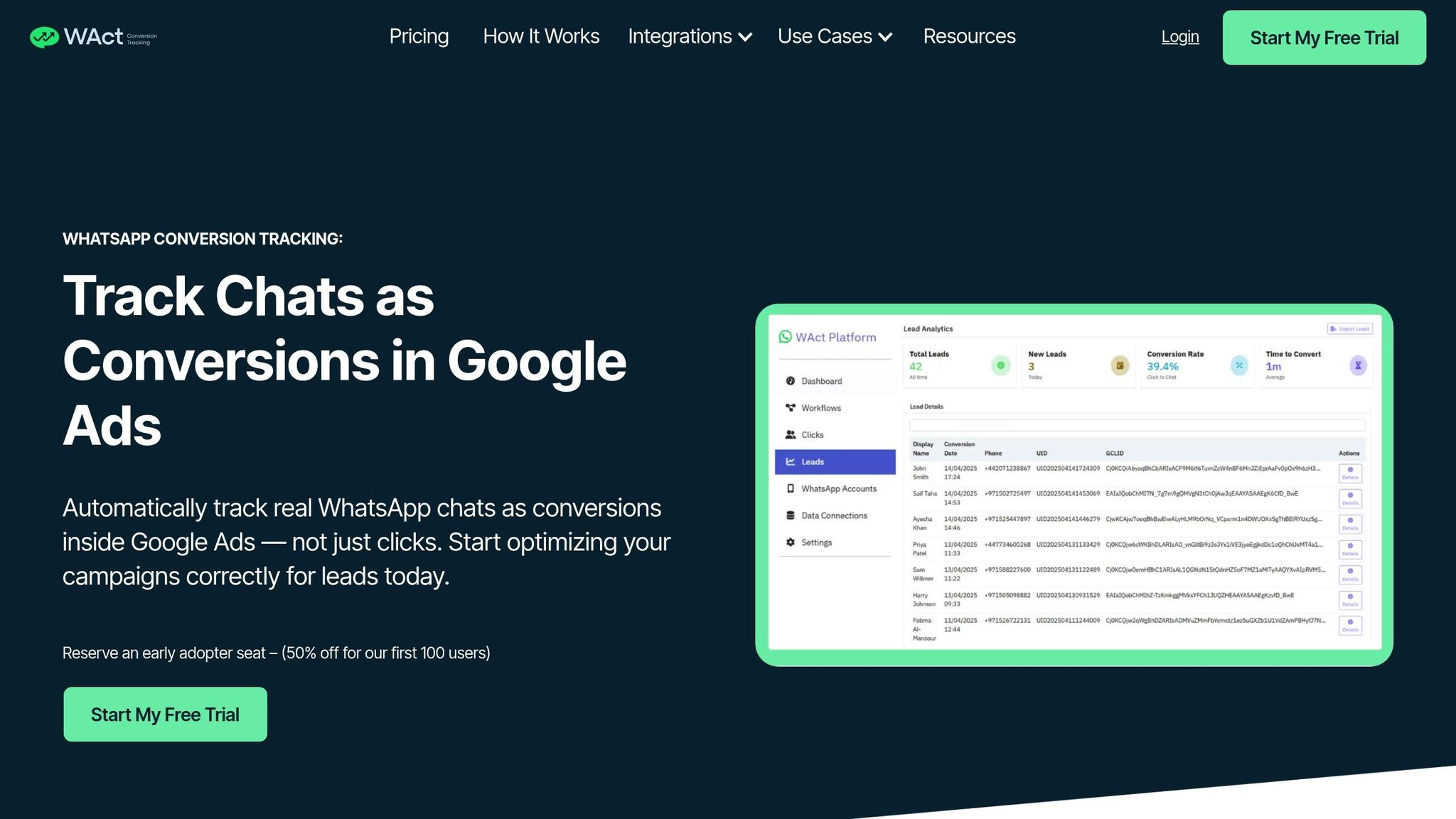
Accurate tracking starts on your landing page, and it’s vital for optimising your campaigns. When someone clicks on your Google Ad and lands on your page, capturing the Google Click ID (GCLID) and UTM parameters from the URL helps you trace which campaign generated the WhatsApp lead. This allows you to connect the lead to the user’s unique ID (UID).
WAConversionTracking simplifies this process. By adding a tracking script to your landing page, the tool captures GCLID and UTM tags whenever a visitor clicks the WhatsApp button. It then matches this data to the user’s unique ID and logs the lead. Even future messages are linked back to the original ad click.
The best part? You don’t need a developer. You can generate the tracking script with a single click, paste it into your landing page code, and connect your WhatsApp account via the workflow dashboard. The tool integrates seamlessly with Google Ads and automatically logs leads into Google Sheets or your CRM. This ensures that your Smart Bidding algorithms work with accurate conversion data, helping you scale campaigns based on actual WhatsApp interactions - not just button clicks.
Tracking WhatsApp Conversations as Conversions
When it comes to a mobile-first landing page strategy, tracking WhatsApp conversations is a game-changer for validating campaign success. Why? Because accurate conversion tracking bridges the attribution gap, ensuring that every WhatsApp chat contributing to your campaign's performance is accounted for.
A common mistake businesses make is focusing on button clicks rather than actual WhatsApp conversations that lead to sales. Tracking these real conversations - from the first message to the final sale - gives you actionable data. This allows Google Ads to optimise your campaigns using Smart Bidding strategies like Maximise Conversions or Target CPA. In short, it’s not about vanity metrics; it’s about meaningful interactions that drive results.
Setting Up Automatic Conversion Tracking with WAConversionTracking
WAConversionTracking is a tool that connects your landing page with your Google Ads account, automatically logging every WhatsApp lead. Here's how it works:
- Add a single line of JavaScript to your website.
- Link your WhatsApp Business API via the dashboard.
Once set up, the system uses GCLID, UTM parameters, and metadata to attribute each conversation to the right campaign, keyword, and ad. This means every lead is tracked accurately, eliminating guesswork.
The tool updates conversion data daily, feeding your Smart Bidding algorithms with real chat data instead of unqualified interactions. Impressively, this method captures lead information for over 98% of leads using a reference number system.
This automated tracking lets you identify which keywords generate real conversations and which ones waste your budget. Even better, it helps you optimise for qualified leads or actual sales - not just the total number of chats - leading to a stronger return on investment.
Tracking the Right Campaign Metrics
For businesses in the UAE, tracking the right metrics in AED is essential for accurate performance evaluation. Here are the key metrics you should focus on:
| Metric | How to Calculate | Why It Matters for UAE Campaigns |
|---|---|---|
| Messaging Conversations Started | Total users who messaged after clicking an ad | Highlights initial engagement and the relevance of your ad |
| Chat-to-Sale Conversion Rate | (Total Sales / Total WhatsApp Chats) × 100 | Shows how effectively your team converts leads into customers |
| Cost Per Acquisition (CPA) | Total Ad Spend / New Customers | Helps determine if your customer acquisition costs are sustainable |
| Return on Ad Spend (ROAS) | Revenue in AED / Ad Costs | Offers a clear snapshot of profitability |
Tracking shouldn’t stop at chat initiations. To truly optimise your efforts, monitor the entire customer journey - from the first message to a closed sale. This full-funnel approach helps you pinpoint where potential customers drop off, giving you a chance to refine your messaging and strategies.
With WAConversionTracking, you can even measure response speed, particularly replies sent within 10 minutes - a critical factor for likely conversions.
Using Conversion Data to Improve Your Campaigns

WhatsApp Campaign Performance: Before vs After Conversion Tracking
Accurate conversion tracking is just the beginning. Conversion data can significantly improve your campaigns by pinpointing performance gaps and guiding precise adjustments.
Adjusting Campaigns Based on Performance Data
Focus on identifying the keywords and campaigns that lead to actual conversations, not just clicks. Tools like WAConversionTracking help match each lead to its Google Click ID (GCLID), making it easier to shift budgets toward high-intent campaigns.
Fine-tune your Google Ads bids to prioritise qualified leads with a lower cost per acquisition (CPA) and a higher return on ad spend (ROAS). Dig into the customer journey - from the initial ad click to the WhatsApp message - to uncover potential friction points. For instance, if users click your ad but don’t initiate a message, it might be time to optimise your landing page. In the UAE, where WhatsApp boasts open rates of over 90%, responding promptly can significantly boost conversions.
These data-driven adjustments form the backbone of measurable improvements, as illustrated in the performance comparison below.
Campaign Performance Before and After WAConversionTracking
Switching from click-based tracking to conversation-based tracking can revolutionise campaign optimisation. Before adopting WAConversionTracking, businesses often focused on clicks and impressions - metrics that don’t always reflect lead quality. Post-implementation, the focus shifts to meaningful conversations and actual sales.
| Metric | Before WAConversionTracking | After WAConversionTracking |
|---|---|---|
| Tracking Depth | Limited to clicks & impressions | Full lead attribution (UID/GCLID) |
| Optimisation Basis | Click-through rate (CTR) | CPA, ROAS, and lead quality |
| Budget Allocation | Estimated based on traffic | Data-driven, targeting high-intent sources |
| Customer Insight | Basic demographics | Detailed conversation history and behaviour |
| Purchase Impact | Standard conversion rates | 89% higher purchases per user |
The results speak for themselves. In 2023, Mercedes-Benz Turkey adopted a hybrid approach by combining social media ads with Click-to-WhatsApp campaigns. This led to a 78% drop in cost per qualified lead and a 93% increase in incremental conversions. Similarly, Tata Cliq achieved $500,000 in revenue from a one-month WhatsApp campaign, delivering an ROI 10 times higher than traditional channels.
"Using WhatsApp, consultants apply the personal touch to multiple customers at once, contributing to a nearly 80 per cent message open rate and a 10 to 11 times increase in purchase orders compared to email campaigns."
– Guido Rosso, Multi-Contact Centre Director, Baro Cosmetics
Feeding this conversion data back into Google Ads' Smart Bidding algorithms allows for automatic optimisation of delivery and targeting. This not only reduces wasted spend but also scales successful strategies effectively.
Conclusion
Running WhatsApp campaigns without conversion tracking is like navigating without a map - you might get somewhere, but you won't know how or why. The difference between simply counting clicks and tracking real conversations is the key to optimising campaigns with confidence instead of relying on guesswork.
WAConversionTracking bridges the gap by linking every WhatsApp chat to its source using GCLID and UTM parameters. This allows you to pinpoint which keywords, ad creatives, and audiences are generating qualified leads. For example, when Bowaba implemented WhatsApp-first funnels across the GCC and leveraged the 72-hour remarketing window, their clients saw up to an 11x return on ad spend. Similarly, Blacklyf moved away from traditional landing pages to WhatsApp campaigns, slashing acquisition costs by 60% and tripling their conversion rates.
With the UAE's digital advertising market valued at over AED 2.3 billion annually, precision tracking for agencies is no longer optional - it's essential to stay competitive. Tracking key down-funnel events like "Add to Cart" or "Purchase Value" provides a clearer picture of ROI and feeds valuable data back into Google Ads' Smart Bidding algorithms. This creates a feedback loop where campaigns continuously improve with each interaction.
The numbers speak for themselves. WhatsApp open rates in the UAE exceed 90%, and users are 1.7 times more likely to make a purchase after receiving a notification . By capturing every interaction, you can refine your strategy and turn WhatsApp into a measurable and scalable revenue engine. Conversion tracking isn't just a tool - it's the foundation for unlocking WhatsApp's full potential. To get started, use a WhatsApp lead tracking planner to organize your campaign goals.
FAQs
How can WAConversionTracking enhance the performance of WhatsApp campaigns in paid search?
WAConversionTracking takes your WhatsApp interactions and turns them into a measurable conversion process, making it easier to track and refine your campaign performance. By integrating a specialised tracking script into your ad-to-WhatsApp links, it captures unique click IDs and matches them to WhatsApp conversations. This means every sales-driven chat can be logged as a conversion.
With precise attribution, you’ll know exactly which keywords, ads, and audiences are driving revenue. The data is exported in real time, giving you the power to fine-tune your campaigns by reallocating budgets, lowering your cost per acquisition (CPA), and accurately calculating your return on ad spend (ROAS). On top of that, the tool automates follow-ups and lead qualification, cutting down on manual tasks and speeding up the sales process.
When paired with WhatsApp’s impressive engagement rates, WAConversionTracking transforms the platform into a fully trackable, ROI-driven tool for paid search campaigns in the UAE.
What compliance rules should I follow for WhatsApp ads in the UAE?
To advertise on WhatsApp in the UAE, it's crucial to stick to specific rules that ensure compliance with local laws and cultural expectations. Start by following WhatsApp’s Business Messaging Policy. This means using pre-approved message templates and avoiding content that may conflict with UAE cultural values, such as political, religious, or adult-oriented topics. Also, make sure you have explicit user consent before sending any non-transactional messages, and always provide recipients with an easy way to opt out.
On top of that, you must comply with the UAE’s Personal Data Protection Law. Handle any personal information you collect with care - secure it, be transparent about its usage, and only keep it for as long as necessary. When creating your ads, consider making them bilingual (Arabic and English) to cater to a broader audience. Clearly identify your business in the messages and include one straightforward call-to-action, like initiating a chat or booking a service. Following these steps will help ensure your WhatsApp ads align with both legal requirements and cultural sensitivities in the UAE.
How can businesses in the UAE personalise WhatsApp messages to connect with their diverse audience?
To make WhatsApp messages more personal for audiences in the UAE, it’s important to consider the region’s rich cultural and linguistic diversity. Start by segmenting your audience based on factors like location (for example, Dubai versus Abu Dhabi), interests, or purchase history. Tailor your messages accordingly - use Arabic for Emirati locals and English for the expatriate community. Even a small touch, such as including a personalised greeting like “Marhaba / Hello [Name]” along with details about their recent activity, can create a sense of exclusivity and connection.
Take advantage of AI tools to customise key elements, such as showing prices in AED or formatting dates in dd/MM/yyyy style, ensuring the message feels aligned with local expectations. Pair concise text with eye-catching visuals, interactive quick-reply buttons, or even location pins, as these elements resonate well with the UAE audience’s preference for engaging and functional content. Timing also plays a crucial role - business updates are best sent in the early morning, while promotional offers perform better in the evening when families are more at ease.
Lastly, always respect local customs and values. Avoid sending unsolicited messages, use polite and respectful language, and consider adding thoughtful emojis like 🌙 for Ramadan-themed promotions. This approach not only builds trust but also ensures your messages feel meaningful and relevant to your UAE audience.