LinkedIn Ads conversion tracking is essential for UAE businesses to stop wasting ad spend on clicks that don’t lead to meaningful results. With over 6.4 million LinkedIn members in the UAE and WhatsApp widely used for lead generation, tracking actual conversions like demo requests or WhatsApp chats is critical. Here's the key takeaway: rely on accurate data, not vanity metrics like impressions or clicks.
What You Need to Know:
- LinkedIn Insight Tag: Tracks website visits and conversions; install it manually or via Google Tag Manager.
- Conversions API: Bypasses browser restrictions for server-side tracking, ensuring precise data.
- WAConversionTracking: Tracks real WhatsApp messages, not just button clicks, syncing them as conversions in LinkedIn.
- Key UAE Metrics: Use AED for conversion values, 90-day attribution windows for B2B sales, and WhatsApp tracking to measure actual customer interactions.
- Fix Common Issues: Double-check Insight Tag installation, ensure URLs match, and use server-side tracking to avoid data loss from ad blockers.
Pro Tip: Combine LinkedIn’s tools with Google Analytics 4 (GA4) for a full view of user behaviour beyond clicks. Use UTM parameters for detailed tracking and match LinkedIn conversions with GA4 events.
Why It Matters:
Conversion tracking ensures every dirham spent delivers measurable outcomes. By focusing on real actions like WhatsApp chats or pipeline activities, you can lower your Cost Per Lead (CPL) and improve campaign performance. Use the right tools, test setups thoroughly, and align tracking with UAE-specific needs for better ROI.

LinkedIn Ads Conversion Tracking Setup Guide for UAE Businesses 2026
The 2026 Guide To LinkedIn Ads Conversion Tracking [Online & Offline]
sbb-itb-0a82e4d
Setting Up LinkedIn Insight Tag
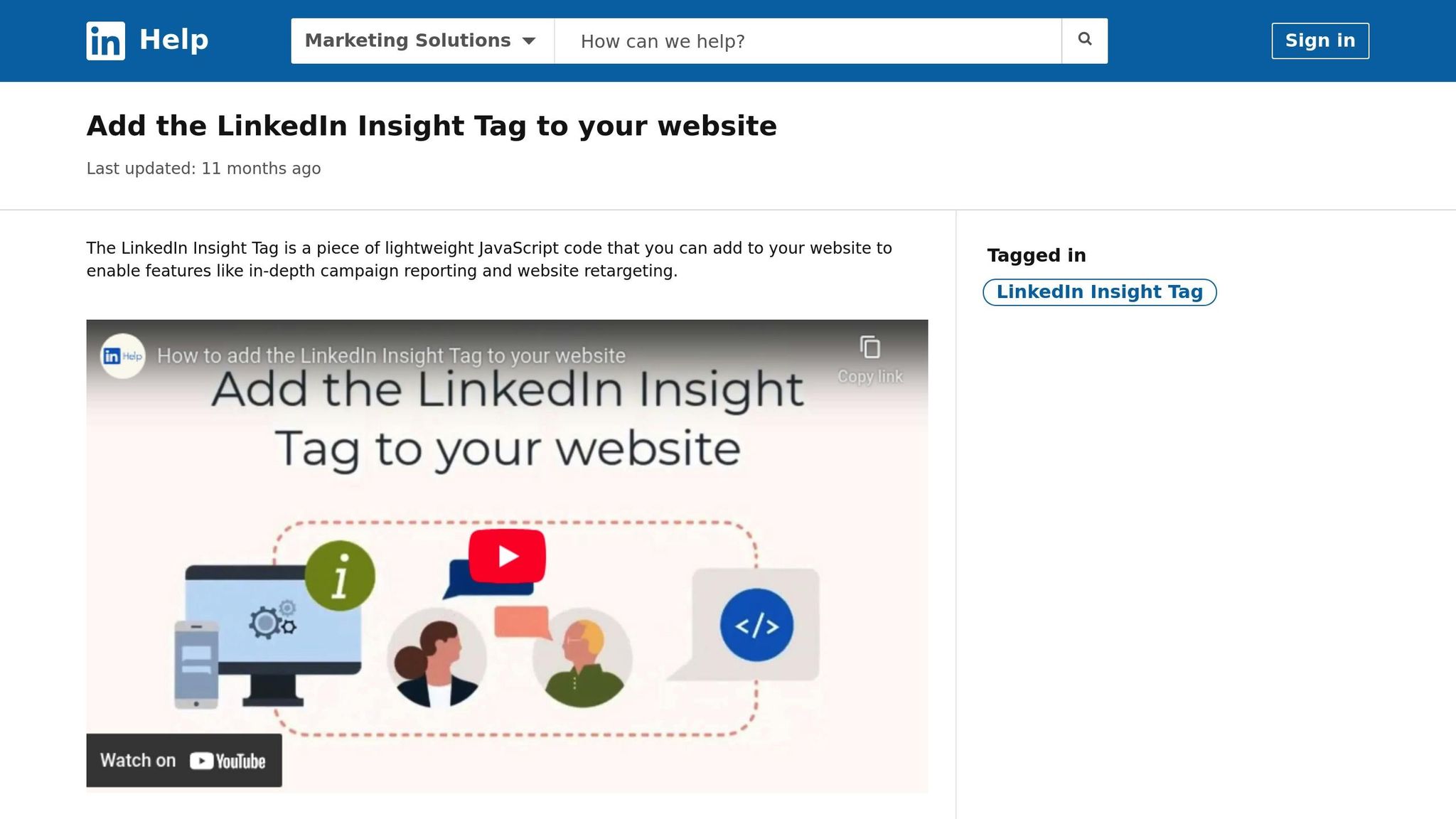
The LinkedIn Insight Tag is a lightweight JavaScript snippet that tracks visitor activity on your site. It enables features like conversion tracking, audience insights, and retargeting, making it a key tool for LinkedIn advertising campaigns.
"The LinkedIn Insight Tag is the foundation of effective B2B advertising on the platform. This small piece of JavaScript code... unlocks LinkedIn's most powerful advertising features." - Gaultier D'Acunto, Co-founder, Benly
Each LinkedIn ad account comes with a unique numeric Partner ID (e.g., 123456), which is necessary for all installation methods.
Installing the LinkedIn Insight Tag
To get started with the Insight Tag, log in to LinkedIn Campaign Manager. From the "Data" menu on the left, select "Signals manager", then click on "Insight Tag" to find your unique Partner ID and JavaScript code. You can install the tag using one of the following methods:
-
Manual Installation or Google Tag Manager (GTM):
Copy the JavaScript snippet and paste it into your website’s global footer right before the closing</body>tag. Alternatively, use the "LinkedIn Insight Tag 2.0" template from the GTM Community Template Gallery. Simply input your Partner ID and set the trigger to "All Pages." -
Developer Option:
Use the "Send the tag to a developer" feature to email the instructions directly to your technical team.
Pro Tip: Google Tag Manager is often the preferred method because it simplifies updates and offers better version control. For UAE advertisers, ensure you set the currency to AED and use the DD/MM/YYYY date format when defining conversion actions. This ensures ROI reports are accurate.
Important Considerations:
- Avoid installing the tag on pages that handle sensitive data, such as financial or health-related transactions.
- If your website has separate mobile and desktop versions (e.g., m.example.com), install the tag on both to ensure full tracking coverage.
- Do not mix manual and GTM installations on the same page to prevent double-counting conversions.
- Enable first-party cookies in the Insight Tag settings to maintain tracking accuracy, especially as third-party cookies are being phased out.
After installation, verify the tag’s functionality immediately to ensure it’s collecting data properly.
Testing and Verifying the Insight Tag
Once installed, domain validation can take anywhere from a few minutes to 24 hours. When the tag is active, it will display as "Active" in Campaign Manager. You can test the tag in real time using the LinkedIn Insight Tag Helper browser extension, which confirms your Partner ID and verifies event tracking.
For a deeper technical check, open your browser's Developer Tools (F12), go to the Network tab, and filter for "ads.linkedin." Refresh the page and look for a successful request with a status code of 200 or 302. This indicates that the tag is successfully communicating with LinkedIn’s servers.
| Verification Method | Tool/Interface | What to Look For |
|---|---|---|
| Campaign Manager | Signals Manager > Sources | Status changes from "Unverified" to "Active" |
| Browser Extension | LinkedIn Insight Tag Helper | Real-time confirmation of Partner ID and events |
| Developer Tools | Browser Network Tab | Requests to "ads.linkedin.com" with 200 or 302 |
Setting up and verifying the LinkedIn Insight Tag is a crucial step. With the tag active, you’re ready to create conversion actions in Campaign Manager, as detailed in the next section.
Creating Conversion Actions in LinkedIn Campaign Manager
Once your Insight Tag is installed and verified, the next step is setting up and linking conversion actions in LinkedIn Campaign Manager.
With the Insight Tag active, you can start tracking key actions like demo requests, downloads, or purchases. To do this, head to the Measurement menu under Conversion Tracking in Campaign Manager.
Selecting a Data Source
Begin by choosing the data source for your conversions:
- LinkedIn Insight Tag for website actions.
- Conversions API for server-side or CRM data.
- Lead Gen Forms for LinkedIn native forms.
- CSV file uploads for offline conversions.
When creating a conversion rule, you’ll need to provide:
- A clear name.
- A category (e.g., Lead, Purchase, Sign Up).
- A conversion value in AED.
- A lookback window.
- An attribution model.
For UAE advertisers, ensure your currency is set to AED and use the DD/MM/YYYY format for date settings. This ensures your ROI reports are aligned with local standards.
"LinkedIn conversion tracking is the key metric I use when thinking about how to optimize our campaigns - and it clearly shows our LinkedIn campaign performance is almost too good to be true." - Rick Salmon, PPC Manager, ConnectWise
Defining Conversion Goals
Your conversion goals should reflect your business objectives and align with different stages of the customer journey. LinkedIn groups conversions into three funnel stages:
- Top of Funnel: Actions like key page views.
- Middle of Funnel: Examples include leads or sign-ups.
- Bottom of Funnel: Actions such as purchases or qualified leads.
For instance, if you’re tracking WhatsApp enquiries from prospects in the UAE, you could create a "WhatsApp Lead – Product Demo" conversion under the Middle of Funnel category.
Assigning a monetary value to each conversion helps you calculate ROAS and pinpoint successful campaigns. For example, if a qualified lead is worth AED 500 to your business, input that value. For purchases, dynamic values can track actual transaction amounts.
Lookback Windows and Attribution Models
Set lookback windows based on your sales cycle. LinkedIn suggests 90-day click and 90-day view windows for most standard conversions. For longer B2B sales cycles common in the UAE, categories like Purchase or Qualified Lead allow lookback windows of up to 365 days. For quicker website conversions, like newsletter sign-ups, a 30-day click and 7-day view window is more suitable.
When selecting an attribution model:
- "Each ad set" credits all ad sets a user interacted with, offering a broader view of touchpoints.
- "Last ad set" credits only the final interaction, focusing on the last step in the journey.
For B2B campaigns with multiple touchpoints, "Each ad set" often provides better insight into how campaigns work together.
Linking Conversions to Campaigns
Once your conversion goals are defined, link them to specific ad sets to ensure accurate tracking. LinkedIn automatically associates ad sets based on the conversion category and campaign objective. However, it’s a good idea to manually review these connections for accuracy.
You can adjust these associations when creating a new ad set or later via the Conversion Tracking page. If the Status column shows "Unverified", trigger an event on the conversion page to verify your setup. This process usually takes 24 to 48 hours, though conversions uploaded via CSV may take up to a week to reflect in reports.
To monitor performance, go to the Campaigns or Ad sets tab, click on the Columns dropdown, and select Conversions & Leads. Metrics like click conversions, view conversions, conversion rate, cost per conversion, and ROAS will be displayed in AED, tailored for UAE campaigns.
Tracking WhatsApp Conversions with WAConversionTracking
In the UAE, WhatsApp reigns as the go-to communication tool for businesses. But there's a catch: traditional LinkedIn tracking often misleads by counting button clicks instead of actual conversations. This inflates metrics and wastes your ad budget.
Enter WAConversionTracking - a tool designed to track real WhatsApp messages, not just clicks. When a customer sends a message, the event is logged and synced back to LinkedIn as an offline conversion. This means you get accurate data to fine-tune your campaigns.
How WAConversionTracking Works
This tool uses a unique identifier (UID) to connect ad clicks to actual WhatsApp messages. When someone clicks your WhatsApp button, the tool attaches a UID to the link. Once the message is sent through the WhatsApp Business API, the UID is matched to the corresponding LinkedIn ad click.
The tracking script gathers detailed data, including GCLID and UTM parameters, timestamps, and device information. This is then sent to LinkedIn Campaign Manager as an offline conversion, helping you optimise your campaigns in real time.
"WAConversionTracking is a lightweight conversion tracking solution that allows you to track real WhatsApp chats as conversions inside Google Ads - not just button clicks." - WAConversionTracking Help Centre
It’s worth noting that this tool respects user privacy. It tracks only anonymised conversion events and does not access personal messages or contact lists.
With the data flow explained, let’s move on to setting up WAConversionTracking for your LinkedIn campaigns.
Setting Up WAConversionTracking for LinkedIn Ads
To get started, you'll need the WhatsApp Business API from providers like Meta Cloud API, 360dialog, or Twilio. Unfortunately, the standard WhatsApp Business app doesn’t support automated chat tracking.
Here’s a quick setup guide:
- Connect your WhatsApp Business API key.
- Link your WhatsApp number and generate the tracking code.
- Embed the code into your website's footer, just before the closing
</body>tag.
Next, head to LinkedIn Campaign Manager. Go to Measurement > Conversion tracking > Create conversion, and choose Conversions API as the data source. Name your conversion (e.g., "WhatsApp Lead - UAE"), select the "Lead" category, and assign a conversion value in AED. WAConversionTracking will then sync real-time chat data to LinkedIn as offline conversions.
Before scaling your ads, use the "Testing Your Setup" feature in the WAConversionTracking Help Centre to ensure everything is working smoothly. The entire setup takes about 10 minutes.
Now, let’s dive into the benefits of using WAConversionTracking for UAE advertisers.
Benefits of Using WAConversionTracking for UAE Advertisers
Once set up, WAConversionTracking offers game-changing advantages for your campaigns:
Switching from click tracking to conversation tracking allows you to focus on high-intent leads - those who actually send messages. This not only lowers your Cost Per Lead (CPL) but also eliminates wasted spending on users who click but never engage.
| Feature | Click Tracking | Chat Tracking |
|---|---|---|
| Lead Accuracy | No way to know if a click became a lead | Tracks actual messages sent |
| Bidding Strategy | Unoptimised conversion-based bidding | Smart bidding optimised for real leads |
| Cost Per Lead | Higher CPL due to wasted spend | Lower CPL through better targeting |
| Attribution | No GCLID or UTM tracking for leads | Captures GCLID and UTM parameters |
| CRM Integration | Manual lead entry required | Automatic lead entry into CRM/Sheets |
Additionally, WAConversionTracking supports automated data syncing to CRMs or Google Sheets, saving your sales team from manual lead logging. For UAE businesses running campaigns across multiple platforms, the tool integrates seamlessly with LinkedIn, Google Ads, TikTok, and Microsoft Ads, with conversion values set in AED.
For those ready to give it a try, there’s a 50% discount for the first 100 users, plus a free trial to test the integration.
Using Analytics Tools to Improve LinkedIn Ads Performance
LinkedIn Campaign Manager can tell you which ads get clicks, but it doesn’t show what happens after those clicks. To understand user behaviour post-click - and to see if they actually convert - you’ll need to integrate Google Analytics 4 (GA4) and WAConversionTracking.
GA4 offers a full view of user activity across your website, helping you track not just clicks but also engaged sessions, page views, and conversions. Together, these tools show which campaigns attract the right audience and which ones deliver real results. Here's how you can use GA4 to track interactions from the initial click to the final conversion.
Connecting LinkedIn Ads with Google Analytics 4
Since LinkedIn doesn’t natively integrate with GA4, you’ll need to rely on UTM values for tracking. Use a structure like this for your URLs:
utm_source=linkedinutm_medium=cpcutm_campaignfor campaign groupsutm_contentfor specific campaignsutm_termfor individual ad names.
These parameters ensure GA4 attributes traffic correctly to your LinkedIn ads.
Once your UTMs are in place, create a custom Traffic Acquisition report in GA4. Filter by session source = linkedin and session medium = cpc to separate paid LinkedIn traffic from organic visits. This allows you to compare metrics like User Conversion Rate (unique individuals who convert) and Session Conversion Rate (total sessions resulting in conversions). The difference can highlight whether users need multiple visits before converting - a common trend in B2B sales.
To align LinkedIn conversions with GA4, mirror them as events using Google Tag Manager (GTM). For example, if you’re tracking demo requests on LinkedIn, create a matching demo_request event in GA4. To minimise data loss caused by ad blockers, use a GTM server container to send events to both LinkedIn’s Conversions API and GA4’s Measurement Protocol. This server-side setup ensures more accurate data collection.
"If you can't measure it, you can't scale it. That's the reality of digital marketing in 2026." - Amrudin Ćatić
Before launching your campaigns, use GA4’s DebugView tool to verify that LinkedIn-triggered events are reaching GA4 properly. Also, make sure LinkedIn’s attribution windows (e.g., 30-day post-click) match GA4’s settings to reduce discrepancies in conversion reporting. This alignment will give you cleaner data for fine-tuning your campaigns.
Using Conversion Data to Improve Campaigns
By combining GA4 data with insights from WAConversionTracking, you can measure AED Return on Ad Spend (ROAS) and refine your bidding strategy. In GA4, assign conversion values in AED and calculate ROAS by linking LinkedIn cost data with actual revenue from your CRM.
For advertisers in the UAE who rely on WhatsApp for leads, WAConversionTracking is especially useful. It tracks actual messages sent - not just button clicks - feeding high-intent conversion data back into LinkedIn’s algorithms. This helps LinkedIn optimise for users likely to start a conversation, not just click, resulting in lower Cost Per Lead (CPL) and reduced spend on unqualified traffic.
| Tracking Method | Reliability | Best Use Case |
|---|---|---|
| Insight Tag | Medium (Cookie-based) | Brand awareness, page views, basic engagement |
| Conversions API | High (Server-to-server) | Mid-to-bottom funnel, offline events, form fills |
| CRM Integration | High (Direct connection) | Qualified leads, pipeline progression, closed deals |
Use GA4’s predictive tools to create high-value LinkedIn retargeting audiences. For instance, if GA4 identifies users likely to convert, you can build a LinkedIn Matched Audience to re-engage them with targeted ads. In B2B campaigns, consider extending your lookback windows to 30 or even 90 days to capture conversions that require longer decision-making periods.
To simplify cross-channel analysis, standardise event names across LinkedIn, GTM, and GA4. Use the same naming conventions (e.g., generate_lead) on all platforms. This consistency makes it easier to identify trends, optimise underperforming campaigns, and allocate budgets where they’ll have the most impact.
Fixing Common Conversion Tracking Problems
Conversion tracking issues can lead to wasted ad spend, potentially costing UAE advertisers thousands of dirhams. Even if LinkedIn's dashboard shows an "Active" status, your conversions might not be recorded. Here's how to identify and address the most common problems.
Insight Tag Errors and How to Fix Them
Minor errors during setup can cause major headaches. For instance, when adding the Insight Tag code from Campaign Manager to your website, ensure no curly quotes replace the straight quotes. Even a single incorrect character can break the JavaScript, preventing the tag from firing. Use the Network tab in Developer Tools to filter for ads.linkedin.com and confirm a 302 response to verify that the tag is working.
Another frequent issue involves Partner ID (PID) mismatches. If you manage multiple LinkedIn accounts, it's easy to install a tag with the wrong PID. While the tag might fire, the conversions could end up being attributed to a different account. Always double-check that the _linkedin_data_partner_id in your code matches the ID under "Analyse > Insight Tag" in Campaign Manager.
In some cases, corporate networks in the UAE block key LinkedIn domains like snap.licdn.com and px.ads.linkedin.com due to strict security protocols. Work with your IT team to whitelist these domains to ensure the tag functions properly.
"The Insight Tag should not be installed on web pages that collect or contain Sensitive Data. This can include pages offering specific health-related or financial services or products to consumers." - LinkedIn Help
For advertisers in fintech or healthcare, it's particularly important to avoid placing the Insight Tag on pages that handle sensitive information, as this could lead to account suspension. Instead, use the Conversions API for tracking post-conversion events.
Another common pitfall is mismatched URLs. If your landing page URL doesn't exactly match the one defined in Campaign Manager, conversions may not be tracked. For websites with dynamic parameters like session IDs, use the "URL Contains" matching option for better accuracy.
| Error Type | Common Cause | Recommended Fix |
|---|---|---|
| Unverified Status | No traffic or tag not firing | Visit the page manually and allow up to 24 hours for the status to update. |
| No Recent Activity | Tag installed but not receiving signals | Check for curly quotes or incomplete code. |
| Incorrect PID | Wrong account tag used | Ensure _linkedin_data_partner_id matches the Campaign Manager ID. |
| Missing Conversions | URL mismatch | Verify that the "Thank You" page URL matches the tracking pattern. |
| Data Discrepancy | Ad blockers/Privacy settings | Use LinkedIn Conversions API (CAPI) to bypass these restrictions. |
Once you've resolved tag-related issues, focus on verifying the accuracy of your conversion data.
Fixing Incorrect Conversion Data
If your conversion numbers differ between LinkedIn and GA4, the issue often lies in misaligned attribution windows. LinkedIn allows lookback windows of 1, 7, 30, or 90 days for clicks and views. For UAE B2B campaigns with longer sales cycles, consider extending LinkedIn's attribution window to 30 or 90 days to capture more conversions.
Another factor is the difference in cookie systems. LinkedIn relies on third-party cookies, which can be blocked by browsers like Safari or on iOS devices, while GA4 uses first-party cookies. This often results in higher traffic numbers for GA4. To address this, implement the LinkedIn Conversions API for server-to-server tracking, which avoids browser restrictions.
LinkedIn also does not deduplicate conversions across ad sets. Actions like "Purchase" or "Add to Cart" are counted each time they occur, unlike GA4, which may use different deduplication logic. Aligning conversion settings across platforms can help ensure consistent reporting.
For advertisers tracking WhatsApp conversions using WAConversionTracking, make sure the following JavaScript event fires correctly:
window.lintrk('track', { conversion_id: YOUR_ID });
Use your browser's developer tools to check the Network tab for requests to snap.licdn.com. If you don't see any activity, an ad blocker or privacy extension might be interfering. Disable these tools during testing.
Technical errors and inconsistencies can disrupt your campaign's ROI. Beyond fixing these issues, adjust your targeting strategies to maintain data accuracy and optimise campaign performance.
Over-targeting is another common challenge for UAE advertisers. Adding too many filters - like industry, job title, seniority, and company size - can shrink your audience below 50,000 members, leading to poor delivery and higher costs.
"Never go below a target audience size of 50,000 or you'll risk too few people seeing your ads, which leads to ad fatigue and poor results." - Justin Kerby, Founder, Something Great
To avoid this, try the 2+1 rule: limit your targeting to two professional categories (e.g., Job Function and Seniority) plus the Location field. This keeps your audience large enough for effective optimisation.
Finally, remember that LinkedIn's reporting can take 24 to 48 hours to fully populate conversion data. If you've just launched a campaign, wait at least one day before troubleshooting. For added assurance, manually test your conversion funnel by clicking your ad, completing the action, and verifying that the final URL matches the one set in Campaign Manager.
2026 Best Practices for LinkedIn Ads Conversion Tracking in the UAE
When it comes to LinkedIn Ads in the UAE, tailoring your conversion tracking strategy to local preferences and behaviours is essential. With 11.3 million active social media users and over 85% of residents aged 16–64 using WhatsApp regularly, understanding these dynamics can make all the difference in your campaign performance.
Aligning Conversion Goals with UAE Metrics
Start by setting conversion values in AED (e.g., AED 500 per qualified lead). This ensures your return on ad spend (ROAS) calculations are accurate and meaningful for the local market. Tools like WAConversionTracking can help streamline this process.
WhatsApp plays a pivotal role in professional communication across the UAE. Instead of tracking simple clicks, focus on measuring actual chat initiations through WAConversionTracking. This allows you to link WhatsApp conversations directly to ad clicks, giving you a clear view of your cost per acquisition.
Additionally, adapt your attribution windows to match the longer B2B sales cycles typical in the UAE. LinkedIn suggests a 90-day click and 90-day view window for leads and other lower-funnel actions. This is particularly important for enterprise-level deals in cities like Dubai and Abu Dhabi, where decision-making often involves multiple stakeholders and takes weeks, not days.
Minimising Wasted Ad Spend with Precise Data
To optimise your budget and reduce unnecessary spending, refine your audience segmentation and bidding strategies. Break your audience into smaller, more targeted groups to identify the most cost-effective segments. If you notice significant differences in cost-per-conversion across job functions or industries, shift your budget towards the higher-performing groups.
Once you've gathered enough conversion data, switch to objective-based bidding. This approach leverages LinkedIn's algorithm to prioritise users likely to complete high-value actions, rather than just driving clicks. Pair this with the Conversions API to capture leads that may otherwise be missed due to browser restrictions, helping you cut down on wasted spend.
Another effective tactic is creating exclusion audiences using Matched Audiences. For example, if someone recently downloaded your whitepaper, exclude them from seeing the same ad again. This simple step prevents budget leakage and boosts campaign efficiency. Considering the median monthly ad spend in the UAE is around AED 9,890, every bit of optimisation counts.
Conclusion
LinkedIn Ads conversion tracking in 2026 is a game-changer for making smarter decisions and tying ad spend directly to business results. With over 1 billion professionals on the platform, the potential is massive - but it all comes down to ensuring every dirham spent delivers measurable outcomes.
To tackle common tracking hurdles, a hybrid approach works best. By combining the LinkedIn Insight Tag with a server-side Conversions API, advertisers can overcome browser restrictions and ad blockers. For businesses in the UAE, where WhatsApp is a key communication tool, solutions like WAConversionTracking help capture actual WhatsApp interactions. This ensures precise attribution for Smart Bidding, cutting down on wasted ad spend.
Most B2B advertisers notice clear performance gains within just 2 to 4 weeks after implementing effective conversion tracking. The focus shifts from vanity metrics like clicks and impressions to meaningful actions like demo requests, free trials, and pipeline events.
"LinkedIn conversion tracking is the key metric I use when thinking about how to optimize our campaigns - and it clearly shows our LinkedIn campaign performance is almost too good to be true." – Rick Salmon, PPC Manager, ConnectWise
For UAE advertisers, the next steps are clear: install the Insight Tag, define conversion actions in AED, and use extended attribution windows (30–90 days) to align with the region's B2B sales cycles. Adding server-side tracking and WhatsApp data creates a more complete picture of campaign performance. With better tracking accuracy, you’ll see stronger ROI and smarter budget decisions.
FAQs
Do I need both the Insight Tag and Conversions API?
To effectively track website actions and improve data accuracy, you don’t always need to use both the Insight Tag and the Conversions API.
The Insight Tag is designed to monitor on-site activities, such as conversions, directly through your website. On the other hand, the Conversions API works by sharing data server-to-server, offering more precise and real-time attribution.
While combining both tools can improve measurement capabilities, the choice ultimately depends on your specific tracking needs and goals.
How can I track real WhatsApp chats from LinkedIn ads?
To monitor WhatsApp chats originating from LinkedIn ads, you can use Meta's offline conversion tracking. This involves uploading WhatsApp interaction data, allowing you to link user engagements with your LinkedIn campaigns.
Start by capturing interactions with WhatsApp contact options on your ads. Once collected, import this data into your analytics tools to gain insights. Platforms like Google Tag Manager (GTM) and Google Analytics 4 (GA4) can also help track WhatsApp clicks. By implementing custom code and event triggers, you can monitor when users click on WhatsApp links.
Although directly tracking the content of chats is not possible, these methods let you connect WhatsApp activity to your LinkedIn advertising efforts, offering a clearer picture of user engagement.
Why don’t my LinkedIn and GA4 conversions match?
Discrepancies between LinkedIn and GA4 data arise due to their distinct tracking mechanisms and how they define conversions. LinkedIn uses its Insight Tag to track actions such as form submissions, while GA4 depends on UTM parameters and other tracking methods. Issues like missing or incorrect UTM setups, unassigned conversions within LinkedIn, or varying attribution models can result in data mismatches. To minimise these inconsistencies, ensure your tags are implemented correctly and maintain consistent UTM usage across campaigns.