
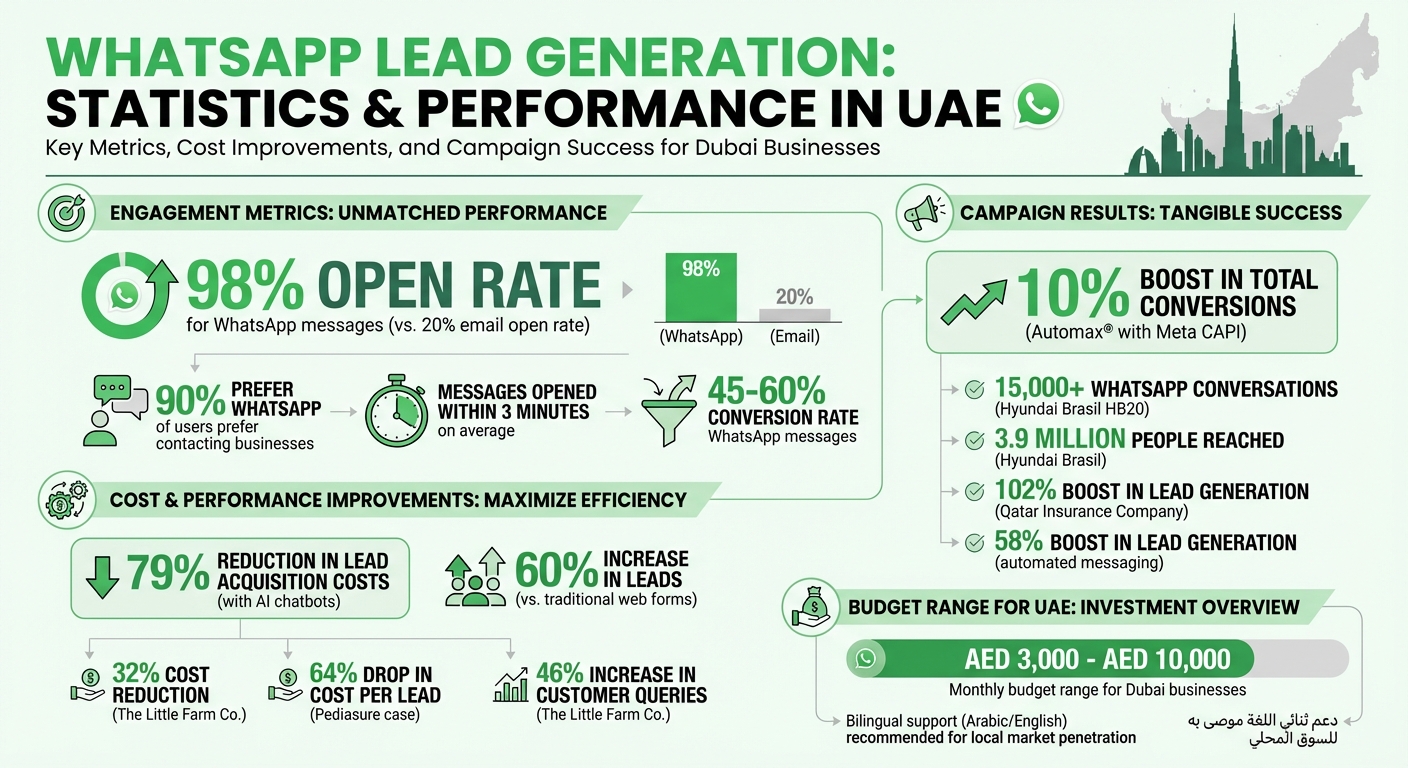
WhatsApp is no longer just a messaging app - it’s a powerful tool for businesses in the UAE to connect with high-intent leads. With a 98% open rate and 90% of users preferring to contact businesses via WhatsApp, it’s clear why companies are shifting their focus to this platform. Here’s how businesses in Dubai, Abu Dhabi, and Sharjah are leveraging WhatsApp to drive leads and cut costs:
- Click-to-WhatsApp Ads: Simplifies lead generation by letting users connect instantly. Businesses using these ads with AI chatbots have reduced lead costs by up to 79%.
- Track WhatsApp button clicks on your website: Placed on high-intent pages, these buttons convert interested users into conversations, with conversion rates as high as 60%.
- QR Codes: Bridges offline and online interactions, allowing users to start WhatsApp chats by scanning codes on storefronts, receipts, or event banners.
- Lead Magnets with WhatsApp Integration: Replacing traditional forms, this allows users to access resources like brochures or price lists instantly while verifying contact details.
- Automated Lead Qualification: Chatbots handle initial queries, collecting key details and passing only qualified leads to agents, saving time and boosting efficiency.
Using tools like the WhatsApp Business API and WAConversionTracking, businesses can track conversations, integrate with CRMs, and optimise campaigns through Google Ads. Whether it’s bilingual messaging or instant responses, WhatsApp is helping UAE businesses achieve better results with budgets starting as low as AED 3,000.
WhatsApp isn’t just a communication tool - it’s a lead generation game-changer.
WhatsApp Lead Generation Statistics and Performance Metrics for UAE Businesses
1. Run Click-to-WhatsApp Ads in Your Paid Campaigns
Effectiveness in Generating High-Quality Leads
Click-to-WhatsApp ads remove the hassle of contact forms, letting users connect with businesses instantly through a single click. This simplicity delivers results: companies combining WhatsApp ads with AI chatbots have seen a 60% increase in leads compared to traditional web forms, while cutting lead acquisition costs by up to 79%.
For example, in 2024, Automax® - an automotive brand - used the Meta Conversions API (CAPI) through respond.io to link WhatsApp conversations directly to sales. This approach led to a 10% boost in total conversions, as it allowed ad platforms to focus on users most likely to make a purchase. Similarly, Hyundai Brasil's Click-to-WhatsApp campaign for the HB20 model reached 3.9 million people and generated over 15,000 WhatsApp conversations.
Ease of Implementation for UAE Businesses
Setting up Click-to-WhatsApp ads on Meta or Google is straightforward. In Dubai, a monthly budget of AED 3,000 to AED 10,000 is typical, with the higher end supporting larger campaigns that provide more actionable data for optimisation. However, speed is critical - responding within minutes during working hours is essential to meet UAE consumers' demand for immediate communication. Delays can push potential leads toward competitors.
For businesses managing high chat volumes, the WhatsApp Business API is a game-changer. Unlike the standard WhatsApp Business app (which caps contact lists at 256), the API supports unlimited messaging, integrates with CRMs, and enables 24/7 AI-driven chatbots. For instance, in 2025, TMV Dongbang clinic automated 95% of after-hours consultations using a WhatsApp chatbot. This system helped the clinic generate 34% of its total leads, with 11% identified as high-quality.
To maximise results, integrate precise tracking tools to monitor and optimise campaigns effectively.
Compatibility with Google Ads and WAConversionTracking
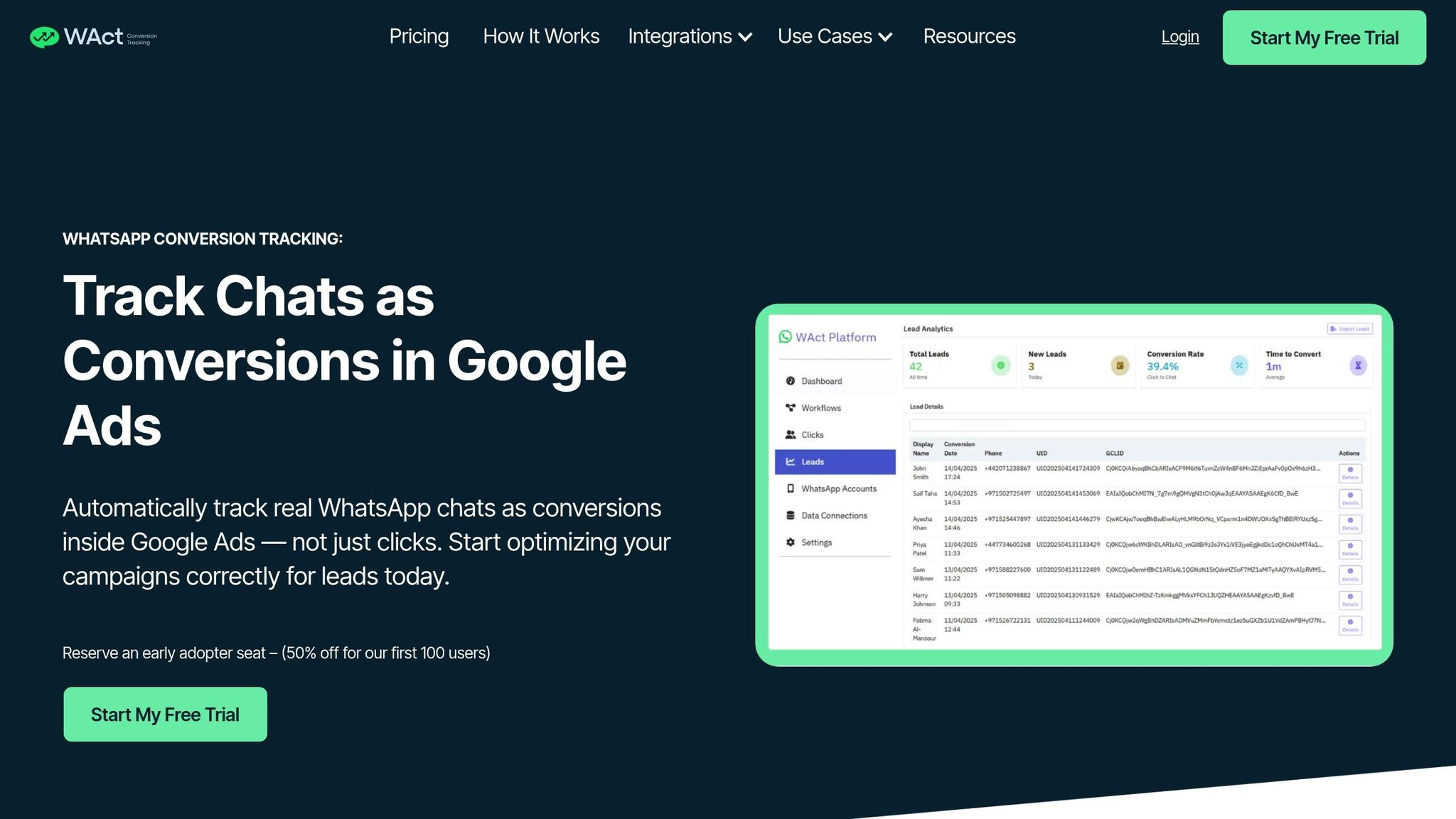
Tracking has always been a challenge for Click-to-WhatsApp ads. A button click doesn’t necessarily mean a genuine conversion. WAConversionTracking addresses this by logging actual WhatsApp conversations and capturing details like GCLID and UTM parameters. These insights are then sent back to Google Ads, helping Smart Bidding focus on high-intent leads rather than simple clicks.
To further refine tracking, include unique references (e.g., ref=campaign_name) in your ads. This allows you to pinpoint which campaigns are driving conversations. Such detailed tracking cuts unnecessary spending and helps you double down on what’s working.
Beyond technical strategies, adapting your ads to connect with the UAE’s bilingual audience can significantly improve engagement.
Localisation for Bilingual (Arabic/English) Audiences
To resonate with UAE audiences, use culturally relevant greetings like "Salam" and tailor your messaging around key UAE holidays. For video ads, include large text and subtitles in both Arabic and English, as many users watch videos without sound. You can also combine languages in the same message (e.g., "English / العربية") or test separate A/B campaigns for each language to ensure inclusivity. This thoughtful localisation helps build trust and engagement with diverse audiences.
2. Add WhatsApp Buttons to High-Intent Pages on Your Website
Effectiveness in Generating High-Quality Leads
Adding WhatsApp buttons to high-intent pages - like pricing, service, or product pages - can be a game-changer. These pages attract users who are already interested, and a WhatsApp button provides a quick, one-tap way to start a conversation. It’s far more user-friendly than traditional web forms, which often require multiple fields and can turn users away.
The numbers back this up. Conversion rates for WhatsApp messages typically range between 45% and 60%. For example, in November 2025, The Little Farm Co. swapped a US$30,000 campaign for WhatsApp engagement. The result? Customer queries increased by 46%, all while cutting costs by 32%. Similarly, Pediasure saw a 64% drop in cost per lead after shifting to WhatsApp-based channels.
"WhatsApp is one of the most used apps in the UAE. People trust it, use it daily, and often prefer to talk there instead of filling forms or sending emails." - Viral Agency UAE
For businesses in the UAE, where personal connections and real-time interactions are highly valued, a "Chat Now" button on a pricing page can make all the difference. It allows potential customers to ask questions, negotiate terms, or get instant clarifications, making the buying process smoother and more personal.
Ease of Implementation for UAE Businesses
The good news? Adding WhatsApp buttons to your website is straightforward and doesn’t require technical expertise. By using simple wa.me links with pre-filled messages (e.g., "I'm interested in the [Product Name] on this page"), you can instantly identify where the lead is coming from. Place these buttons strategically on high-intent pages like checkout pages, contact forms, or service landing pages to capture users when they’re most engaged.
For businesses juggling multiple chats, integrating the WhatsApp Business API with CRMs like HubSpot, Zoho, or Salesforce can make a huge difference. This ensures every conversation is logged automatically, making follow-ups seamless. Features like WhatsApp Flows can also allow users to book appointments or fill out forms directly within the chat, keeping the interaction inside the app.
In the UAE market, speed is everything. Automated greeting messages can direct leads to the right agent instantly, and responding within minutes during business hours is crucial.
Compatibility with Google Ads and WAConversionTracking
One common challenge with tracking WhatsApp interactions is that traditional methods often only measure button clicks, not actual conversations. WAConversionTracking solves this by capturing real WhatsApp chats, along with GCLID and UTM parameters, and syncing them back to Google Ads. This enhances Click-to-WhatsApp ad strategies (discussed earlier in Section 1) by feeding Smart Bidding with accurate data for better lead optimisation. Metrics like "cost per qualified chat" and "chat completion rates" can also help fine-tune button placement and messaging.
Localisation for Bilingual (Arabic/English) Audiences
In a diverse market like the UAE, bilingual support is essential. Ensure your WhatsApp setup caters to both Arabic and English speakers. This could mean creating separate automated flows or training agents to handle both languages fluently. A verified WhatsApp Business profile with a clear brand name, logo, and operating hours in both languages can further build trust and prevent losing valuable leads due to language barriers.
3. Use QR Codes to Connect Offline Audiences to WhatsApp
Turning Offline Interactions into High-Quality Leads
QR codes are a simple yet effective way to connect offline audiences directly to WhatsApp, making them a valuable tool for lead generation. Just like Click-to-WhatsApp ads or website buttons, they streamline the process - this time from physical spaces. In the UAE, where malls, storefronts, business cards, event banners, and metro stations see heavy foot traffic, QR codes provide a seamless way to bridge offline and online interactions. With a quick scan, users can skip the hassle of manually saving numbers.
For example, Qatar Insurance Company collaborated with Gallabox in 2025 to automate lead qualification through WhatsApp. This initiative led to a 102% boost in lead generation and a 31% improvement in employee productivity. Similarly, a marketing agency in Hong Kong used unique QR codes on billboards across various MRT stations to track which locations delivered the most valuable leads using a WhatsApp lead tracking planner. These examples highlight how QR codes can effectively convert offline engagements into actionable leads.
Simple Setup for UAE Businesses
Setting up QR codes is straightforward, even for businesses with limited technical expertise. You can generate free QR codes directly within the WhatsApp Business App by navigating to Settings > Business Tools > Short Link. For companies looking for more advanced options, platforms like QR Tiger, Unitag, or VistaPrint offer branded and trackable QR codes. While static QR codes are free and permanent, dynamic QR codes allow you to update destination links and monitor scan data.
To maximise their effectiveness, customise each QR code with pre-filled messages tailored to specific locations. For instance, a QR code on a receipt at a Dubai Mall store could open WhatsApp with a message like, "Hi, I’m at the Dubai Mall branch and would like more information." Similarly, a code used in Abu Dhabi could include a localised greeting. Pair this with automated replies via the WhatsApp Business API to create a system that operates 24/7.
Enhanced Tracking with Google Ads and WAConversionTracking
QR codes not only simplify offline-to-online connections but also integrate seamlessly with tools like WAConversionTracking. By funnelling offline leads into WhatsApp and syncing data with your CRM, businesses can gain detailed insights into performance. WAConversionTracking further bridges the gap by linking WhatsApp interactions to Google Ads campaigns. This integration enables businesses to optimise campaigns with precision, ensuring that every lead - whether online or offline - contributes to a comprehensive WhatsApp conversion strategy.
Catering to Bilingual Audiences in the UAE
Given the UAE’s diverse population, offering bilingual support is crucial. Create separate QR codes for Arabic and English audiences, each triggering greetings in the appropriate language. To build trust and encourage scans, incorporate your logo and brand colours into the QR code design. Adding clear calls-to-action, such as “Scan to get 10% off your first order” or “Scan for an instant quote,” can further drive engagement. This approach ensures that your QR codes resonate with a wide audience while maintaining a professional and approachable image.
4. Embed WhatsApp Contact Options in Lead Magnets and Funnels
Effectiveness in Generating High-Quality Leads
Taking WhatsApp integration a step further, embedding contact options directly into lead magnets can simplify the lead capture process. Traditional lead magnets often rely on lengthy forms, which can discourage potential leads. By adding WhatsApp contact options, businesses can offer instant access to resources like PDF brochures, price lists, or property tour schedules with just one click. This not only provides immediate value but also verifies phone numbers for follow-up automatically.
This strategy works particularly well in the UAE, where real-time communication is highly valued. Replacing form-heavy funnels with WhatsApp-driven ones has helped businesses cut marketing costs by over 30%, as they no longer need to rely on complex landing pages.
"WhatsApp messages are opened almost instantly. Most users open messages within the first 3 minutes of receiving them. For any lead generation company, this high engagement rate makes WhatsApp a goldmine." – Socio
Ease of Implementation for UAE Businesses
Setting up WhatsApp-based funnels is straightforward and doesn't require advanced technical skills. The Quick Replies feature in the WhatsApp Business App can handle common UAE-specific questions about pricing, location, or availability with ease. For more advanced setups, businesses can use hybrid automation. Chatbots can collect basic details - like name, service interest, and budget - before connecting high-priority leads to live agents.
In Dubai, companies can run WhatsApp-focused lead generation campaigns on budgets ranging from AED 3,000 to AED 10,000 per month. Integrating WhatsApp with CRMs like HubSpot, Zoho, or Salesforce ensures seamless lead tracking and follow-up, making the entire process smoother.
Compatibility with Google Ads and WAConversionTracking
While standard WhatsApp links don’t natively support UTM parameters, WAConversionTracking can bridge this gap. It captures WhatsApp chats along with GCLID, UTM data, and other metadata, feeding this information into Google Ads. This helps Google Ads agencies refine Smart Bidding strategies and reduce wasted ad spend.
For better tracking, consider using a bridge page with a WhatsApp widget. This ensures conversion tags and UTM parameters are recorded before users enter the encrypted chat environment. Alternatively, pre-filled messages with trackable keywords (e.g., "I'm interested in the Google Search offer") can help identify specific funnel sources.
Localisation for Bilingual (Arabic/English) Audiences
To cater to the UAE's bilingual market, configure chatbots to offer a language selection menu - like "Press 1 for Arabic, 2 for English" - or set them to detect the user’s preferred language automatically. When running campaigns, create separate ad sets with tailored content for Arabic and English audiences.
"In a region like the Middle East where dozens of languages are spoken... the ability to communicate in the language of your customer's choosing can really differentiate you from the competition." – Unifonic
For lead magnets such as e-books or white papers, include distinct WhatsApp contact buttons for Arabic and English versions. Using verified WhatsApp Business API accounts with green checkmarks enhances credibility and reduces the chance of messages being flagged as spam. This bilingual approach ensures a smooth and culturally considerate experience, helping businesses capture quality leads across Dubai, Abu Dhabi, and Sharjah.
sbb-itb-0a82e4d
5. Automate Lead Qualification with WhatsApp Business Tools
Effectiveness in Generating High-Quality Leads
Automation transforms WhatsApp into a round-the-clock lead qualifier. With chatbots, businesses can ask pre-set questions like budget preferences, timelines, or service needs. Only sales-ready leads are then passed on to human agents for follow-up. This approach works particularly well in the UAE, where customers expect quick responses, no matter the time.
WhatsApp boasts an impressive 98% open rate compared to email's 20%. Companies using automated messaging have seen a 58% boost in lead generation, with conversion rates ranging from 45% to 60% - far better than traditional methods.
A great example? In 2023, Heritage Foods launched a chat-based catalogue and subscription system via WhatsApp, which doubled their conversion rates. Now, let’s look at how UAE businesses can implement these tools with ease.
Ease of Implementation for UAE Businesses
Setting up automated lead qualification is straightforward. The WhatsApp Business API integrates seamlessly with popular CRMs like HubSpot, Zoho, and Salesforce, making it easy to connect with existing systems.
WhatsApp Flows offer a simple way to create step-by-step forms within the chat. Prospects can share details or select service options without leaving the app.
| Feature Comparison | WhatsApp Business App | WhatsApp Business API |
|---|---|---|
| Automation | Basic (Greetings/Quick Replies) | Advanced (Chatbots/Workflows) |
| CRM Integration | No | Yes (e.g., HubSpot, Zoho) |
| Multi-Agent Support | Limited | Full (Shared Inbox) |
| Lead Qualification | Manual | Automated (Flows/Bots) |
With these tools in place, let’s explore how they integrate with tracking systems for better campaign insights.
Compatibility with Google Ads and WAConversionTracking
Tracking the source of WhatsApp leads can be tricky since standard WhatsApp links don’t support UTM parameters. WAConversionTracking addresses this by capturing key data - like GCLID and UTM parameters - alongside WhatsApp chats. This data is then fed into Google Ads, enabling Smart Bidding to optimise campaigns based on actual conversations instead of just clicks.
For web traffic, chatbots can pull UTM parameters from URLs before redirecting users to WhatsApp. You can also assign unique keywords to specific entry points (e.g., "Interested_GoogleAd" or "Enquiry_QRCode") to track leads in your CRM. Additionally, automated goal blocks in chatbot flows can record specific behaviours during lead qualification.
Localisation for Bilingual (Arabic/English) Audiences
Adding bilingual capabilities to automated systems can significantly enhance engagement. Chatbots can either prompt users to select their preferred language or auto-detect it. For Click-to-WhatsApp campaigns, consider creating separate ad sets with tailored content for Arabic and English audiences to maximise reach.
"People in the UAE often look for personal contact when they are making a serious purchase or booking. A good balance is to use automation to collect basic details, then have a live agent step in." – Viral Agency UAE
Use Quick Replies to address common questions about pricing, locations, and availability in both languages. This hybrid approach - automation for initial interactions followed by human support for complex queries - respects the UAE’s preference for personal engagement while maintaining efficiency. Ensure your WhatsApp Business profile and "About" section are professional and bilingual to build trust with audiences across Dubai, Abu Dhabi, and Sharjah.
5 Ways To Build High Quality WhatsApp Lead List | Lead Generation
Conclusion
WhatsApp redefines lead generation by blending instant communication with precise tracking. With its unmatched open and conversion rates, it achieves results that traditional methods often struggle to deliver.
What truly sets WhatsApp apart is its ability to turn conversations into actionable data. Using advanced tracking tools like WAConversionTracking, businesses can capture essential details - such as GCLID and UTM parameters - from each chat. This data feeds directly into Google Ads, enabling Smart Bidding to optimise campaigns based on real conversations. The result? Better campaign performance, reduced wasted spend, and the ability to scale what works.
For businesses in Dubai, Abu Dhabi, and Sharjah, starting with a monthly budget of AED 3,000–10,000 is a smart move. Create bilingual workflows for both English and Arabic audiences, and ensure quick response times - most users open messages within three minutes. Track "message started" events as primary conversions in Meta Ads Manager and use labels to categorise chats by quality and intent. These steps provide a solid foundation for UAE businesses to unlock WhatsApp’s potential in lead generation.
FAQs
How can businesses in the UAE use WhatsApp to streamline lead management in their CRM systems?
Businesses in the UAE can connect WhatsApp with their CRM systems through the WhatsApp Business API, enabling features like automated messaging, real-time data syncing, and two-way communication. For instance, details such as contact information, opt-in timestamps, and conversation metadata can be securely transferred to the CRM. This creates a centralised lead record that updates automatically whenever a prospect interacts. Sales teams benefit by accessing full chat histories and logging follow-up actions directly within the CRM, which saves time and boosts efficiency.
To ensure compliance with UAE regulations, businesses must use a TDRA-approved WhatsApp Business number and obtain explicit opt-in consent before sending messages. Adding click-to-chat buttons or QR codes on websites, emails, and even physical stores is an effective way to engage potential customers. Using Arabic greetings where appropriate can help establish trust and strengthen connections. Additionally, data stored in the CRM should align with UAE standards, such as displaying currency in AED (e.g., AED 1,250.00), using the DD/MM/YYYY date format, and applying metric units and Celsius for measurements.
With WhatsApp’s impressive open rates (around 98%) and conversion rates ranging from 45% to 60%, integrating it with a CRM allows businesses in the UAE to qualify leads faster, automate follow-ups, and effectively track ROI. Tools like WAConversionTracking can further streamline this process by tagging WhatsApp-originated conversions directly in the CRM, ensuring an efficient and measurable lead management system.
How can WhatsApp QR codes help generate leads from offline channels?
WhatsApp QR codes are an excellent way to transform offline materials - like store displays, flyers, event badges, or print advertisements - into instant lead generation tools. When someone scans the QR code, it opens a pre-filled WhatsApp chat, making it incredibly easy for potential customers to share their contact information with a single tap. This seamless process allows you to collect leads instantly and engage with them directly on WhatsApp, a platform where communication is always voluntary and user-approved.
What makes this even more effective is the versatility of QR codes. You can print them on almost any offline medium, enabling you to track and connect offline interactions to your sales efforts. By feeding these interactions into a WhatsApp-driven sales funnel, you not only gather more leads but also turn those leads into measurable conversations that can boost conversions and drive sales. This approach ensures your offline efforts are not just impactful but also actionable.
How can UAE businesses effectively use WhatsApp to engage bilingual audiences?
To connect effectively with both English- and Arabic-speaking audiences in the UAE, it's essential to treat both languages with equal importance. Start communications with a bilingual header like English / العربية and ensure the content is available in both languages - either displayed side-by-side or sent in separate follow-up messages. For formal communication, use Modern Standard Arabic, while Gulf Arabic works best for casual, conversational tones.
Make sure all quick-reply buttons, automated greetings, and QR code prompts are accessible in both languages, allowing users to easily select their preference. When presenting numbers, dates, or prices, adhere to en-AE standards: use Arabic numerals with a comma for thousands and a period for decimals (e.g., AED 1,250.00), format dates as dd/mm/yyyy (e.g., 08/01/2026), and follow the 24-hour clock. Stick to metric units like kilograms and kilometres, and display temperatures in °C. Use British English spelling (e.g., colour, organise) and ensure Arabic text follows the standard right-to-left alignment.
Cultural awareness is crucial. Begin messages with a respectful Arabic greeting like السلام عليكم, avoid overly aggressive sales pitches, and be mindful of UAE holidays and prayer times. Take advantage of WhatsApp Business tools such as segmented broadcast lists, language-specific automated replies, and click-to-chat links to create a smooth, culturally considerate experience. This strategy not only respects local preferences but also leverages WhatsApp’s high open rates to generate leads effectively.