
Integrating WhatsApp with Google Ads is a challenge because the two platforms don’t share data. When someone clicks a Click-to-WhatsApp ad, the tracking information (like GCLID or UTM parameters) gets lost. This makes it impossible to measure real conversions, optimise campaigns, or accurately calculate ROAS.
Here’s why this happens and what’s at stake:
- WhatsApp and Google Ads operate on separate ecosystems (Meta vs. Google), so there’s no direct data exchange.
- Google Ads can track clicks but not what happens in WhatsApp - like messages sent, leads qualified, or sales completed.
- DIY tracking methods (like counting clicks or using spreadsheets) fail to provide reliable data and often lead to errors.
The solution? Tools like WAConversionTracking bridge this gap by:
- Tracking real WhatsApp conversations instead of just clicks.
- Preserving campaign data (like GCLID and UTM) through the WhatsApp deep link.
- Sending conversion data back to Google Ads in real time for smarter bidding.
For UAE businesses relying on WhatsApp to drive leads, this kind of integration is critical for aligning ad spend with actual results.
How Click to WhatsApp Campaigns Work (and Where the Data Gets Lost)
How Click to WhatsApp Campaigns Send Users to WhatsApp
Google Ads Message Assets allow you to include a WhatsApp call-to-action button directly in your search ads. When users click on it, they’re taken straight to WhatsApp, where a pre-written message pops up automatically for them to send. While this creates a smooth experience for users by bypassing the need to visit your website, it also creates a major issue: Google’s tracking tags can’t set cookies or capture conversion data when users skip your site. This streamlined process may improve engagement, but it leaves marketers with a gap in the data trail.
Why Attribution Breaks Down
Google Ads typically relies on the Google Click ID (GCLID) and UTM parameters to track conversions. These are normally stored in website cookies. However, when users click on the WhatsApp button, this data is lost, breaking the connection between the ad click and any conversions that follow. While it’s already been mentioned that GCLID and UTM data disappear during the switch to WhatsApp, the real problem lies in how this impacts tracking the actions that matter most - such as confirmed bookings, qualified leads, or sales - which often happen within WhatsApp itself.
For instance, Google Ads may log the initial "Conversation Started" event, but it doesn’t capture the more meaningful actions that occur after that. A good example of this issue emerged in March 2022 when a travel-focused tour operator discovered that counting every click on a WhatsApp button led to overly optimistic conversion data. Many of those clicks didn’t result in actual conversations or confirmed bookings, skewing the results.
This disconnect highlights a broader issue for marketers in the UAE: the difficulty of aligning ad spend with real conversion outcomes. Without a way to link WhatsApp conversations back to your Google Ads campaigns, it’s nearly impossible to identify which keywords are driving genuine sales or to determine which campaigns are delivering a return on investment. This missing data also makes it harder to use advanced bidding strategies like Target CPA or Maximise Conversions effectively. To close this gap, a specialised tracking solution is essential to bridge the divide between ad clicks and WhatsApp-driven results.
Google Ads Message Assets with WhatsApp
Why DIY WhatsApp Conversion Tracking Doesn't Work
DIY WhatsApp Tracking Methods vs Professional Solution Comparison
When campaign metadata gets lost during the transition to WhatsApp, many marketers resort to DIY solutions to track conversions. Unfortunately, these quick fixes often create more problems than they solve. Let’s break down why the most common approaches fall short.
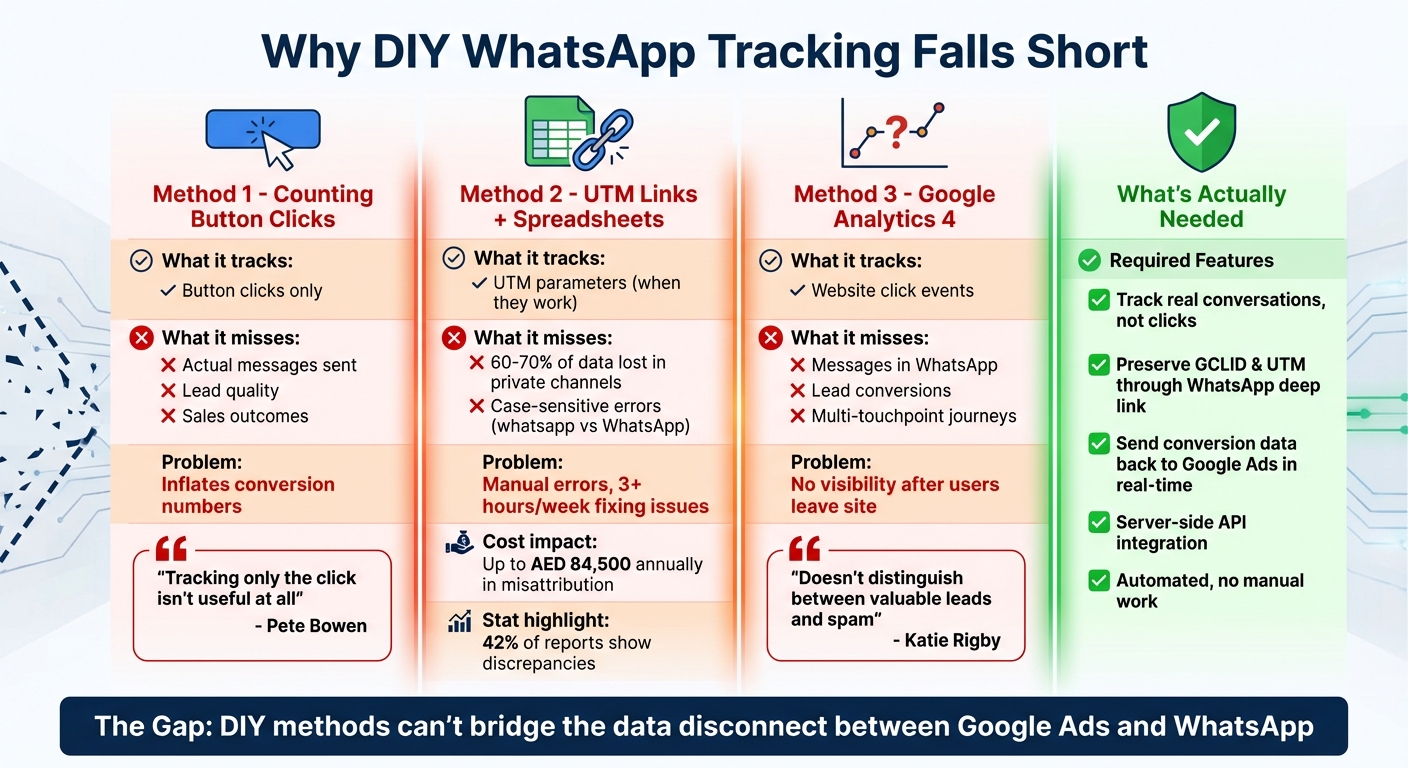
Method 1: Counting Button Clicks as Conversions
One of the simplest methods is to track every WhatsApp button click as a conversion. While this might seem logical, a click only shows interest - it doesn’t guarantee that a message was sent or a sale occurred. This approach inflates conversion numbers, leading to inaccurate data. As a result, automated bidding strategies end up optimising for clicks rather than actual business outcomes.
"Tracking only the click on a WhatsApp button (the only built-in thing you can track with Google Ads) isn't useful at all. Tracking the click doesn't tell you what happened afterward. Did the person send a message? Were they a good fit for the business? Did they turn into a sale? How much was the sale worth?"
- Pete Bowen
Method 2: Using UTM-Tagged Links and Manual Spreadsheets
Another common workaround is adding UTM parameters to WhatsApp links and manually logging leads into spreadsheets. However, these UTM parameters often get stripped during the switch from a browser to WhatsApp. This, combined with the manual nature of spreadsheets, makes the process prone to errors and inconsistencies.
With 60–70% of social sharing happening through private channels, campaign metadata frequently goes missing. On average, marketing teams spend over three hours each week fixing UTM issues, and 42% of campaign reports show significant discrepancies. The case-sensitive nature of UTMs (e.g., "whatsapp" vs. "WhatsApp") only adds to the confusion. Without standardised practices, companies risk misattributing marketing spend - an issue that could cost organisations up to AED 84,500 annually.
Method 3: Tracking Click Events with Google Analytics
Google Analytics 4 (GA4) can track WhatsApp button clicks on your website, but it doesn’t go beyond that. Once users leave your site and open WhatsApp, GA4 loses visibility. You won’t know if a message was sent, let alone if the lead converted. If these click events are imported into Google Ads as conversions, you’ll end up optimising for clicks instead of meaningful leads.
"For one, it doesn't distinguish between a valuable sales lead and a spam call. More importantly, it doesn't help if the lead converts days or weeks later, after multiple offline touchpoints. GA4 simply doesn't have the ability to connect those dots."
- Katie Rigby, Ruler Analytics
Why All DIY Solutions Fall Short
Without a direct way to transfer data, tracking actual WhatsApp conversions becomes impossible. DIY methods fail to bridge this gap, making it difficult to determine which campaigns truly contribute to revenue. A specialised, automated solution is the only way to gain accurate insights.
sbb-itb-0a82e4d
What a Working WhatsApp Conversion Tracking Solution Needs
To overcome the limitations of DIY tracking, an effective WhatsApp conversion tracking solution must tick three crucial boxes.
Track Real Conversations, Not Just Clicks
An effective solution needs to go beyond tracking clicks and focus on actual WhatsApp messages. It should identify meaningful conversion events like lead submissions, qualified enquiries, or completed purchases. This means analysing the content of messages to pinpoint specific conversion actions and distinguishing between conversation types - whether it's service-related, marketing-focused, or for authentication. Additionally, it must accurately log messages sent, received, and delivered.
If you're only optimising for clicks, you're missing the bigger picture: meaningful business outcomes.
Preserve Campaign Data Through the WhatsApp Deep Link
To measure performance effectively, the solution must retain critical metadata - such as GCLID, UTM parameters, and ctwa_clid - from the moment a user clicks on an ad through to the WhatsApp conversation. Retaining this data ensures you can trace every WhatsApp lead back to its original campaign.
Once this attribution data is preserved, the next step is to integrate these insights into Google Ads for precise optimisation.
Send Conversion Data Back to Google Ads
A complete solution doesn’t just track conversions - it feeds that data back into Google Ads in real time using server-side integration. This involves sending conversion events - complete with values in AED - directly via API. When Google Ads receives this data, its Smart Bidding algorithms can focus on optimising for leads and sales, rather than superficial interactions. This is particularly important for advanced bidding strategies like Target ROAS or Maximise Conversion Value.
For example, in 2025, platforms like Wati.io showcased this functionality by capturing conversations from Google Click-to-Message ads and sending conversion events, such as qualified leads and purchases, back to Google Ads for optimisation.
This seamless data loop turns WhatsApp interactions into actionable insights, ensuring your ad spend delivers measurable business results.
How WAConversionTracking Solves the Problem
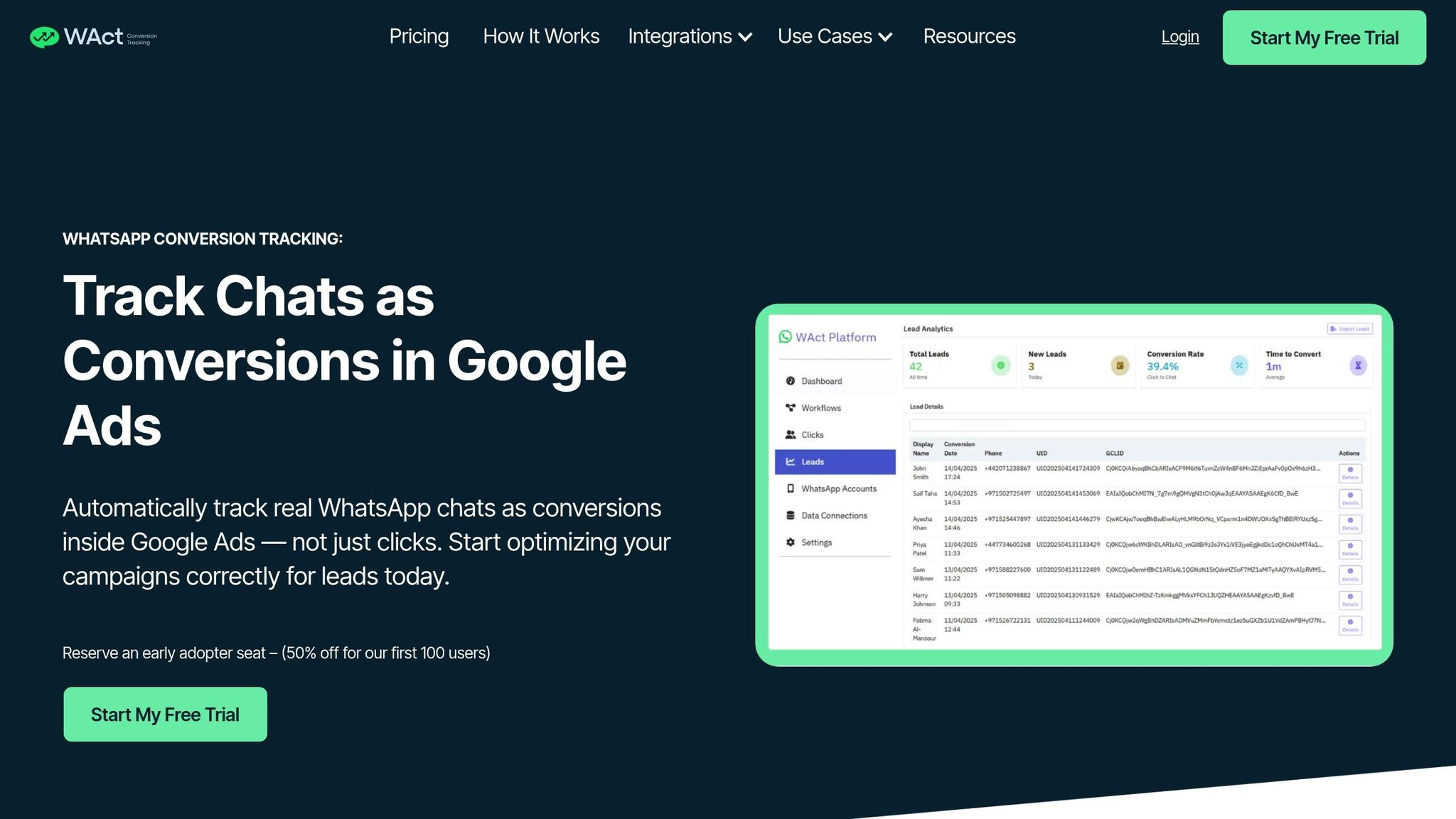
WAConversionTracking bridges the gap between Google Ads and WhatsApp, turning WhatsApp interactions into actionable conversion data. Here's how it works.
Tracking Real WhatsApp Chats as Conversions
WAConversionTracking doesn't just count button clicks - it tracks the first user-initiated WhatsApp message as a conversion. This ensures you’re capturing genuine interest, like when someone messages, “I’d like to know more about your product” or “What’s the price?” rather than clicks that don’t lead to meaningful engagement. This approach directly addresses the limitations of traditional click-based attribution.
The tool uses advanced analysis to identify key events within conversations. For instance, Meta’s Automatic Events API, introduced in November 2025, can detect events like "LeadSubmitted" or "Purchase" based on message content. If a business replies with something like “Your tracking number is AB123456789BR,” the system logs it as a "Purchase" event.
Automatic Metadata Capture and Attribution
WAConversionTracking automatically links important identifiers - such as GCLID, UTM parameters, and ctwa_clid (Click-to-WhatsApp Click ID) - to each WhatsApp conversation. The ctwa_clid is retrieved via the WhatsApp Business Platform’s Messages webhook, allowing the tool to trace each conversation back to the original ad click. This seamless process ensures campaign data is preserved throughout the customer journey, solving the problem of lost attribution.
Everything is automated, so every lead is accurately tied to its source campaign, ad group, and keyword, giving you a complete picture of your ad performance.
Server-Side Conversion Uploads
Once a conversion is logged, WAConversionTracking sends the event - calculated in AED - directly to Google Ads via a server-side API. This real-time integration feeds precise conversion data into Google’s Smart Bidding algorithms, enabling strategies like Target ROAS and Maximise Conversion Value to focus on leads and sales instead of just clicks.
"Messaging events should only represent customer interactions that occur in the messaging thread, not conversions that occur on other channels like websites." - Meta for Developers
This setup helps optimise ad spend by prioritising campaigns that drive actual business results, making it especially effective for UAE-based marketers.
Designed for UAE Marketers and Agencies
WAConversionTracking is built with ease of use in mind - no coding required. You can generate a tracking script with a single click, add it to your website, and start tracking immediately. The tool supports AED currency formatting, integrates effortlessly with Google Sheets and CRMs, and is tailored for bilingual teams managing both English and Arabic conversations. Whether you’re a small business or an agency juggling multiple client accounts, WAConversionTracking scales to fit your needs perfectly.
Conclusion: Why Accurate WhatsApp Conversion Tracking Matters
If you're running Google Ads in the UAE and using WhatsApp to capture leads, tracking just button clicks won't give you the full picture of customer interactions. DIY methods - like counting clicks, managing UTM-tagged links in spreadsheets, or logging events in Google Analytics - fall short because they only track website clicks, not the actual WhatsApp conversations that lead to conversions. These approaches overlook in-thread interactions (messages exchanged within WhatsApp) and off-thread events (actions users take after leaving the app).
Proper attribution requires advanced integrations and technical know-how that many businesses simply don't have. Additionally, the basic metrics provided by the WhatsApp Business Platform lack the depth needed to fine-tune campaigns for meaningful results.
Accurate tracking is the backbone of successful WhatsApp ad campaigns. By attributing real conversations to your ads, you can pinpoint which ads, keywords, and audiences are driving conversions - whether it's purchases, sign-ups, or demo requests. This insight helps lower Customer Acquisition Costs (CAC), boost Customer Lifetime Value (CLV), and ensure every dirham spent on advertising delivers measurable value.
WAConversionTracking turns WhatsApp chats into actionable data, feeding Google's Smart Bidding algorithms with precise signals. This ensures your campaigns focus on real business outcomes rather than vanity metrics.
For marketers in the UAE, where WhatsApp is a key driver for leads, bridging the gap between Google Ads and WhatsApp isn't just helpful - it’s essential for scaling success and achieving tangible ROI.
FAQs
How does WAConversionTracking help boost WhatsApp ad results?
WAConversionTracking makes it easier to monitor and enhance your WhatsApp ad campaigns by directly connecting in-chat conversions to your ad performance. With real-time insights into user interactions, it helps you pinpoint what sparks engagement and leads to conversions.
Unlike typical DIY approaches that might overlook in-chat actions or misattribute conversions, WAConversionTracking ensures accurate tracking and optimised campaign results. This allows you to make informed decisions, boost your return on investment (ROI), and maximise the impact of your ad budget in the UAE market.
Why is tracking WhatsApp conversions with Google Ads so challenging?
Tracking WhatsApp conversions through Google Ads can be tricky because there’s no straightforward way to measure what customers actually do after clicking. Sure, you can track how many people click on the WhatsApp button, but those numbers often don’t tell the full story. They can be misleading, as they don’t show whether those clicks turned into real conversations, leads, or sales.
Relying on basic methods like tracking clicks only gives you part of the picture. You miss out on what happens after someone starts a chat - whether they became a lead or made a purchase. This lack of insight makes it hard to fine-tune your campaigns for better results. That’s where tools like WAConversionTracking come in. They help you go beyond clicks, offering accurate data on WhatsApp leads and conversions so you can make smarter decisions.
Why don’t DIY methods work well for tracking WhatsApp ad conversions?
Tracking WhatsApp ad conversions with DIY methods often proves unreliable due to a mix of technical and practical hurdles. Issues like pinpointing user origins, dealing with encryption, and managing message encoding can make these approaches inconsistent. For instance, using unique identifiers in messages might seem like a solution, but it can come across as intrusive, get filtered out, or simply fail to deliver dependable results.
Another major drawback is the lack of integration with analytics platforms, which makes it tough to gather accurate, real-time data. Without a dedicated tool like WAConversionTracking, these methods fall short on scalability and fail to meet essential privacy standards - both critical for secure and efficient WhatsApp conversion tracking.