
WhatsApp is transforming how businesses generate leads, especially in the UAE. With over 3 billion global users and 98% message open rates, it’s a powerful tool for reaching customers. UAE consumers now prefer WhatsApp over emails or web forms, making it essential for industries like real estate, automotive, clinics, and education. Here’s a quick breakdown of the most effective WhatsApp strategies:
- Click-to-WhatsApp Ads: Use Meta Ads Manager to create ads that drive users directly to WhatsApp chats.
- Website WhatsApp Buttons: Add buttons on key pages like pricing or checkout to enable instant communication.
- QR Codes: Bridge offline and online engagement by placing WhatsApp QR codes on physical and digital materials.
- Lead Magnets: Offer discounts or exclusive content to encourage WhatsApp opt-ins.
- Automated Bots: Use chatbots to reply instantly, qualify leads, and handle routine queries.
- Follow-Up Campaigns: Send timely WhatsApp messages to nurture leads and boost conversions.
- Conversion Tracking: Tools like WAConversionTracking link WhatsApp chats to ad platforms for better ROI tracking.
- CRM Integration: Sync WhatsApp with CRMs like HubSpot or Salesforce to manage leads efficiently.
- Bilingual Messaging: Cater to both Arabic and English speakers with tailored communication.
- Multimedia Content: Use images, videos, and voice notes to engage and convert leads.
Businesses in Dubai, Abu Dhabi, and Sharjah are already seeing impressive results, with WhatsApp campaigns achieving conversion rates of 45%-60% and reducing lead costs by up to 64%. Whether it’s through Click-to-WhatsApp ads, automated bots, or bilingual messaging, these strategies can help you connect with customers and drive meaningful conversations.

10 WhatsApp Lead Generation Strategies for UAE Businesses
3 WhatsApp Lead Generation Hacks for Fast Success | SleekFlow 2.0 Guide
1. Click-to-WhatsApp Ads on Facebook and Instagram
To set up Click-to-WhatsApp ads in Meta Ads Manager, start by selecting Leads as your campaign objective. Then, in the Conversion section, choose WhatsApp, link your Facebook Page to your WhatsApp Business number, which may require a WhatsApp Business API setup for advanced tracking, and prepare a pre-filled message template like, "I'm interested in the price list".
For audiences in the UAE, it's a good idea to run separate campaigns in both English and Arabic, testing each to see which performs better. Since many users browse without sound, use vertical videos with on-screen text and subtitles. Ensure your creative highlights WhatsApp in the call-to-action, such as "Message us to check availability," so users know what to expect.
When tracking performance, use Meta Ads Manager to monitor metrics like cost per click and cost per message started using a WhatsApp lead tracking planner. Additionally, rely on your CRM or WhatsApp manager to track qualified leads and conversions. Focus on the cost per qualified chat - this means measuring chats that meet specific criteria, not just general inquiries. This approach ensures you're not just generating leads but generating the right leads.
A great example comes from Hyundai Brasil, which used Click-to-WhatsApp ads in August 2023 to promote their HB20 car model. The campaign reached 3.9 million people and initiated over 15,000 WhatsApp conversations through a chatbot assistant.
"Click-to-WhatsApp ads can nearly double your engagement rates while reducing your marketing costs by 30% (or more)." – Ram Shengale, Founder & CEO, WANotifier
Timely responses are critical. Aim to reply within minutes during working hours to keep leads warm. Meta offers a 72-hour free conversation window after a user messages you from an ad. Use this time wisely to qualify leads, answer their questions, and secure their opt-in for future updates.
2. WhatsApp Buttons on Websites and Landing Pages
Adding WhatsApp buttons to strategic areas like pricing, product details, checkout, or even error pages can transform user frustration into instant communication opportunities. This approach complements dynamic ad strategies, helping to increase lead conversions effectively.
Consider using floating widgets that stay visible as users scroll. These widgets can pass page-specific data, allowing your team to respond with precise, informed answers. In the UAE, it’s a great idea to include an Arabic/English language selection option to ensure users are routed appropriately.
Pre-filled messages with unique keywords can also make interactions seamless while helping you track leads. For example, a button on the pricing page could auto-fill with "I'm interested in the Premium package" or, in Arabic, "مرحباً، أود معرفة المزيد عن خدماتكم".
"A WhatsApp widget acts as a direct hotline - ready to answer product queries, handle objections, or close sales instantly." – QuickReply.ai
To take it a step further, link the WhatsApp button to a chatbot that captures UTM variables and uses "Goal Blocks" to log key actions like email submissions or quote requests. Tools like WaliChat and SendPulse make this process smoother, with some setups reportedly boosting lead qualification conversion rates by up to 30%.
3. QR Codes for Physical and Digital Channels
In the UAE, where WhatsApp is a preferred communication tool, QR codes play a key role in bridging the gap between offline and online engagement. These codes make it effortless for businesses to connect with potential customers by directing them straight to a WhatsApp chat. Imagine placing QR codes on business cards, storefront posters, restaurant menus, product packaging, or event booths - this approach can turn casual foot traffic into meaningful conversations. The process is straightforward: scan the code, tap to open WhatsApp, and start chatting. This instant connection simplifies lead generation and keeps the conversation flowing.
Take Starbucks India as an example. They used a WhatsApp QR code on their Instagram feed to encourage followers to join the Starbucks Rewards programme. By scanning the code, users were guided by a WhatsApp chatbot through the registration process, receiving personalised offers along the way. This shows how QR codes can effectively integrate physical and digital channels to enhance customer interaction.
Creating your own WhatsApp QR code is easy with tools like GenQRCode, Walink, or Respond.io. Simply input your WhatsApp number and include a pre-filled message, such as "I'd like to know more about your services" or its Arabic equivalent. This small step reduces barriers for customers and helps you track leads more effectively.
For even greater flexibility, dynamic QR codes are worth considering. Services like Walink offer branded URLs (e.g., wa.link/YourBrand), real-time click analytics, and the ability to update your phone number or message without reprinting materials - all for about AED 22 per year (approximately $6). To boost engagement, pair your QR code with clear incentives like "Scan to get 10% off your first order", and use UTM parameters to track which campaigns are driving the most traffic.
With WhatsApp messages boasting an open rate of 98% compared to just 20% for traditional email, QR codes have become indispensable in industries like real estate, clinics, and automotive. In cities such as Dubai, Abu Dhabi, and Sharjah, businesses are using these codes to seamlessly transition potential customers from offline browsing to immediate conversations and negotiations.
4. Lead Magnets and Incentive-Based Opt-Ins
Lead magnets are a powerful way to turn interest into meaningful WhatsApp conversations, especially in the UAE, where WhatsApp messages boast an impressive 98% open rate. The idea is simple: offer something your audience truly values in exchange for their contact details. Think discount codes, free consultations, or exclusive content.
Here are some ideas that work particularly well:
- WhatsApp-only flash sales offering discounts between 10–30%.
- Complimentary services, such as free skin analyses or business setup consultations.
- Bilingual resources, like guides or eBooks in Arabic and English.
- Exclusive VIP group access, creating a sense of community and privilege.
To make the opt-in process seamless, consider using Click-to-WhatsApp ads with pre-filled messages like, "I’d like to claim my 10% discount". You can also embed wa.me links across your digital platforms and use UTM parameters to track campaign performance.
Cultural alignment is key. For example, tailor your campaigns around Ramadan or Eid, and always provide language options in Arabic and English. Hospitality-driven incentives, such as inviting prospects for a complimentary consultation, resonate strongly in the region. Don’t forget to obtain clear consent to comply with UAE data privacy regulations.
To maximise results, monitor how many opt-ins convert into sales by integrating your CRM. WhatsApp chatbots, for instance, have been shown to boost lead generation by up to 138%, with conversion rates ranging from 45% to 60%. Automating welcome messages can also ensure the promised incentive is delivered instantly.
5. Automated Welcome Messages and Qualification Bots
When it comes to Click-to-WhatsApp campaigns, speed is everything. Quick responses on WhatsApp can make or break conversions. In fact, leads who get a relevant reply in under a minute are far more likely to convert compared to those who wait longer.
To ensure lightning-fast replies, set up an automated bot. Platforms that support the WhatsApp Business API, like BotPenguin, Flowcart, Typebot, and Respond.io, allow you to design conversational flows without any coding. You can program your bot to greet users and ask 1–3 targeted questions right away - questions like budget, timeline, or specific needs. This helps qualify leads almost instantly. A great example is iMotorbike in Malaysia, which used Respond.io's AI Agents in 2025 to automate routine queries. Their bot handled 70% of conversations, doubling their daily lead capacity and cutting response times by 67%.
Once the initial engagement is complete, scoring leads can sharpen your strategy even further. Assign points based on the type of enquiry - say, 3 points for pricing-related questions and 1 point for general queries. This approach helps prioritise high-value leads. For instance, a UAE-based automotive retailer saw a 42.5× ROI on broadcasts and a 10% improvement in ad conversions by integrating Meta's Conversion API with their bot.
For the UAE market, tailoring your bot to local preferences is crucial. Bilingual automation is a must - platforms like BotPenguin support over 60 languages. Start conversations by letting users pick between Arabic and English. To make interactions feel more human, include short delays of 2–5 seconds between messages to simulate natural typing. Also, provide a "human escape option" by allowing users to type keywords like "agent" or "help" to connect with a real person.
Finally, integrate your bot with your CRM system. This ensures contact details, lead sources, and qualification scores flow directly into your sales pipeline. With bots handling up to 80% of routine enquiries, businesses can cut customer service costs by 30–50%. To see how these efficiencies impact your bottom line, use a WhatsApp API cost calculator to estimate your potential savings.
6. Follow-Up Campaigns and Message Sequences
Turn initial interest into tangible results with well-timed follow-up messages. WhatsApp messages have an impressive open rate of around 98%, far surpassing email's average of 20%. By sending timely and relevant follow-ups, you're ensuring your messages actually get noticed.
A simple three-step sequence works wonders: share educational content on Day 1, follow up with a pricing summary on Day 3, and finish with a direct offer on Day 5. This approach keeps you visible without bombarding potential customers. For the UAE audience, it's crucial to offer bilingual communication - both English and Arabic should be available from the outset. In fast-paced markets like Dubai, where buying decisions often jump from social media to chat, quick responses are key. Leads typically expect replies within minutes during business hours.
Automation tools like respond.io and Flowcart make it easy to build these sequences with workflows or journey builders. For example, Automax, a UAE-based automotive retailer, used respond.io's AI Agents and workflows to handle 6,000–8,000 WhatsApp leads monthly in 2025. Their structured follow-ups and broadcasts delivered a stunning 42.5× ROI and increased ad conversions by 10% through Meta's Conversion API.
To avoid overwhelming your audience, limit automated messages to two per week. If a lead goes completely silent, wait about three weeks before sending a casual reactivation message. Always include a clear opt-out option to minimise spam complaints.
Finally, keep improving your campaigns by tracking response rates and identifying where leads drop off in your sequences. Analysing this data helps you fine-tune your approach. Up next, we'll explore the tools and integrations that can take your WhatsApp lead generation to the next level.
sbb-itb-0a82e4d
7. Conversion Tracking with WAConversionTracking
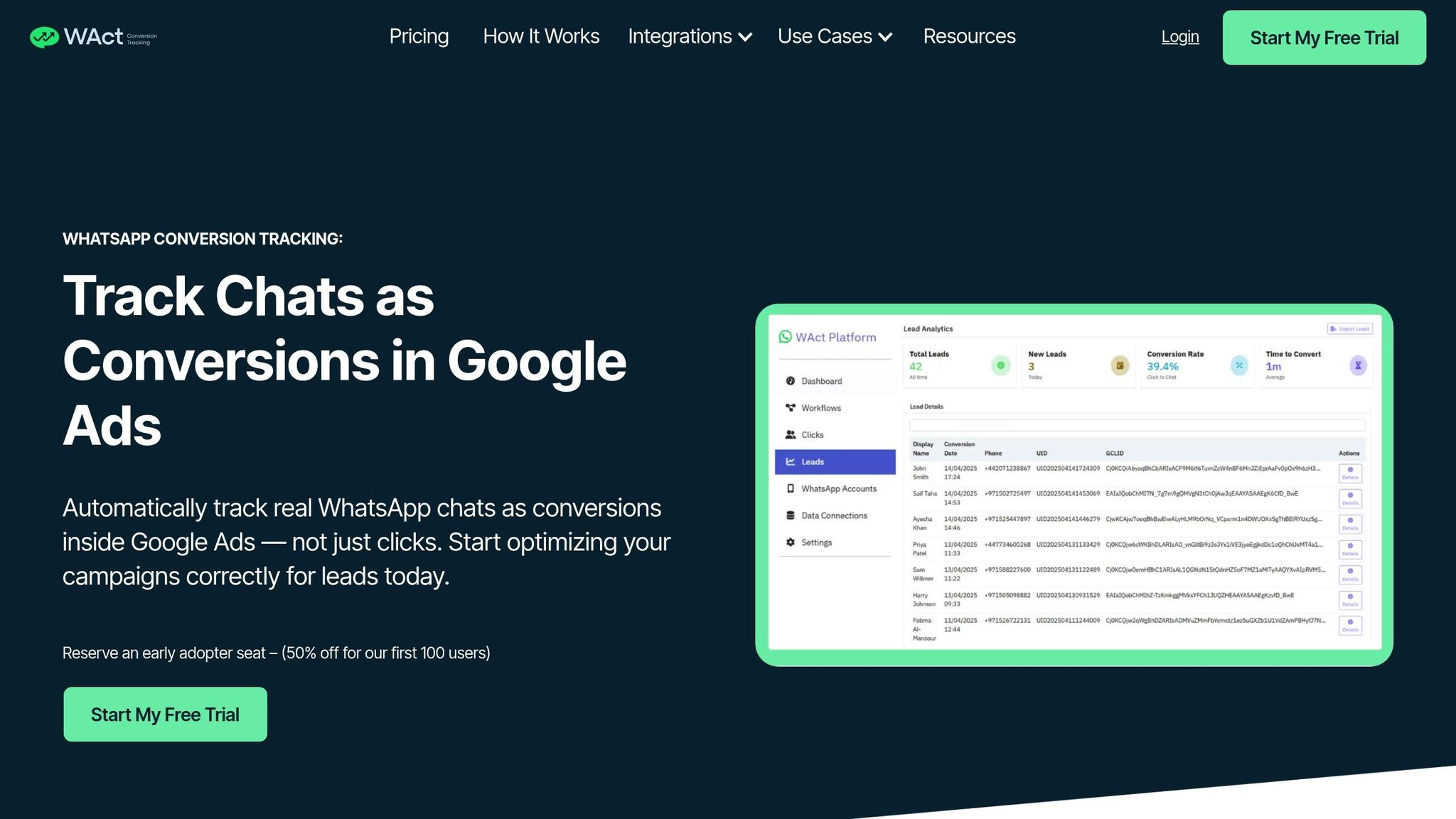
Tracking is crucial when running Google Ads campaigns for WhatsApp. Without it, your ad spend can go to waste as users move from your landing page to the WhatsApp app, leaving web analytics in the dark. That’s where WAConversionTracking steps in to save the day.
This tool works by capturing key parameters like GCLID and UTM tags from your landing page and linking them to WhatsApp chats. When a user messages your business via WhatsApp, WAConversionTracking automatically uploads the conversion event back to Google Ads using Offline Conversion Uploads. This means you can track which keywords, ads, and campaigns are driving actual conversations - not just clicks.
"GCLID is how Google connects the dots between an ad click and a conversion." – Jack Browning, Northbeam
To get started, you’ll need to connect your WhatsApp Business API, link Google Ads to your data destination (like Google Sheets), and either install the pre-built tracking button or add a tracking script. Don’t forget to enable auto-tagging in Google Ads, which is essential for generating GCLIDs. With this setup, every WhatsApp conversation can be accurately tied back to your Google Ads campaigns, giving you a clearer picture of what’s working.
8. CRM Integration and Sales Pipeline Management
Linking WhatsApp to your CRM turns scattered conversations into an organised sales pipeline. Every message, contact detail, and interaction is automatically logged, giving your sales team a comprehensive view of each lead's journey.
Take this as an example: regional retailers have shown that combining Click-to-WhatsApp ads with CRM attribution can significantly improve both ROI and conversion rates.
By leveraging data-driven tracking, seamless CRM integration takes your sales pipeline to the next level. Different platforms offer various integration options. For instance, HubSpot and Salesforce provide official marketplace apps that sync contacts, deal stages, and chat transcripts automatically. If you're using Zoho CRM, webhooks or automation tools can bridge the gap. The critical factor here is bidirectional synchronisation - WhatsApp updates should reflect instantly in your CRM, and your CRM should trigger WhatsApp messages when a deal reaches a specific stage.
AI-powered agents can also step in to pre-qualify leads, routing them to human sales reps when needed. This can double the number of leads handled daily while improving response times. Such integrations ensure no lead slips through the cracks. Accurate attribution within your CRM connects every step of the lead’s journey, a process often managed by Google Ads agencies to optimize campaign performance.
Custom field mapping is another important aspect. It allows your CRM to attribute each WhatsApp lead to its specific campaign, even tracking ROI down to the keyword level.
9. Bilingual Messaging for Arabic and English Audiences
In the UAE, where WhatsApp has over 80% penetration, effective communication must cater to both Arabic and English speakers. This means not only offering messages in both languages but also adjusting tone and timing to suit each audience.
Start every conversation with a simple language selection prompt, like: "Press 1 for English, 2 for Arabic." This ensures users immediately receive messages in their preferred language. A great example of this is Qobolak, a study abroad agency. They incorporated this feature into their WhatsApp chatbot, enabling tailored FAQ responses and routing leads to representatives fluent in the chosen language. This approach reduces drop-offs and builds trust right from the start.
Customising your messages further boosts engagement and conversions. For instance, creating separate ad campaigns for Arabic and English speakers on platforms like Facebook and Instagram can make a big difference. Use Click-to-WhatsApp ads tailored to each language group and adjust the tone and timing to align with cultural expectations. Automax, for example, achieved a 42.5× ROI by leveraging bilingual WhatsApp broadcasts and click-to-chat ads.
To ensure seamless communication, integrate language tags into your CRM. This allows you to send follow-ups in the correct language automatically. Tools with AI-powered detection can identify the language and intent of incoming messages, even for voice notes - a popular communication method in the Middle East. For high-value Arabic enquiries, connecting users with native speakers who understand local nuances can significantly enhance the experience.
Finally, use localised Arabic testimonials to build credibility and trust. Quick bilingual responses for common queries like pricing, location, and services meet the fast-paced expectations of UAE audiences.
10. Multimedia Content for Lead Engagement
WhatsApp offers a variety of multimedia formats - like images (JPEG, PNG), videos (MP4, 3GP), documents (PDF, DOCX, XLSX), and voice messages (AAC, MP3, OGG) - that are perfect for engaging leads in the UAE market. With an impressive engagement rate of around 98%, using multimedia ensures your message grabs attention and gets delivered effectively.
To stay within WhatsApp's file size limits, keep images under 5 MB, videos and audio files under 16 MB, and documents under 100 MB. Adding captions (up to 1,024 characters) not only clarifies your message but also lets you include calls-to-action. For better accessibility, create multimedia assets in both English and Arabic, and opt for vertical videos with subtitles and bold on-screen text to maximise engagement.
Voice messages can add a personal touch, especially for high-intent leads. Tools like OpenAI's Whisper can transcribe these messages, speeding up sentiment analysis and lead qualification. Additionally, webhooks via the WhatsApp Cloud API can link conversations directly to your CRM, enabling seamless lifecycle tracking. Combining multimedia with automation strengthens your lead nurturing efforts.
A great example of this strategy in action comes from a regional consumer electronics retailer. In December 2025, they integrated Flowcart's guided shopping assistant into WhatsApp, allowing leads to browse visual catalogues and complete purchases within the chat. This approach led to over 100 WhatsApp orders in just the first 30 days. It’s a clear demonstration of how blending multimedia and automation can drive results.
Don’t overlook the WhatsApp Status feature for showcasing time-sensitive offers or new product launches. This 24-hour disappearing content creates a sense of urgency, encouraging quick action. Use visuals that reflect local settings, such as clinics, showrooms, or offices, instead of generic stock images, to better connect with UAE audiences. Experiment with different formats - like videos versus voice notes - to discover what resonates most and drives higher conversion rates.
Tools and Integration Requirements
To effectively implement the strategies mentioned earlier, choosing the right tools and integrations is crucial for a smooth lead generation process.
For scalable lead generation, the WhatsApp Business API is indispensable. It offers advanced automation, unlimited broadcasts, and multi-user access - all vital for handling the high message volumes seen in UAE industries like real estate, automotive, and healthcare. To manage API access and ensure ease of use, partnering with a BSP service like respond.io, WATI, or Infobip is essential.
WAConversionTracking is another key tool. It links WhatsApp chats to Google Ads by leveraging metadata such as GCLID and UTM parameters, automatically sending conversion events through automated integrations. This allows for accurate attribution and seamless integration into your broader marketing setup.
For managing leads, CRM platforms like HubSpot, Salesforce, and Zoho can sync WhatsApp leads in real time. These platforms automate follow-up tasks and track the customer lifecycle efficiently. For instance, Automax, a UAE-based automotive retailer, successfully handled 6,000–8,000 WhatsApp leads monthly using respond.io's AI Agents. By December 2025, they achieved an impressive 42.5× ROI through over 80,000 monthly broadcasts.
To comply with UAE regulations and Meta's policies, ensure you include explicit opt-in mechanisms, such as forms on landing pages or chatbot flows. It’s also important to incorporate bilingual message templates and automated opt-out processes, allowing users to unsubscribe by replying with "STOP". Additionally, Meta's Conversion API (CAPI) can help track offline conversions while adhering to data privacy standards.
When it comes to ad creation, Meta Ads Manager enables Click-to-WhatsApp campaigns on Facebook and Instagram. For Google Ads, integration with WAConversionTracking ensures proper attribution for Click-to-Chat campaigns. To enhance reliability, consider platforms with multichannel failover systems that switch to SMS or email if WhatsApp messages aren't delivered within 24 hours.
These tools and integrations form the backbone of a strong WhatsApp lead generation strategy, ensuring every lead is captured, tracked, and nurtured effectively across channels.
Conclusion
WhatsApp has firmly established itself as the go-to inbound lead source for businesses in Dubai, Abu Dhabi, and Sharjah. With over 80% market penetration in the UAE and an impressive 98% open rate, it’s clear why this platform plays such a pivotal role in connecting with customers. By streamlining mobile user experiences, enabling instant lead qualification, and fostering personalised interactions, WhatsApp aligns perfectly with the preferences of UAE customers, who often favour conversational engagement over traditional web forms.
"WhatsApp leads convert twice as fast - and our sales pipeline has never moved smoother."
- Younis Al Balushi
This statement highlights the effectiveness of a conversational, data-driven approach to lead generation.
As outlined earlier, tools like Click-to-WhatsApp ads, automated qualification bots, bilingual messaging, CRM integration, and WAConversionTracking can help businesses maximise their potential. (See our guide on adding a WhatsApp account to get started.) Companies leveraging WhatsApp chatbots have reported a staggering 138% boost in lead generation, with conversational campaigns achieving conversion rates ranging from 45% to 60%.
Whether you're in real estate, automotive, healthcare, or home services, adopting even a handful of these strategies can significantly shorten your sales cycle and enhance lead quality. To kick things off, consider allocating a monthly budget of AED 3,000 to AED 10,000. Set up rapid-response systems to ensure replies within minutes, and use structured WhatsApp Flows to keep conversations organised. With the right tools and strategies in place, there’s no better time to get started.
FAQs
How can businesses create effective bilingual messages on WhatsApp for UAE audiences?
To create effective bilingual messages on WhatsApp for audiences in the UAE, businesses need to prioritise clear communication in both Arabic and English while adhering to local norms. This includes using AED currency (د.إ), the dd/mm/yyyy date format, and ensuring Arabic messages follow the right-to-left script.
Start by segmenting your contact list based on language preferences. Tools like chatbots or CRM integrations can help automate the process, allowing you to switch between templates seamlessly. Prepare parallel message templates for important customer interactions - such as greetings, product information, calls-to-action (CTAs), and payment links - in both languages.
Adopt a culturally sensitive tone: use formal Arabic for professional contexts and a more casual English style for younger audiences. Enhance user experience with bilingual quick-reply buttons and menu options, and ensure your messages are reviewed by native speakers to avoid any misunderstandings.
Track performance metrics like read rates to refine your approach. By combining language-specific segmentation, localised templates, and regular testing, businesses can deliver messages that resonate with UAE audiences and drive better engagement on WhatsApp.
What is the best way to integrate WhatsApp with a CRM for lead generation?
To connect WhatsApp with your CRM effectively, start by leveraging the WhatsApp Business API. This tool allows you to automatically gather essential details like phone numbers, names, and opt-in timestamps, which can then be seamlessly synced with your CRM. Be sure to format phone numbers according to UAE standards (e.g., +971 xxx xxx xxx) to maintain consistency and accuracy.
Automate lead collection across various channels, such as click-to-WhatsApp ads, QR codes, and social media buttons. To streamline segmentation, utilise hidden tracking parameters like campaign IDs. For instance, you could label leads as Dubai Real Estate Q1-2026 based on their source. This approach ensures leads are categorised correctly and assigned to the right sales representative for quicker follow-ups.
Additionally, set up two-way syncing to transfer conversation histories into your CRM. This provides sales teams with the context they need for meaningful follow-ups. Tools like WAConversionTracking can help link WhatsApp chats to measurable outcomes, such as an AED 2,500 property viewing on 15/02/2026. Always stay compliant with UAE data privacy regulations by storing consent records and including easy opt-out options in automated messages. By standardising data and automating workflows, you can transform WhatsApp interactions into actionable leads with minimal effort.
How can using QR codes help generate leads through WhatsApp?
QR codes simplify the process for prospects to start a WhatsApp conversation with your business, removing unnecessary steps and capturing their interest at the perfect time. Whether placed on store windows, flyers, vehicle wraps, or digital ads, these codes allow users to scan with their phone camera and instantly open a pre-filled WhatsApp chat link. No more manually typing numbers or searching for contacts - this convenience boosts engagement and increases conversion rates. Plus, with WhatsApp messages boasting an impressive 98% open rate, this strategy is incredibly effective.
By embedding UTM parameters or unique identifiers into QR codes, businesses can tag and sync each interaction with their CRM or WAConversionTracking tool. This makes it easy to track which offline or online assets - like mall kiosks, restaurant menus, or event badges - are delivering the most qualified leads. Once leads are identified, businesses can segment them by source and trigger automated workflows, such as sending welcome messages or sharing product catalogs, ensuring a smooth and efficient lead-generation process.
Here’s a practical example: A retailer in Dubai could display a QR code on their storefront with a message like “Scan to get a 10% AED 1,000.00 discount - Chat now!” When scanned, the code opens a WhatsApp chat pre-filled with a message such as “Hi, I’d like the discount”. The system then acknowledges the request, captures the customer’s details, and logs them into the CRM. The data is formatted to align with UAE standards, such as using dd/MM/yyyy for dates and AED for currency, ensuring accurate reporting and actionable insights for future campaigns.