
WhatsApp marketing is legal in the UAE, but businesses must follow strict rules to avoid fines and account bans. Here’s what you need to know:
- Consent is mandatory: Businesses must get clear, explicit opt-in permission before sending messages.
- Timing regulations: Marketing messages are only allowed between 9:00 AM and 6:00 PM.
- Permits required: Companies need a telemarketing permit and must use UAE-registered numbers linked to their trade licence.
- Do Not Connect Register (DNCR): Avoid contacting numbers listed here to prevent fines starting at AED 50,000.
- Data protection laws: Adhere to the UAE’s Personal Data Protection Law by securing customer data and respecting opt-out requests.
Non-compliance can result in fines up to AED 150,000 or account restrictions. Use tools like WAConversionTracking to log interactions and stay compliant while improving campaign results.
Legal Rules for WhatsApp Marketing in the UAE
UAE Marketing and Privacy Laws
WhatsApp marketing in the UAE is tightly regulated under Cabinet Resolution No. 56 of 2024, which sets clear boundaries for marketing practices on social media platforms like WhatsApp. For instance, marketing messages can only be sent between 9:00 AM and 6:00 PM. If a customer does not respond, you are allowed to follow up just once more that day and no more than twice in a week.
Before engaging in phone-based marketing, businesses must secure a permit from the relevant Competent Authority and use UAE-registered phone numbers linked to their commercial licence. Additionally, the Do Not Connect Register (DNCR), managed by the TDRA, lists individuals who have opted out of receiving marketing calls. Contacting numbers on this register can lead to fines starting at AED 50,000, with repeat violations escalating to AED 150,000.
Under Federal Decree Law No. 45 of 2021 (the Personal Data Protection Law), explicit consent is required before processing any personal data. Businesses must also maintain comprehensive records of all marketing activities and retain them for a period specified by the Competent Authority. Violations, such as trading consumer data without proper authorisation, can result in penalties of up to AED 150,000. Companies operating in the DIFC or ADGM free zones must adhere to separate data protection regulations, with fines under ADGM rules reaching as high as US$ 28 million.
WhatsApp Business and API Policies
In addition to UAE laws, WhatsApp has its own policies governing the use of its platform for marketing. Businesses must secure explicit opt-in consent before sending marketing messages. Moreover, any business-initiated messages sent outside the 24-hour customer service window must use pre-approved "Message Templates", as free-form promotional messages are not allowed.
WhatsApp employs an automated quality control system that monitors user complaints and feedback. High rates of negative reports can lead to account restrictions or even bans. The platform also prohibits marketing for certain industries, including alcohol, tobacco, gambling, and specific financial services. The UAE is not exempt from these restrictions. Each message must clearly identify the business and its purpose upfront, along with an easy option for recipients to opt out or block further communication.
International Privacy Standards
If your UAE-based business targets customers in the EU, compliance with GDPR is mandatory. GDPR requires explicit consent for data processing and mandates timely notification in case of data breaches. Similarly, for customers in the United States, marketing messages must adhere to TCPA regulations, which also emphasise consent and opt-out mechanisms.
"GDPR standard must be heeded by all sites that attract European visitors, even if they don't specifically market goods or services to European Union residents." - Certvalue
The UAE's Personal Data Protection Law aligns closely with international standards, particularly in areas like consent, data minimisation, and cross-border data transfers. To ensure compliance across different regions, businesses should follow the strictest applicable standard - whether it’s UAE law, GDPR, or TCPA.
Common Risks in WhatsApp Marketing and How to Avoid Them

WhatsApp Marketing Compliance Guide: Legal vs Illegal Practices in UAE
High-Risk Practices to Avoid
Certain actions in WhatsApp marketing can lead to serious legal and operational consequences. For instance, buying or scraping contact lists is a major red flag. Not only does this breach WhatsApp's policies, but it also violates UAE data protection laws, exposing your business to significant penalties. Similarly, using unofficial WhatsApp clients or unauthorised automation tools can result in a permanent account suspension.
Another critical issue is contacting numbers listed on the Do Not Call Registry. This can incur hefty fines, with repeat violations leading to even harsher penalties. Additionally, you must respect customer preferences: if someone declines your service or doesn't respond, limit contact to no more than once per day or twice per week. Persisting after a user opts out is not only bad practice but also illegal.
It’s also worth noting that natural persons cannot conduct marketing under their own name. WhatsApp marketing is strictly limited to licensed companies operating with prior approval from the Competent Authority. These businesses must use UAE-based numbers registered to their trade licence. These high-risk practices highlight the importance of adhering to data protection measures, which we’ll explore next.
Data Protection and Tracking Risks
Beyond operational pitfalls, tracking customer interactions on WhatsApp brings its own set of challenges. Under UAE law, your business assumes the role of the Controller of customer data. This means you’re responsible for obtaining necessary consents and providing clear disclosures about how you handle customer information. Processing personal data without explicit consent is strictly prohibited.
Avoid requesting or sharing sensitive information, such as payment card details, account numbers, or ID numbers, via WhatsApp. If you need to record conversations, always inform the customer beforehand. Furthermore, your business should publish a privacy policy that clearly outlines how customer data is collected, used, and stored.
Data security is another area where businesses often stumble. Ensure that customer information is stored securely using industry-standard measures. If you suspect a security breach, delete the affected data immediately. Sharing or selling customer data to third parties without explicit consent is a serious violation of UAE regulations.
Compliant vs Non-Compliant Practices
Following best practices is essential for staying within UAE regulations and maintaining the integrity of your WhatsApp marketing efforts.
| Practice Area | Compliant Practice | Non-Compliant (High Risk) |
|---|---|---|
| Sourcing Contacts | Obtaining numbers directly from users with clear opt-in. | Buying contact lists or scraping data from websites/groups. |
| Communication Timing | Sending messages between 9:00 AM and 6:00 PM UAE time. | Messaging users late at night or early in the morning. |
| Identity & Transparency | Using local UAE numbers tied to the company’s trade licence. | Using international or personal numbers for business purposes. |
| User Preference | Respecting opt-out requests immediately. | Re-contacting users who have opted out. |
| Content Type | Using WhatsApp-approved templates for business messages. | Sending spam, misleading messages, or promoting prohibited items. |
| Data Handling | Publishing a privacy policy and securing customer information. | Sharing sensitive data or selling user information without consent. |
WhatsApp actively monitors account activity through automated tools and human reviews. High rates of user blocks or complaints can lower your account’s quality rating, leading to stricter messaging limits or even account suspension. If you’re using automation, always provide a clear path to a human agent, whether through a phone number, email, or in-chat transfer.
Best Practices for Legal WhatsApp Marketing in the UAE
Getting and Managing Opt-Ins
Before you send any marketing messages on WhatsApp, make sure you've got clear and explicit consent from your audience. This isn't just a formality - silence or pre-ticked boxes won't cut it. Users need to actively confirm their consent, like ticking an empty box or clicking a confirmation button.
"You may only contact people on WhatsApp if: (a) they have given you their mobile phone number; and (b) you have received opt-in permission from the recipient confirming that they wish to receive subsequent messages or calls from you." - WhatsApp Business Messaging Policy
When setting up your opt-in process, be transparent about what users are agreeing to. If you're planning to send both order updates and promotional messages, make sure to get separate permissions for each. Keep a digital record of every opt-in. Also, before launching any campaign, cross-check your contact list against the Do Not Call Registry (DNCR) to ensure you're not messaging someone who has opted out nationally.
If someone wants to stop receiving your messages, make it simple for them. Include a clear "Stop" or "Unsubscribe" option in every message, and ensure these requests are acted on immediately. UAE law gives consumers the right to withdraw their consent at any time, and ignoring this can lead to serious legal consequences. Keep records of all opt-out requests too - authorities may ask for proof that you're managing consent properly.
Content and Frequency Guidelines
Once you've secured consent, focus on following the rules around timing and content. In the UAE, marketing messages should only be sent between 9:00 AM and 6:00 PM. Also, avoid excessive follow-ups to respect user preferences.
Every message should start by identifying your business and clearly stating its purpose. If you're using automated messages, include an option for recipients to connect with a real person. WhatsApp keeps a close eye on user feedback, so high block or report rates can lower your account’s quality rating, limiting the number of messages you can send.
Never ask for sensitive information like payment card details, account numbers, or national ID numbers over WhatsApp. If you need to record conversations for compliance or quality purposes, let the customer know right at the start. Considering the UAE's multilingual population, it's a good idea to offer opt-in forms and marketing materials in both English and Arabic to make them accessible and inclusive.
Data Handling and Security Best Practices
Once you've nailed the opt-in and messaging processes, the next step is managing customer data responsibly. As the Controller of this data, you're accountable for how it's collected, stored, and used. Publish a clear privacy policy and only collect information that's absolutely necessary.
If you're processing large amounts of sensitive data or engaging in high-risk profiling, appoint a Data Protection Officer (DPO) to oversee compliance. UAE law requires that personal data be deleted once its purpose is fulfilled, unless it’s anonymised. In case of a data breach, notify the UAE Data Office and inform affected individuals immediately.
To simplify data management, consider using tools like WAConversionTracking. This feature helps capture chats with metadata for campaign tracking, reducing manual intervention and ensuring accurate records. By automating data handling, you can stay compliant while minimising the risk of exposing sensitive customer information.
sbb-itb-0a82e4d
Using WAConversionTracking for Compliant WhatsApp Marketing
Why Button-Click Tracking Falls Short
Many businesses rely on tracking WhatsApp conversions by counting button clicks - like when someone taps "Click to Chat" on an ad or website. But here's the catch: a button click doesn’t guarantee a conversation. Users might click by mistake or never actually send a message, leaving you with data that doesn’t reflect genuine engagement.
From a compliance standpoint, this approach creates challenges. According to UAE Cabinet Resolution No. 56 of 2024, companies must keep records of marketing communications. A simple click doesn’t provide a verifiable record of interaction or proof that your business and its purpose were clearly identified, as required by law. This leaves a gap that calls for a more reliable solution.
How WAConversionTracking Ensures Compliance
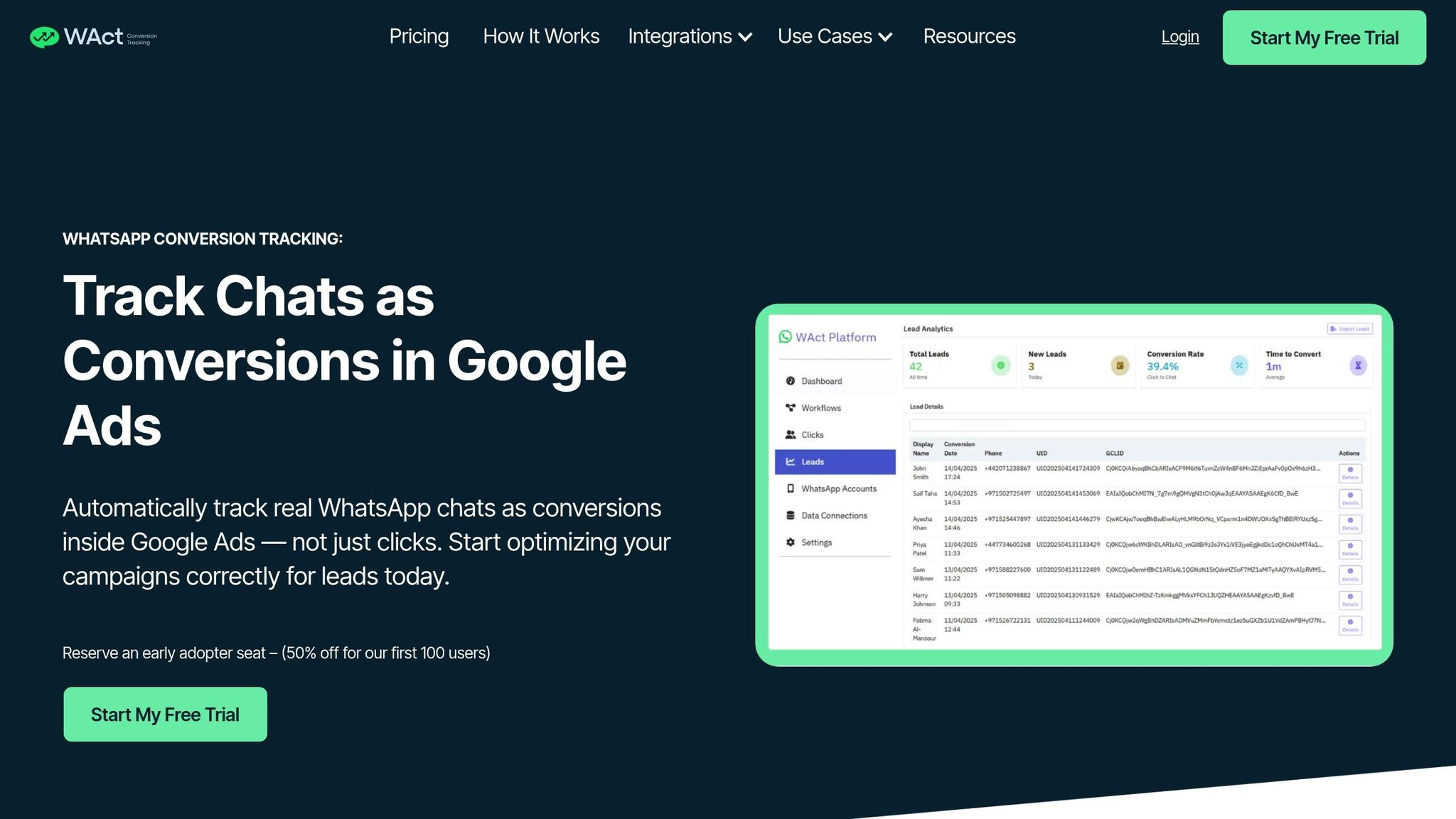
WAConversionTracking steps in to address these issues with a more reliable and compliant approach. Instead of just tracking clicks, it focuses on real conversations. When a user sends a message, the tool logs the chat along with important metadata - like the Google Click ID (GCLID) and UTM parameters - and uploads this data to Google Ads as an offline conversion. This ensures accurate data for Smart Bidding while maintaining a verifiable record of interactions.
By capturing actual conversations, WAConversionTracking helps you meet UAE transparency regulations. Logging the start of a real chat shows that users have voluntarily initiated contact, aligning with WhatsApp’s opt-in guidelines. The automated system records timestamps and interaction details, making it easier to handle regulatory audits. Plus, by focusing on authentic interactions, it reduces the chances of engaging low-intent users who might block or report your account, protecting your business’s quality rating.
Setting Up a Compliant Tracking Workflow
Getting started with WAConversionTracking is straightforward and aligns with UAE messaging laws. First, generate the tracking script and install it on your website where users initiate WhatsApp chats. The script automatically captures the GCLID from your Google Ads campaigns and attaches it to each new conversation.
To stay compliant, configure your workflow to log consent details. Use the first message as an opportunity to introduce your business, explain your purpose, and confirm if the user wants to continue. This approach satisfies UAE transparency requirements and WhatsApp’s opt-in rules. The tool also integrates with Google Sheets and CRMs, allowing you to cross-check your contacts against the Do Not Connect Register (DNCR) before running follow-up campaigns. Make sure to respect the 9:00 AM to 6:00 PM messaging window and adhere to frequency limits to remain fully compliant.
Conclusion: Legal and Effective WhatsApp Marketing in the UAE
In the UAE, WhatsApp marketing is permissible as long as businesses stick to strict legal guidelines. To comply, companies must obtain clear opt-in consent from recipients and ensure they operate within regulated hours, specifically from 9:00 AM to 6:00 PM. Additionally, it's crucial to cross-check contact lists against the UAE's Do Not Connect Register and keep thorough records of all communications, as outlined in Cabinet Resolution No. 56 of 2024. Offering an easy opt-out option is equally important to meet regulatory standards.
Failure to comply with these rules can result in hefty fines of up to AED 150,000 and even account bans. Despite these risks, WhatsApp marketing boasts impressive results, with message open rates reaching approximately 70% - far surpassing traditional email marketing.
Once legal requirements are addressed, the next step is to use tools designed to support compliance while enhancing campaign performance. Tools like WAConversionTracking are particularly effective, as they create verifiable records of conversations, align with UAE transparency laws, and integrate accurate conversion data into platforms like Google Ads. This not only safeguards your account quality rating but also improves Smart Bidding, ensuring your messages reach users who genuinely want to hear from you.
Unlike cold calling, which Wetarseel describes as "risky, outdated, and no longer worth the gamble", permission-based WhatsApp marketing offers a more conversational and trust-building approach. This method respects consumer preferences while delivering measurable results. With nearly 99% internet penetration in the UAE and over 2 billion active users globally, the potential for WhatsApp marketing is enormous.
FAQs
What are the consequences of not complying with WhatsApp marketing laws in the UAE?
Non-compliance with WhatsApp marketing rules in the UAE can result in administrative penalties, including hefty fines as specified in Ministerial Resolution No. (57) of 2024, which governs telemarketing communications. In more serious breaches, such as using VPNs to bypass regulations, businesses could face criminal penalties under Federal Law No. (34) of 2021 on cybercrimes.
To steer clear of these consequences, businesses should strictly follow UAE laws and WhatsApp’s guidelines, ensuring all marketing efforts remain both legal and ethical.
How can businesses legally obtain consent for WhatsApp marketing?
To stay compliant with WhatsApp’s Business Messaging Policy and data-protection laws, such as GDPR, businesses need to secure clear, documented consent from users before sending out marketing messages. Here's what that entails:
- Clearly state the purpose of the messages when asking for consent.
- Maintain a record of the user’s opt-in agreement for future reference.
- Offer users a simple way to withdraw their consent whenever they choose.
By adhering to these guidelines and ensuring transparency, businesses can ethically use WhatsApp for marketing while staying within legal boundaries.
How do UAE data protection laws differ from international rules for WhatsApp marketing?
The UAE’s Personal Data Protection Law (PDPL) sets strict rules for businesses using WhatsApp for marketing. Companies must obtain explicit consent from individuals before processing their data, whether the data is handled within the UAE or abroad. Unlike the EU GDPR, which allows for alternatives like legitimate interest or soft opt-ins for existing customers, the PDPL offers no such flexibility.
Adding to this, the UAE’s 2024 Cabinet Resolution on Telemarketing enforces even stricter measures. Businesses are required to maintain detailed records of consent and face penalties for sending unsolicited messages. In contrast, the GDPR provides more leeway, offering multiple lawful bases for marketing and generally less rigid requirements.
For businesses operating in the UAE, compliance means securing clear, upfront consent for WhatsApp marketing campaigns and strictly following telemarketing regulations - even if their practices align with international standards.