
Click tracking in Google Ads often misleads businesses by counting every "Chat on WhatsApp" button click as a conversion, even when users don’t send a message. This creates inflated metrics, distorts ROI, and wastes ad spend on low-quality traffic. For UAE businesses, where ad budgets are tight and competition is high, this approach doesn’t provide the clarity needed to make informed decisions.
Key Issues with Click Tracking:
- False Conversions: Many clicks don’t lead to actual WhatsApp conversations, with up to 90% being false positives.
- Poor Optimisation: Google’s Smart Bidding relies on inaccurate data, leading to wasted budgets on irrelevant clicks.
- Limited Insights: Click tracking doesn’t differentiate between serious leads, existing customers, or spam.
Solution: Automated WhatsApp conversation tracking fixes these issues by logging only real conversations, syncing accurate data with Google Ads, and improving campaign performance. Businesses using this method report up to a 40% reduction in cost per lead and significantly better ROI.
If you’re running WhatsApp ads in the UAE, shifting from click tracking to conversation tracking is essential to avoid wasting dirhams and to focus on real leads.

Click Tracking vs Conversation Tracking for WhatsApp Ads: Key Differences and ROI Impact
The Problem with Click-Only Conversion Tracking
Inflated Metrics and Missing Data
Let’s delve deeper into how click-only tracking can distort your conversion data. When tracking WhatsApp conversions in Google Ads using this method, what you’re really measuring is intent - not action. Each button click is logged as a conversion, but the system has no way of knowing if the user actually sent a message after the WhatsApp app opened.
"You can track the click on your WhatsApp button as a conversion but that's not very useful because it doesn't tell you if the person who clicked actually started a conversation." – Pete Bowen
This process involves three steps: the click, the app loading, and the user manually sending a message. At every stage, there’s potential for drop-offs. For instance, desktop users who don’t have WhatsApp installed or individuals who change their mind after clicking can result in abandoned clicks that are still counted as conversions.
What’s the outcome? Your dashboard might show 5,000 WhatsApp conversions, but only 500 of those clicks led to actual conversations - a staggering 90% false positive rate. On top of that, click tracking doesn’t differentiate between a serious buyer, an existing customer, a job seeker, or even a spammer. This lack of precision leads to unreliable data, making performance reports far less useful.
Impact on Campaign Optimisation and ROI
When your data isn’t accurate, your campaign optimisation efforts suffer. Google’s Smart Bidding algorithms - like Target CPA, Maximise Conversions, or Target ROAS - depend on accurate conversion signals to identify valuable clicks. Feeding the system inflated click data means it optimises for clicks that might not represent genuine leads.
"Without this you don't know if you're actually getting real value from your ad spend and optimising campaigns is guesswork." – Pete Bowen
This data inaccuracy undermines the goal of driving genuine lead engagement. It wastes your budget on broad match keywords and low-quality traffic that fails to convert into meaningful business. Moreover, it becomes challenging to pinpoint which ad creatives or audience segments are generating qualified leads versus casual inquiries. ROI calculations lose their credibility when they’re based on clicks rather than actual sales or quality conversations.
In competitive markets like the UAE, where cost-per-click can be high, this kind of guesswork can significantly impact profitability. Such misaligned optimisation highlights the critical need for a more precise tracking method, which will be explored in the next sections.
Why Click Metrics Mislead Campaign Performance
Click metrics often paint an incomplete and misleading picture of how well a campaign is performing. Let’s break down why relying solely on clicks can lead to flawed conclusions.
Overstating Campaign Results
Click tracking tends to inflate the perception of success. For instance, every time a user clicks a WhatsApp button, it might be counted as a "conversion." But does that click mean the user actually engaged? Not necessarily. Platforms like Google Ads register a click as soon as someone taps on an ad - even if WhatsApp doesn’t open at all. This can make your campaign dashboard look impressive, showing a high number of conversions. However, only a small percentage of those clicks may result in actual WhatsApp conversations. This disconnect skews your performance data, making it unreliable for assessing campaign effectiveness or adjusting bidding strategies.
Misdirected Smart Bidding and Inefficient Budget Allocation
Google’s Smart Bidding tools - like Target CPA, Maximise Conversions, and Target ROAS - depend on accurate conversion data to function effectively. If the system is fed inflated or misleading click data, it optimises for clicks rather than meaningful actions, such as WhatsApp messages that lead to real business results. This often results in a surge of low-quality traffic. Without proper conversion tracking, it becomes impossible to identify which search terms drive actual WhatsApp conversations. Broad match keywords, for example, might keep triggering irrelevant queries, wasting your budget. Over time, this inefficiency chips away at your ad spend, leaving your campaigns less profitable.
Long-Term Costs of Incomplete Data
Relying only on click tracking can have serious financial consequences, especially over the long term. Without accurate data on conversions, you lose critical insights into which keywords or ad creatives are driving qualified leads and sales. In competitive markets like the UAE, where cost-per-click rates are already high, this lack of visibility can severely impact profitability. Advertisers with precise conversion tracking can capture over 98% of WhatsApp leads, while those relying on click-only setups are left in the dark beyond the initial tap. This gap can translate into thousands of dirhams wasted on campaigns that fail to deliver meaningful results. Over time, this inefficiency limits your ability to refine and optimise campaigns for sustained growth.
Current Native Solutions and Their Shortcomings
Google Ads offers a native feature for tracking WhatsApp conversions, but its limitations have made it less appealing for widespread use among advertisers.
Google Ads' 'Conversation Started' Feature
Google introduced the 'Conversation Started' action for WhatsApp ads, aiming to provide a built-in way to track when users begin a WhatsApp conversation. While this feature sounds useful, it’s still in beta and isn’t widely accessible. Eligibility is restricted to specific business categories, excluding sensitive areas like political campaigns and elections. Even if your business qualifies, you must complete Google's advertiser verification process and maintain a strong compliance history to gain access.
The bigger issue lies in what this feature actually tracks. The conversion event is triggered when a user clicks to open WhatsApp, not when they send a message. This means conversions are recorded even if no actual conversation takes place, leading to inflated metrics that don’t represent real leads.
Why Manual or Technical Workarounds Fall Short
To bypass these limitations, advertisers often turn to tools like Google Tag Manager (GTM) or use unique reference codes in pre-filled WhatsApp messages. However, these methods come with their own problems. GTM-based tracking only captures the intent to start a conversation, not whether a conversation actually happens . On the other hand, reference codes - though effective at tracking 98% to 99% of leads - can still lose 1–2% of data if users delete the code before sending the message .
Scaling these workarounds is another challenge. For businesses handling hundreds or thousands of leads each month, manually matching references or performing lookups becomes unmanageable. Without real-time, automated data syncing, advertisers can’t send accurate conversion signals back to Google Ads. This makes advanced strategies like Target CPA or Target ROAS unusable, forcing advertisers to rely solely on click data for optimisation . In high-stakes markets like the UAE, where competition is fierce, this inefficiency can lead to wasted dirhams and missed opportunities. These challenges underscore the demand for an automated, reliable solution for WhatsApp conversion tracking.
sbb-itb-0a82e4d
The Solution: Automated WhatsApp Conversation Tracking
Forget inflated numbers from click-only methods that often lead to misguided decisions. Automated tracking offers a more accurate way to measure engagement by focusing on actual WhatsApp messages instead of just button clicks. For advertisers in the UAE, this means precise conversion data, better campaign optimisation, and saving dirhams by turning clicks into genuine leads.
How Automated Tracking Works
Here’s how it functions: the system captures key data like the Google Click ID (GCLID) and UTM parameters the moment someone clicks a WhatsApp button. It then includes a unique reference number in the pre-filled WhatsApp message. When the user sends the message, the system matches this reference to the ad click. Only real interactions are logged, ensuring the data is reliable. This verified information is automatically synced with Google Ads as an offline conversion, giving the platform the accurate signals it needs for optimisation. The result? Over 98% tracking accuracy.
This level of precision sets the stage for campaigns that truly deliver results.
Key Benefits for Advertisers
Accurate tracking leads to tangible advantages. By focusing on real interactions rather than vanity clicks, businesses can make smarter decisions. With reliable conversion data, Smart Bidding strategies like Target CPA and Target ROAS become far more effective. In fact, businesses have reported up to a 40% reduction in cost per lead by distinguishing genuine conversations from meaningless clicks.
Additionally, you can assign monetary values to different stages - such as a qualified lead or a completed sale - enabling value-based bidding and offering a full-funnel view that goes beyond the basic "Conversation Started" metric.
Real-time lead qualification is another game-changer. Your sales team can instantly identify which campaigns and keywords are driving high-quality prospects on WhatsApp, allowing for faster optimisation in competitive markets like Dubai and Abu Dhabi.
Implementing WAConversionTracking for WhatsApp Ads
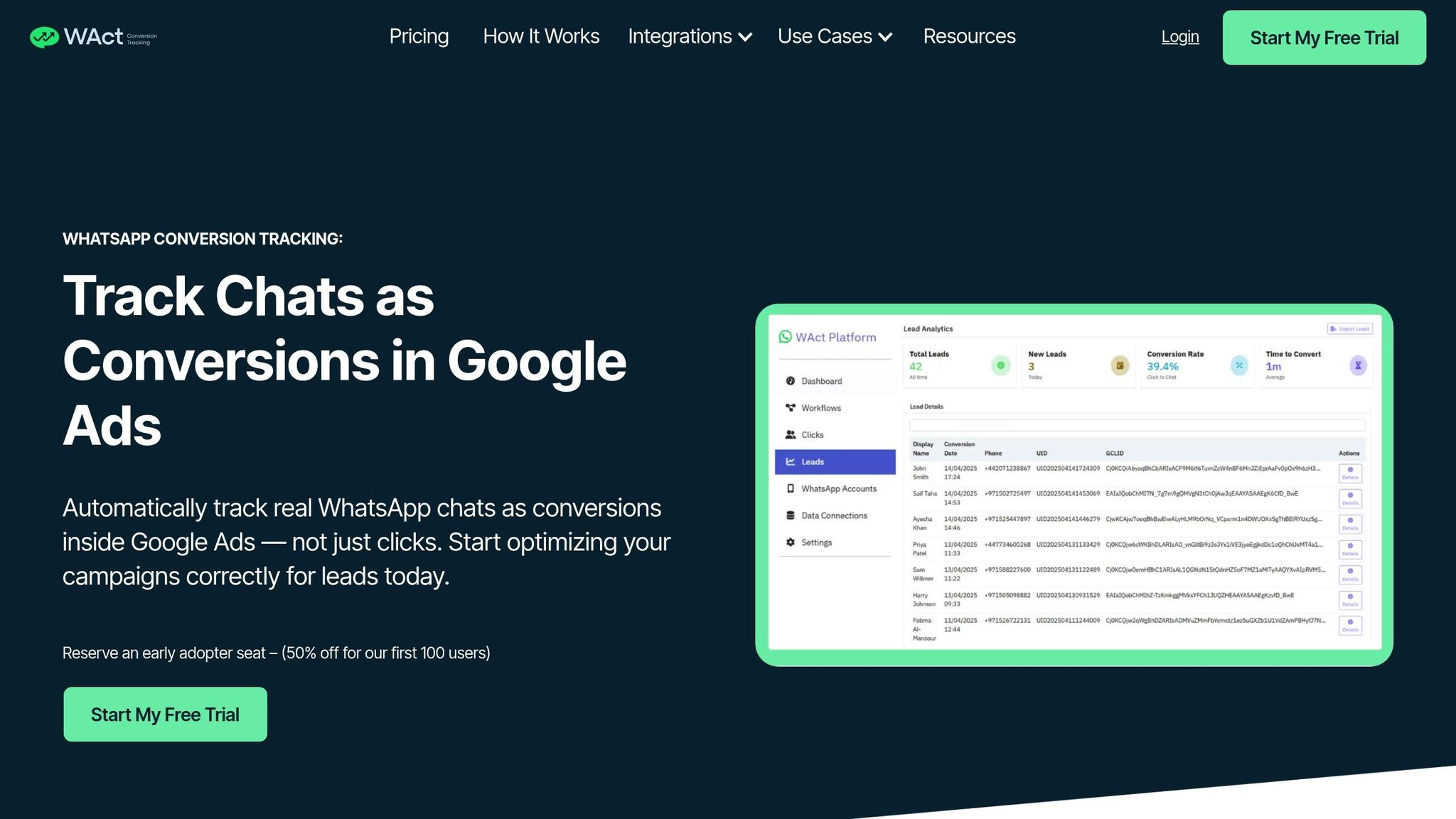
Setting up WAConversionTracking is quick and hassle-free, taking just 5–15 minutes. The best part? No coding skills are needed. This straightforward setup integrates seamlessly with your WhatsApp Business API, enabling smooth and efficient tracking.
Easy Integration with WhatsApp Business API

The platform uses a "Workflow" system to bring together your WhatsApp Business API account, Google Ads, and data sheets on a single platform. You can integrate instantly by using a pre-built WhatsApp button with built-in tracking logic or a simple script for your existing design.
The "Button Generator" automatically creates the required code for each workflow, while the "Active Workflow Filter" helps organise data by campaign. For businesses in the UAE, there's even concierge onboarding via Zoom, where experts guide you step-by-step through the setup and testing process.
Real-Time Data Sync with Google Ads
The system captures both the GCLID and UTM parameters when a user clicks, matches them with the WhatsApp message sent, and uploads conversion data to Google Ads daily. It also keeps a lead log where you can view and export all tracked WhatsApp leads, making it easy to analyse your campaign performance. Just make sure auto-tagging is enabled in your Google Ads settings so the GCLID is captured correctly. This real-time syncing allows for precise, data-driven adjustments to your campaigns.
Tangible Business Results
With accurate conversion data, you can focus on high-intent traffic and optimise Smart Bidding strategies like Target CPA and Target ROAS. This approach eliminates the inaccuracies of click-only metrics, replacing them with verified conversation data. Businesses adopting this method have reported an average 3.7x ROI, with health and wellness brands achieving a 40% reduction in cost per lead. You'll also gain valuable insights into which keywords and ad copy drive revenue on WhatsApp, making it easier to scale successful campaigns and cut underperforming ones.
Conclusion
Relying solely on click tracking can paint a misleading picture of your campaign's success. For instance, a campaign might report 5,000 clicks but result in just 500 WhatsApp chats - leaving a significant gap in understanding the true performance. Without insights into actual conversations, you're optimising for clicks rather than meaningful actions that drive revenue. This underscores the need for a smarter, more automated approach.
WAConversionTracking bridges this gap by capturing every WhatsApp chat and linking it directly to the campaign that initiated it. This data is then synced back to Google Ads, addressing the inaccuracies of click-based metrics. With this system, Smart Bidding evolves - it no longer guesses which ads are effective. Instead, it learns from real conversations, qualified leads, and actual purchases. The result? A noticeable boost in ROI.
With precise data at your fingertips, you can pinpoint which keywords attract high-intent buyers versus those generating support queries. This allows you to reallocate your budget to strategies that deliver results while cutting out wasteful spending on low-quality leads. Accurate tracking leads to smarter ad optimisation, ensuring your campaigns are both efficient and profitable.
For businesses in the UAE aiming to get the most out of their Google Ads on WhatsApp, automated tracking isn't just a helpful tool - it’s a game-changer.
FAQs
Why isn’t click tracking enough for WhatsApp ads on Google Ads?
Click tracking tells you when someone clicks the WhatsApp button, but it stops there. It doesn’t reveal whether a conversation actually began or what the user’s intent might be. Are they a serious lead? A loyal customer? Or just someone casually clicking around? That crucial context is missing.
Without knowing if those clicks turned into meaningful interactions, businesses are left in the dark when it comes to measuring ad performance. You’re stuck relying on surface-level metrics like clicks or impressions, which don’t tell you much about actual sales or qualified leads. If you want to truly gauge the ROI of your WhatsApp-driven ads, chat tracking is the game-changer you need.
How can tracking WhatsApp conversations improve the performance of my Google Ads campaigns?
Automated WhatsApp conversation tracking takes a simple click-to-chat interaction and turns it into a measurable conversion point, giving advertisers a clearer picture of the entire customer journey. By tying each WhatsApp lead back to its original Google Ads click using unique identifiers, businesses can move beyond surface-level metrics like impressions and clicks. Instead, they can focus on results that truly matter - qualified leads, sales, and return on ad spend (ROAS).
In the UAE, where WhatsApp is a go-to communication platform with over 8.6 million daily users in Dubai alone, this tracking capability helps businesses tap into a powerful trend. Companies that have implemented full chat attribution have seen up to 89% higher engagement and noticeable growth in qualified leads. This method not only ensures smarter allocation of ad budgets but also allows for better campaign optimisation and a shopping experience tailored to the preferences of the region's consumers.
Why isn’t Google Ads’ ‘Conversation Started’ feature enough for tracking WhatsApp chats?
Google Ads’ ‘Conversation Started’ metric only tells you when someone clicks the WhatsApp button. However, it doesn’t confirm if they actually opened WhatsApp or began a chat. Even more frustrating, it doesn’t reveal who clicked or which keywords played a role in driving meaningful conversations. Without this level of detail, you’re left guessing, making it tough to measure real conversions or fine-tune campaigns with conversion-based bidding.
If you want to truly understand how your WhatsApp ads are performing and get the most out of your budget, you’ll need a tool that tracks actual conversations - not just clicks.